
诺瓦克·德约科维奇标志
几何画板及绘图内容加载中,请稍等……
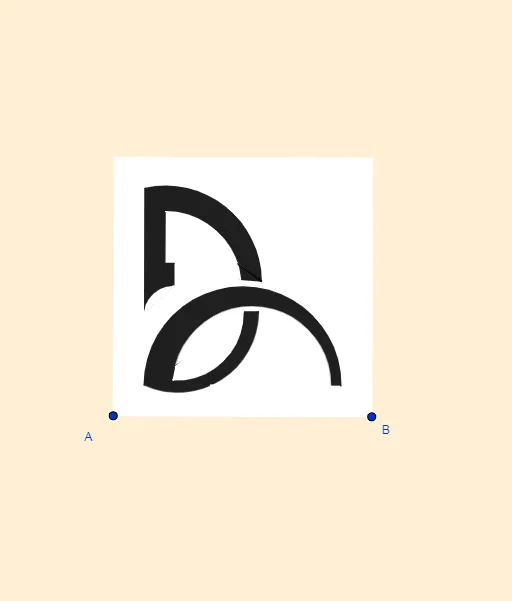
这个范例展示了诺瓦克·德约科维奇的标志。它涉及几何图形的构造,特别是三角形和圆的使用。通过使用GeoGebra命令如Line, OrthogonalLine, Vector, Polygon等,可以构造出标志的各个部分。适合初中及以上学生学习几何作图。
GeoGebra 命令及参数
Line(A, B) → sOrthogonalLine(A, s) → bVector(A, B) → uOrthogonalVector(u) → vOrthogonalLine(F, b) → fOrthogonalLine(D, s) → iIntersect(i, f) → ZLineBisector(A, B) → mLineBisector(A_1, A) → lIntersect(m, l) → IMirror(f, l) → f'Intersect(i, f') → EOrthogonalLine(A_1, b) → rOrthogonalLine(K, l) → jOrthogonalLine(B, u, xOyPlane) → gIntersect(g, r) → CMirror(f, l) → f'_1Mirror(F, l) → F'Polygon(A_1, C, B, A) → c4, a_1, c_3, b_2, a_2Intersect(m, f') → JLineBisector(A, B) → nMirror(i, n) → i'Intersect(n, f) → OMirror(E, n) → E'Intersect(i', f) → NIntersect(n, f') → D_1OrthogonalLine(U, b) → hOrthogonalLine(L, b) → kMirror(U, n) → U'Intersect(n, h) → GIntersect(n, k) → PMirror(O, l) → O'Mirror(L, n) → L'Polygon(U, L, L', U') → c1, u_1, l_1, l', u'Semicircle(Z, N) → cOrthogonalLine(H, f'_1) → pIntersect(p, h) → MIntersect(p, f) → QSemicircle(Q, R) → dLineBisector(T, Z) → qIntersect(c, q) → V,CircleArc(V, Z, S) → eLineBisector(S, M) → tIntersect(c, t) → W,CircleArc(W, M, S) → c_1LineBisector(E, C_1) → aIntersect(a, j) → E_1CircleArc(E_1, C_1, E) → d_1LineBisector(F_1, B_1) → f_1Intersect(f_1, j) → G_1CircleArc(G_1, B_1, F_1) → g_1OrthogonalLine(H_1, p) → h_1Intersect(p, h_1) → J_1LineBisector(I_1, K_1) → i_1Intersect(c, i_1) → L_1,CircleArc(L_1, K_1, I_1) → k_1Polygon(E, I_1, K_1, J_1, H_1, F_1, H) → polígono1, e_3, j_1, m_1, n_1, p_1, q_1, h_2OrthogonalLine(F_1, p) → r_1Polygon(M_1, K, F_1) → t1, s_1, t_1, k_2Intersect(g_1, h_1) → N_1,Polygon(B_1, C_1, N_1) → t2, b_1, f_2, g_2Polygon(T, S, O_1) → t3, o_1, t_2, s_2Intersect(j, k) → P_1Polygon(M, Q_1, S) → t4, s_3, m_2, i_2Intersect(e, f) → S_1, T_1Segment(T_1, R) → j_2Segment(I_1, K_1) → l_2Segment(T_1, R) → n_2Segment(U_1, C_1) → p_2
AI 绘图提示语参考
绘制一个诺瓦克·德约科维奇的标志。首先画出两个点A和B,然后通过它们画一条直线s。接着画出与s垂直的直线b,以及向量u和v。使用这些直线和向量构造一系列三角形和圆弧,最终形成标志的轮廓。
以上提示语为根据原始绘图命令整理而来,仅供参考。