
角度与曲面流
几何画板及绘图内容加载中,请稍等……
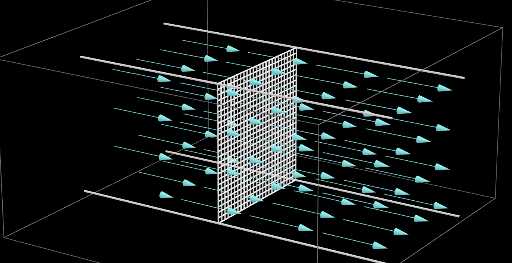
①本范例演示流体通过曲面的动态过程,结合角度变化进行可视化分析;②涉及核心数学概念包括微积分、向量场、几何变换及多边形构造;③构造中运用了CurveCartesian, Sphere, PointIn, OrthogonalLine, Rotate, Line, Point, Vector, Circle, Intersect, Polygon, OrthogonalPlane, Angle, Segment, Sequence, Element, If, Prism, Translate等GeoGebra命令与对象;④适合高中及以上学段,用于流体力学、空间几何及计算几何的教学演示。
GeoGebra 命令及参数
CurveCartesian((2 * t) - 4, 0, 0, t, 0, 10) → PathlineSphere(FluidPt_2, 1) → a_1PointIn(a_1) → S_4PointIn(a_1) → S_5PointIn(a_1) → S_2PointIn(a_1) → S_1PointIn(a_1) → S_6PointIn(a_1) → S_7PointIn(a_1) → S_3OrthogonalLine(A, xOyPlane) → i_1Rotate(B, (-angle), A) → B'Line(A, B') → bOrthogonalLine(B', b, xOyPlane) → dPoint(d) → G_1Vector(B', G_1) → v_1Circle(A, 2, normalvectorplane) → s_1Intersect(xOyPlane, s_1) → J_1, K_1Line(K_1, J_1) → a_2OrthogonalLine(J_1, xOyPlane) → t_1OrthogonalLine(K_1, xOyPlane) → j_1Intersect(i_1, s_1) → H_1, I_1Line(I_1, a_2) → c_2Intersect(j_1, c_2) → Cuadro3Intersect(t_1, c_2) → Cuadro4Line(H_1, a_2) → b_2Intersect(b_2, t_1) → Cuadro2Intersect(b_2, j_1) → Cuadro1Polygon(Cuadro3, Cuadro4, Cuadro2, Cuadro1) → poly3, o_2, n_2, m_2, l_2OrthogonalPlane(B', d) → eOrthogonalPlane(FluidPt, yAxis) → mOrthogonalLine(FluidPt, xOyPlane) → lPoint(l) → FOrthogonalLine(F, m) → rOrthogonalLine(FluidPt, xAxis, xOyPlane) → hPoint(h) → EOrthogonalLine(E, xOyPlane) → qIntersect(r, q) → KLine(E, xAxis) → iLine(K, i) → Container3Intersect(Container3, e) → PCircle(FluidPt, E, xOyPlane) → kIntersect(h, k) → H, JOrthogonalLine(H, xOyPlane) → nIntersect(r, n) → LLine(H, xAxis) → jLine(L, j) → Container4Intersect(Container4, e) → OCircle(h, F) → pIntersect(l, p) → G, ILine(I, h) → sIntersect(s, q) → NLine(N, i) → Container2Intersect(Container2, e) → QIntersect(s, n) → MLine(M, j) → Container1Intersect(Container1, e) → RIntersect(xAxis, yAxis) → ZVector(D_1, Z) → u_1OrthogonalLine(A, xAxis, xOyPlane) → aAngle(B', A, B, xOyPlane) → θOrthogonalPlane(A, xAxis) → cSegment(A, B') → gPoint(h) → DPolygon(L, K, N, M) → poly1, l_1, k_1, n_1, m_1Segment(O, P) → d_1Segment(P, Q) → e_1Segment(R, Q) → f_1Segment(R, O) → g_1PointIn(poly1) → TPointIn(poly1) → UPointIn(poly1) → VPointIn(poly1) → WSequence(Sequence[Sequence[Vector[(j, k, l), (j + (scale * F_1(j, k, l)), k + (scale * F_2(j, k, l)), l + (scale * F_3(j, k, l)))], j, (-extent) - 1, extent + 3, (2 * step)], k, (-extent), extent, step], l, (-extent), extent, step) → VField, {{{(2, 0, 0), (2, 0, 0), (2, 0, 0), (2, 0, 0)}, {(2, 0, 0), (2, 0, 0), (2, 0, 0), (2, 0, 0)}, {(2, 0, 0), (2, 0, 0), (2, 0, 0), (2, 0, 0)}, {(2, 0, 0), (2, 0, 0), (2, 0, 0), (2, 0, 0)}}, {{(2, 0, 0), (2, 0, 0), (2, 0, 0), (2, 0, 0)}, {(2, 0, 0), (2, 0, 0), (2, 0, 0), (2, 0, 0)}, {(2, 0, 0), (2, 0, 0), (2, 0, 0), (2, 0, 0)}, {(2, 0, 0), (2, 0, 0), (2, 0, 0), (2, 0, 0)}}, {{(2, 0, 0), (2, 0, 0), (2, 0, 0), (2, 0, 0)}, {(2, 0, 0), (2, 0, 0), (2, 0, 0), (2, 0, 0)}, {(2, 0, 0), (2, 0, 0), (2, 0, 0), (2, 0, 0)}, {(2, 0, 0), (2, 0, 0), (2, 0, 0), (2, 0, 0)}}, {{(2, 0, 0), (2, 0, 0), (2, 0, 0), (2, 0, 0)}, {(2, 0, 0), (2, 0, 0), (2, 0, 0), (2, 0, 0)}, {(2, 0, 0), (2, 0, 0), (2, 0, 0), (2, 0, 0)}, {(2, 0, 0), (2, 0, 0), (2, 0, 0), (2, 0, 0)}}}Point(xAxis) → A_1Vector(A_1, Z) → vIntersect(yAxis, xAxis) → C_1Vector(B_1, Z) → wElement(list2, faces) → SelectedvectorLine(S, E_1) → direction1Sequence(Segment[Cuadro1 + (i * (Cuadro3 - Cuadro1) / net), Cuadro2 + (i * (Cuadro4 - Cuadro2) / net)], i, 0, net) → nethSequence(Segment[Cuadro1 + (i * (Cuadro2 - Cuadro1) / net), Cuadro3 + (i * (Cuadro4 - Cuadro3) / net)], i, 0, net) → netvIf(-4 ≤ x(FluidPt) ≤ 1, 0, Flux) → FluxconditionPoint(VField) → CPoint(Container4) → O_1Prism(poly1, O_1) → t, L_1, edge1, edge3, edge4, edge5, edge7, edge8, edge6, M_1, N_1, face1, face2, face4, face3, face5, edge2Sequence(Vector[Element[motionvectors, i], (x(Element[motionvectors, i]) + (scale * F_1(x(Element[motionvectors, i]), y(Element[motionvectors, i]), z(Element[motionvectors, i]))), y(Element[motionvectors, i]) + (scale * F_2(x(Element[motionvectors, i]), y(Element[motionvectors, i]), z(Element[motionvectors, i]))), z(Element[motionvectors, i]) + (scale * F_3(x(Element[motionvectors, i]), y(Element[motionvectors, i]), z(Element[motionvectors, i]))))], i, 1, 8) → vectorParticlesPoint(neth) → P_1Point(netv) → Q_1Element(Element[VField, 1, 1], 1) → vvTranslate(vv, Q_1) → v1Translate(vv, P_1) → v2OrthogonalLine(P_1, e) → no1OrthogonalLine(Q_1, e) → no2Point(no1) → R_1Point(no2) → T_1Translate(Vector[P_1, R_1] / abs(Vector[P_1, R_1]), P_1) → nn1Translate(Vector[Q_1, T_1] / abs(Vector[Q_1, T_1]), Q_1) → nn2
AI 绘图提示语参考
绘制一个流体通过表面的流动示意图,包括一个球体和多个点,通过旋转和投影生成流线和角度。首先绘制一条曲线,然后创建一个球体并从中选取多个点,接着通过旋转和投影生成流线和角度,最后用这些流线和角度构造一个多边形。
以上提示语为根据原始绘图命令整理而来,仅供参考。