
真分数乘法面积模型练习(1)——动态可视化15题
几何画板及绘图内容加载中,请稍等……
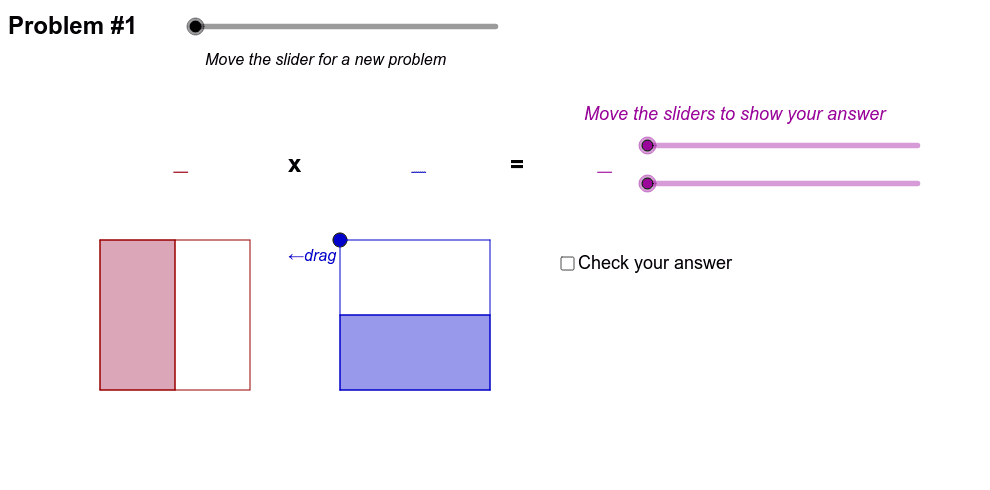
① 本范例通过动态面积模型直观演示真分数乘法的几何意义,用户可拖动滑块切换15道不同的分数乘法问题,并观察矩形区域被分割与重叠的过程。② 核心数学概念是真分数乘法、面积模型(部分-整体关系)、分数乘法的几何解释,以及分数与整数相乘的直观理解。③ 作图要点:利用GeoGebra的Segment、Point、Sequence、Polygon等命令构建可交互的矩形网格,通过Element、Max、If等命令控制滑块切换题目,并使用FractionText显示分数文本,numList和denomList存储分子分母数据,H系列对象表示高亮区域。④ 适合小学高年级至初中阶段学习分数乘法的学生,也可用于教师课堂演示或学生自主探索,帮助建立分数乘法的直观印象,弥补纯符号计算的抽象性。
GeoGebra 命令及参数
Segment((0, 3), (4.8, 3)) → ePoint(e) → H15Point(e) → H14Point(e) → H13Point(e) → H12Point(e) → H11Point(e) → H10Point(e) → H9Point(e) → H8Point(e) → H7Point(e) → H6Point(e) → H5Point(e) → H4Point(e) → H3Point(e) → H2Point(e) → H1Element(f2denom, ex) → dElement(f2num, ex) → cElement(f1num, ex) → aElement(f1denom, ex) → bMax(Sequence[If[Mod[a * c, i] + Mod[b * d, i] ≟ 0, i, -1], i, 1, Min[{a * c, b * d}]]) → Simplified_{GCF}Sequence(A + t * (B - A), t, 0, 1, 1 / b) → L1Sequence(C + t * (D - C), t, 0, 1, 1 / b) → L2Segment(A, B) → c_1Segment(C, D) → d_1Sequence(Segment[Element[L1, k], Element[L2, k]], k, 2, b) → L5Element(dragPoint, ex) → HSegment(H, E) → fSegment(E, F) → gSegment(F, G) → hSegment(G, H) → iSegment(D, B) → jSegment(C, A) → kElement(L1, a + 1) → T1Element(L2, a + 1) → T2Polygon(A, T1, T2, C) → poly1, a_1, t1, t2, c_2Sequence(E + t * (H - E), t, 0, 1, 1 / d) → L3Sequence(F + t * (G - F), t, 0, 1, 1 / d) → L4Sequence(Segment[Element[L3, k], Element[L4, k]], k, 2, d) → L6Element(L3, c + 1) → T3Element(L4, c + 1) → T4Polygon(E, F, T4, T3) → poly2, e_1, f_1, t4, t3FractionText(Element[f1num, ex] * Element[f2num, ex] / (Element[f1denom, ex] * Element[f2denom, ex])) → simplTextElement(numList, ex) → numElement(denomList, ex) → denomPolygon((0, 0), (3 * Element[f1num, ex] / Element[f1denom, ex], 0), (3 * Element[f1num, ex] / Element[f1denom, ex], 3 * Element[f2num, ex] / Element[f2denom, ex]), (0, 3 * Element[f2num, ex] / Element[f2denom, ex])) → overlap, m, n, p, qIf(bl, 0, 1) → black