
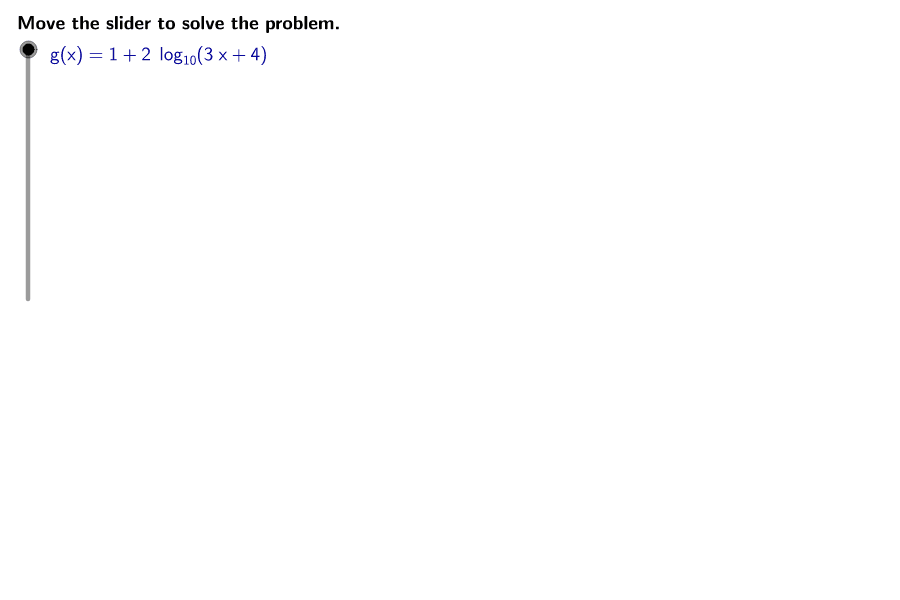
对数母函数 f(x)=log x 向 g(x)=1+2·log(3x+4) 的变换演示
几何画板及绘图内容加载中,请稍等……
该范例演示了以对数母函数 f(x)=log x 为基础,通过内部运算 3x+4、系数 2 以及常数项 1 实现的水平压缩、平移与垂直拉伸等变换,得到 g(x)=1+2·log(3x+4) 的函数图像演变过程。核心数学概念涵盖对数函数、函数变换(平移、伸缩、压缩)、复合函数、定义域与值域、图像关键特征。作图要点:调用 GeoGebra 命令 LaTeX 渲染数学公式、Corner 控制文本位置、FractionText 生成分数文本、If 执行条件判断;使用对象 stepMax、stepper、steps、counter 构建步进交互,RandomizationText 与 button1 实现题目随机化,参数 a、b、c、d 控制变换系数,f、g、h、p 分别表示母函数与变换后函数,xmin/xmax/ymin/ymax 设置动态视窗,intercept、relation、domain 用于标注截距、关系式与定义域。适合高中代数 II 或预微积分阶段的函数变换专题教学、课堂演示与自主探究练习。
GeoGebra 命令及参数
LaTeX(steps) → counterLaTeX("\text{Use the buttons below to return to the original problem or}\cr\text{randomly generate a similar practice problem.}") → RandomizationTextCorner(1) → ACorner(3) → BLaTeX((("\textcolor{#000099}{g(x)=" * g) * "}")) → ProblemLaTeX("\text{Identify the transformation(s) of the parent function.}") → text1LaTeX("\text{Compare the domain and range of the parent function to those of the transformed}\cr\text{function }\textcolor{#000099}{g(x)}.") → text8LaTeX("\text{The domain of the parent function is }\textcolor{#006633}{(0, \infty)}.") → text9FractionText(((-d)) / c) → LLLaTeX("\text{The transformations of }\textcolor{#006633}{f(x)}\text{ that result in }\textcolor{#000099}{g(x)}\text{ alter the rate at which the function}\cr\text{values change, but not their upper and lower bounds.}") → text12LaTeX("\text{Calculate the y-intercept of }\textcolor{#000099}{g(x)}.") → text13If(Defined[g(0)], LaTeX[("\approx " * g(0))], LaTeX["\text{ is undefined.}"]) → interceptIf(c < 0, "<", ">") → relationIf(c < 0, LaTeX[(("\left(-\infty," * LL) * "\right)")], LaTeX[(("\left(" * LL) * ",\infty\right)")]) → domainLaTeX((((((((((("\text{Since }\textcolor{#000099}{g(x)}\text{ is a logarithmic function, the domain of }\textcolor{#000099}{g(x)}\text{ is defined by the argument}\cr\text{of the logarithmic term, }\textcolor{#000099}{" * h) * "}\text{. The condition }\textcolor{#000099}{") * h) * " > 0}\text{ or }\textcolor{#000099}{x ") * relation) * " ") * LL) * "}\text{ exists}\cr\text{on the argument. Therefore, the domain is }\textcolor{#000099}{") * domain) * "}.")) → text10If(Defined[g(0)], LaTeX[(((((("\text{The y-intercept of }\textcolor{#000099}{g(x)=" * g) * "}\text{ is approximately }\textcolor{#000099}{") * g(0)) * "}\text{, or }\cr\textcolor{#000099}{(0, ") * g(0)) * ")}.")], LaTeX[(("\text{The y-intercept of }\textcolor{#000099}{g(x)=" * g) * "}\text{ is undefined.}")]) → text16LaTeX((("\text{To determine how the parent function }\textcolor{#006633}{f(x) = log(x)}\text{ was transformed, compare it to }\cr\textcolor{#000099}{g(x)=" * g) * "}.")) → text2LaTeX("\text{The range of both functions is }\textcolor{#000099}{(−\infty,\infty)}.") → text11LaTeX("\text{Move the slider to solve the problem.}") → text0LaTeX((((("\bullet \text{ The coefficient }\textcolor{#000099}{" * c) * "}\text{ is in the argument of the logarithm, }\textcolor{#000099}{") * h) * "}\text{. Multiplying}\cr\text{ the independent variable by a constant is the transformation }\textcolor{#000099}{g(x) = }\textcolor{#006633}{f(}\textcolor{#000099}{k}\textcolor{#006633}{x)}.")) → text5LaTeX((((("\bullet \text{ Also notice that }\textcolor{#000099}{" * b) * "}\text{ is multiplied by }\textcolor{#000099}{") * p) * "}\text{. Multiplying the}\cr\text{ function value by a constant is the transformation }\textcolor{#000099}{g(x) = k }\textcolor{#000099}{ \cdot }\textcolor{#006633}{f(x)}.")) → text4LaTeX((((("\bullet \text{ Furthermore, note the addition of }\textcolor{#000099}{" * d) * "}\text{ in the argument of the logarithm, }\textcolor{#000099}{") * h) * "}\text{.}\cr\text{ Adding a constant to the independent variable in the argument of the}\cr\text{ logarithm is the transformation }\textcolor{#000099}{g(x)=}\textcolor{#006633}{f(x}\textcolor{#000099}{+k}\textcolor{#006633}{)}.")) → text6LaTeX((((("\bullet \text{ First, note that in }\textcolor{#000099}{g(x)}\text{, the constant }\textcolor{#000099}{" * a) * "}\text{ is added to }\textcolor{#000099}{") * f) * "}.\cr\text{ Adding a constant to the function value is the transformation }\textcolor{#000099}{g(x)=}\textcolor{#006633}{f(x)}\textcolor{#000099}{+k}.")) → text3LaTeX("\text{Therefore, four transformations—}\textcolor{#000099}{g(x) = f(x) + k}\text{, }\textcolor{#000099}{g(x) = k \cdot f(x)}\text{, }\textcolor{#000099}{g(x) = f(kx)},\cr\text{ and }\textcolor{#000099}{g(x) = f(x + k)}\text{—have been performed on the parent function }\textcolor{#006633}{f(x) = log(x)}.") → text7LaTeX("\text{The y-intercept of }\textcolor{#000099}{g(x)}\text{ is defined by the function value }\textcolor{#000099}{g(0)}\text{. Substitute }\textcolor{#000099}{0}\text{ for }\textcolor{#000099}{x}\cr\text{ and solve for }\textcolor{#000099}{g(0)}:") → text14LaTeX(((((((((((((((((((" \textcolor{#000099}{g(x)=" * g) * "}\cr \textcolor{#000099}{g(0)=") * a) * "+") * b) * "log\left[") * c) * "(0)+") * d) * "\right]}\cr \textcolor{#000099}{g(0)=") * a) * "+") * b) * "log") * h(0)) * "}\cr \textcolor{#000099}{g(0) ") * intercept) * "}\cr ")) → text15
AI 绘图提示语参考
绘制一个对数函数变换的教学示意图。先画出父函数 f(x)=log x 的曲线,再画出变换后的函数 g(x)=1+2log(3x+4) 的曲线。图中需标注两条曲线的关键特征:父函数的定义域为 (0,∞),值域为全体实数;变换函数的定义域由 3x+4>0 决定,即 x>-4/3,值域仍为全体实数。还需标出 g(x) 的 y 截距(若存在)。用不同颜色区分两条曲线,并添加文字说明,指出变换包括水平压缩、水平平移、垂直拉伸和垂直平移。图中可包含一个滑块或按钮,用于逐步展示变换过程,并随机生成类似题目。
以上提示语为根据原始绘图命令整理而来,仅供参考。