
直线函数图示例
几何画板及绘图内容加载中,请稍等……
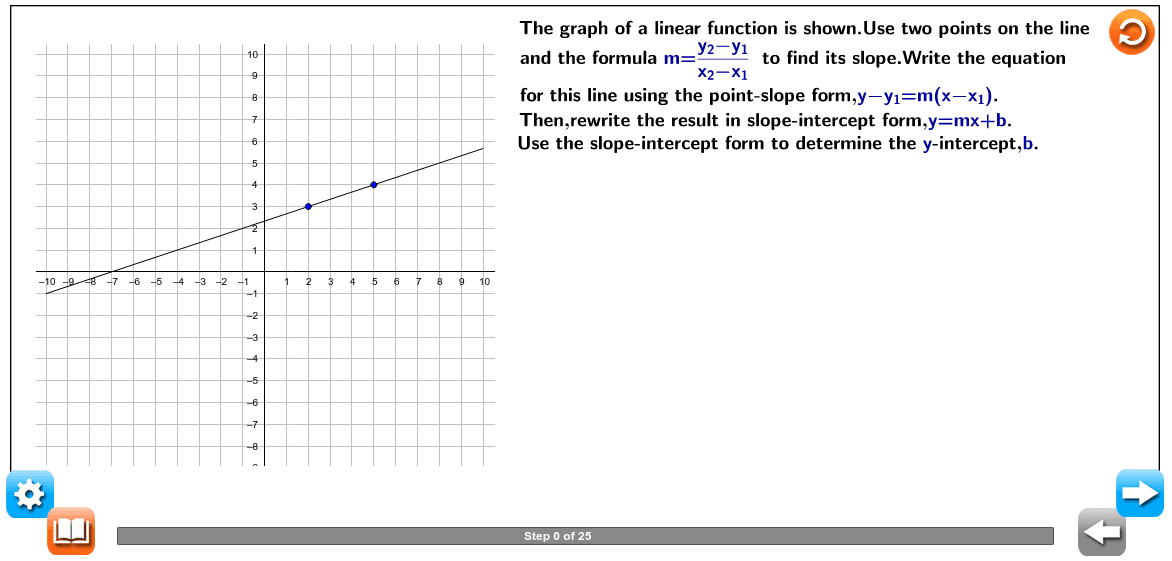
本示例展示了直线函数的图像。通过选取直线上两点,利用斜率公式 [math]m=
rac{y_2-y_1}{x_2-x_1}[/math] 计算斜率,并写出直线方程。使用了SelectedElement, Polygon, LaTeX, Segment, Division, FractionText等GeoGebra命令。适合初中及以上学生学习直线函数的相关概念。
GeoGebra 命令及参数
SelectedElement(FXX) → FXXVSelectedElement(FXC) → FXCVSelectedElement(GXX) → GXXVSelectedElement(GXC) → GXCVPolygon(H, I, J, K) → poly1, h, i, j, kLaTeX("\text{Determine the slope of the line.}") → text14LaTeX("\text{into the slope formula.}") → text18LaTeX("\text{Use the point-slope form to write the equation for this line.}") → text25LaTeX("\text{to write the point-slope form of this line.}") → text29LaTeX("\text{in the point-slope form.}") → text31LaTeX("\text{Rewrite the equation in slope-intercept form.}") → text38LaTeX("\text{of the equation.}") → text53Segment(R, T) → aLaTeX("\text{x₁:}") → DKT1LaTeX("\text{y₁:}") → DKT2LaTeX("\text{x₂:}") → DKT3LaTeX("\text{y₂:}") → DKT4LaTeX("\text{The graph of a linear function is shown.Use two points on the line") → text1LaTeX("\text{for this line using the point-slope form,\textcolor{#000099}{y−y₁=m(x−x₁)}.}") → text11LaTeX("\text{Then,rewrite the result in slope-intercept form,\textcolor{#000099}{y=mx+b}.}") → text12LaTeX("\text{Use the slope-intercept form to determine the \textcolor{#000099}{y}-intercept,\textcolor{#000099}{b}.}") → text13LaTeX("\text{Use two points on the line to determine the slope.Two easily identifiable}") → text15LaTeX((((((((("\text{points on the line are \textcolor{#000099}{(" * FXXV) * ", ") * FXCV) * ")} and \textcolor{#000099}{(") * GXCV) * ", ") * GXXV) * ")}.}")) → text16LaTeX((((((((("\text{Let \textcolor{#000099}{(x₁,y₁)} be \textcolor{#000099}{(" * FXXV) * ", ") * FXCV) * ")} and \textcolor{#000099}{(x₂,y₂)} be \textcolor{#000099}{(") * GXCV) * ", ") * GXXV) * ")}.Substitute these values}")) → text17LaTeX((((((((("\text{\textcolor{#000099}{m=}}{\textcolor{#000099}{\frac{(" * GXXV) * ")−(") * FXCV) * ")}{(") * GXCV) * ")−(") * FXXV) * ")}}}")) → text20LaTeX((((((("\text{Substitute \textcolor{#000099}{" * GXXV) * "} for \textcolor{#000099}{y₂},\textcolor{#000099}{") * FXCV) * "} for \textcolor{#000099}{y₁},\textcolor{#000099}{") * GXCV) * "} for \textcolor{#000099}{x₂},}")) → text21LaTeX((("\text{and \textcolor{#000099}{" * FXXV) * "} for \textcolor{#000099}{x₁}.}")) → text22LaTeX((((("\text{The given line has a slope of }{\textcolor{#000099}{\frac{" * numupdate) * "}{") * denupdate) * "}}.}")) → text24LaTeX("\text{The point-slope form of a linear function is \textcolor{#000099}{y−y₁=m(x−x₁)},where}") → text26LaTeX("\text{\textcolor{#000099}{m} is the slope and \textcolor{#000099}{(x₁,y₁)} is a point on the line.}") → text27LaTeX((((((((("\text{Substitute the point \textcolor {#000099} {(" * FXXV) * ",") * FXCV) * ")} for \textcolor{#000099}{(x₁,y₁)} and substitute the slope }\textcolor{#000099}{{\frac{") * numupdate) * "}{") * denupdate) * "}}}\text{ for \textcolor{#000099}{m}}")) → text30LaTeX("\text{\textcolor{#000099}{y−y₁=m(x−x₁)} Point-slope form}") → text32LaTeX((((((((("\text{The equation of the line in point-slope form is \textcolor{#000099}{y−" * FXCV) * "={ \frac{") * numupdate) * "}{") * denupdate) * "}}(x−") * FXXV) * ")}.}")) → text37LaTeX("\text{The slope-intercept form of a linear function is \textcolor{#000099}{y=mx+b},where \textcolor{#000099}{m} is}") → text39LaTeX("\text{the slope and \textcolor{#000099}{b} is the \textcolor{#000099}{y}-intercept.}") → text40LaTeX("\text{the equation for \textcolor{#000099}{y} and simplify.}") → text42LaTeX("\text{Determine the \textcolor{#000099}{y}-intercept of the line.}") → text47LaTeX("\text{This equation is in slope-intercept form,\textcolor{#000099}{y = mx + b},where \textcolor{#000099}{m}\ is the}") → text49LaTeX("\text{slope and \textcolor{#000099}{b} is the \textcolor{#000099}{y}-intercept.}") → text50LaTeX("\text{\textcolor{#000099}{m=}}{\textcolor{#000099}{\frac{y₂−y₁}{x₂−x₁}}}{\text{ Slope formula}}") → text19LaTeX((((((((("\text{The \textcolor{#000099}{y}-intercept can be determined from the equation}\textcolor{#000099}{\text{ y=} {\frac{" * numupdate) * "}{") * denupdate) * "}}\text{x+{\frac{") * ssimpnum) * "}{") * denupdate) * "}}}.}")) → text48LaTeX((((((((("\text\textcolor{#000099}{{y=} {\frac{" * numupdate) * "}{") * denupdate) * "}}\text{x+{\frac{") * ssimpnum) * "}{") * denupdate) * "}}}}")) → text45LaTeX((("\text{Add \textcolor{#000099}{" * FXCV) * "} to both sides to isolate \textcolor{#000099}{y}.}")) → text45_1LaTeX((((((("\text{Distribute\textcolor{#000099}{{ \frac{" * numupdate) * "}{") * denupdate) * "}}} \text{over \textcolor{#000099}{x−") * FXXV) * "}.}}")) → text441LaTeX((((((((((("\text{\textcolor{#000099}{{y−" * FXCV) * "=} { \frac{") * numupdate) * "}{") * denupdate) * "}}\text{x−{\frac{") * simpnum) * "}{") * denupdate) * "}}}}")) → text44LaTeX("\text{Point-slope form of the line}") → text431LaTeX((((((((("\text{\textcolor{#000099}{{y−" * FXCV) * "=} { \frac{") * numupdate) * "}{") * denupdate) * "}}\text{(x−") * FXXV) * ")}}")) → text43LaTeX("\text{Simplify.}") → text361LaTeX((((((((("\text{\textcolor{#000099}{y−" * FXCV) * "={ \frac{") * numupdate) * "}{") * denupdate) * "}}(x−") * FXXV) * ")}}")) → text36LaTeX("\text{Simplify.}") → text231LaTeX((((("\text{\textcolor{#000099}{m=}}{\textcolor{#000099}{\frac{" * numupdate) * "}{") * denupdate) * "}}}")) → text23LaTeX((((((((((((("\text{Use either one of the points,\textcolor{#000099}{(" * FXXV) * ",") * FXCV) * ")} or \textcolor{#000099}{(") * GXCV) * ",") * GXXV) * ")},along with the slope,}{\textcolor{#000099}{\frac{") * numupdate) * "}{") * denupdate) * "}},}")) → text28LaTeX((((((((("\text{\textcolor{#000099}{y−(" * FXCV) * ")={\left( \frac{") * numupdate) * "}{") * denupdate) * "} \right)}[x−(") * FXXV) * ")]}}")) → text33LaTeX((((((((("\text{To write the equation \textcolor{#000099}{y−" * FXCV) * "={ \frac{") * numupdate) * "}{") * denupdate) * "}}(x−") * FXXV) * ")}}\text{ in slope-intercept form,solve}")) → text41Division(ssimpnum, denupdate) → checkfrac1FractionText(displayfrac) → text54FractionText(displayfrac) → text55LaTeX((("\text{the \textcolor{#000099}{y}-axis at approximately \textcolor{#000099}{" * Element[checkfrac1, 1]) * "} ,so this verifies the slope‑intercept form}")) → text52LaTeX((((((("\text{Substitute \textcolor{#000099}{" * FXCV) * "} for \textcolor{#000099}{ y₁},}{\textcolor{#000099}{\frac{") * numupdate) * "}{") * denupdate) * "}}\text{for \textcolor{#000099}{m},}")) → text34LaTeX((("\text{and \textcolor{#000099}{" * FXXV) * "} for \textcolor{#000099}{x₁}.}")) → text35LaTeX("\text{method,draw a line using only two points on the coordinate plane.}") → text3LaTeX((((((((("\text{The equation of the line in slope-intercept form is}\textcolor{#000099}{\text{ y=} {\frac{" * numupdate) * "}{") * denupdate) * "}}\text{x+{\frac{") * ssimpnum) * "}{") * denupdate) * "}}.}")) → text46LaTeX((((((("\text{The \textcolor{#000099}{y}-intercept is \textcolor{#000099}{{\frac{" * ssimpnum) * "}{") * denupdate) * "}}},or \textcolor{#000099}{") * Element[checkfrac1, 1]) * "} .Note that on the graph the line crosses}")) → text51Polygon(U, V, W, Z) → poly2, u_1, v_1, w, z_1Polygon(B_1, C_1, D_1, E_1) → poly3, b_1, c_1, d_1, e_1LaTeX("\text{\mathbf{Slope}-\mathbf{intercept\;method} the method used to graph a linear equation;with this }") → text2LaTeX("\text{\mathbf{\textcolor{#000099}{y}}-\mathbf{intercept} the point at which the graph crosses the \textcolor{#000099}{y}-axis;written as \textcolor{#000099}{(0, y)}.}") → text4
AI 绘图提示语参考
画一个直线函数的图像,通过选择直线上两个点来确定斜率,使用点斜式方程 y - y₁ = m(x - x₁) 写出直线方程,然后将其转换为斜截式 y = mx + b。首先,选择直线上两个点,计算斜率 m = (y₂ - y₁) / (x₂ - x₁),接着使用点斜式方程写出直线方程,最后简化为斜截式方程。
以上提示语为根据原始绘图命令整理而来,仅供参考。