
积分作为f(x)值的累积:动态可视化
几何画板及绘图内容加载中,请稍等……
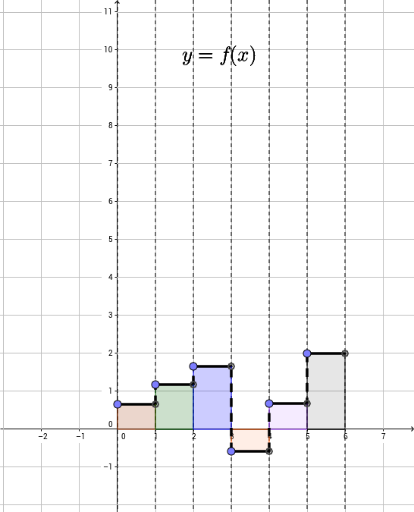
① 本范例通过动态图形直观展示定积分作为函数f(x)值在区间上的累积过程,即面积累加形成积分值。② 核心数学概念是定积分的几何意义——曲线下面积,以及黎曼和的思想,涉及函数、区间分割、矩形面积求和。③ 作图要点:使用GeoGebra命令如Point、OrthogonalLine、Intersect、Segment、Polygon、Vector、Translate、Ray等构造点、垂线、交点、线段、多边形和向量,通过平移和射线生成多个矩形条,对象包括A_0至A_6、Y_0至Y_5等,体现分割与累积。④ 适合高中至大学微积分入门教学,帮助学生理解积分与面积的关系,也可用于探究黎曼和逼近。
GeoGebra 命令及参数
Point({0, 0}) → A_0Point({1, 0}) → A_1Point({2, 0}) → A_2Point({3, 0}) → A_3Point({4, 0}) → A_4Point({5, 0}) → A_5OrthogonalLine(A_0, xAxis) → uOrthogonalLine(A_1, xAxis) → gOrthogonalLine(A_2, xAxis) → hOrthogonalLine(A_3, xAxis) → iOrthogonalLine(A_4, xAxis) → jOrthogonalLine(A_5, xAxis) → kPoint(u) → Y_0Point(g) → Y_1Point(h) → Y_2Point(i) → Y_3Point(j) → Y_4Point(k) → Y_5OrthogonalLine(Y_0, u) → lOrthogonalLine(Y_1, g) → mOrthogonalLine(Y_2, h) → nOrthogonalLine(Y_3, i) → pOrthogonalLine(Y_4, j) → qOrthogonalLine(Y_5, k) → rIntersect(g, l) → AIntersect(h, m) → BIntersect(i, n) → CIntersect(j, p) → DIntersect(k, q) → EPoint({6, 0}) → A_6OrthogonalLine(A_6, xAxis) → sIntersect(r, s) → FSegment(Y_0, A) → tSegment(Y_1, B) → bSegment(Y_2, C) → dSegment(Y_3, D) → f_1Segment(Y_4, E) → i_1Segment(Y_5, F) → k_1Segment(A_6, A_5) → aSegment(A_4, A_3) → cSegment(A_2, A_1) → ePolygon(Y_0, A, A_1, A_0) → многоугольник1, y_0, a_1, a_2, a_0Polygon(Y_1, B, A_2, A_1) → многоугольник2, y_1, b_1, a_3, a_4Polygon(Y_2, C, A_3, A_2) → многоугольник3, y_2, c_1, a_5, a_6Polygon(Y_3, D, A_4, A_3) → многоугольник4, y_3, d_1, a_7, a_8Polygon(Y_4, E, A_5, A_4) → многоугольник5, y_4, e_1, a_9, a_{10}Polygon(Y_5, F, A_6, A_5) → многоугольник6, y_5, f_2, a_{11}, a_{12}Vector(A_0, Y_0) → vVector(A_1, Y_1) → wVector(A_2, Y_2) → u_1Vector(A_3, Y_3) → v_1Vector(A_4, Y_4) → w_1Vector(A_5, Y_5) → g_1Vector(A_0, A_1) → j_1Translate(A, j_1) → A'Translate(A', w) → A''Vector(A', A'') → l_1Translate(A'', j_1) → A'''Vector(A'', A''') → m_1Translate(A''', u_1) → GVector(A''', G) → n_1Translate(G, j_1) → G'Vector(G, G') → p_1Translate(G', v_1) → G''Vector(G', G'') → q_1Translate(G'', j_1) → G'''Vector(G'', G''') → r_1Translate(G''', w_1) → HVector(G''', H) → s_1Translate(H, j_1) → H'Vector(H, H') → t_1Translate(H', g_1) → H''Vector(H', H'') → u_2Translate(A_1, v) → IVector(A_1, I) → v_2Vector(I, A') → h_1Ray(I, A') → g_2Ray(A'', A''') → h_2Ray(G, G') → i_2Ray(G'', G''') → j_2Ray(H, H') → k_2Intersect(u, xAxis) → JSegment(J, I) → l_2Segment(I, A'') → m_2Segment(A'', G) → n_2Segment(G, G'') → p_2Segment(G'', H) → q_2Segment(H, H'') → r_2Segment(A, Y_1) → fSegment(B, Y_2) → s_2Segment(Y_3, C) → t_2Segment(D, Y_4) → b_2Segment(Y_5, E) → c_2