
i几何维度演示
几何画板及绘图内容加载中,请稍等……
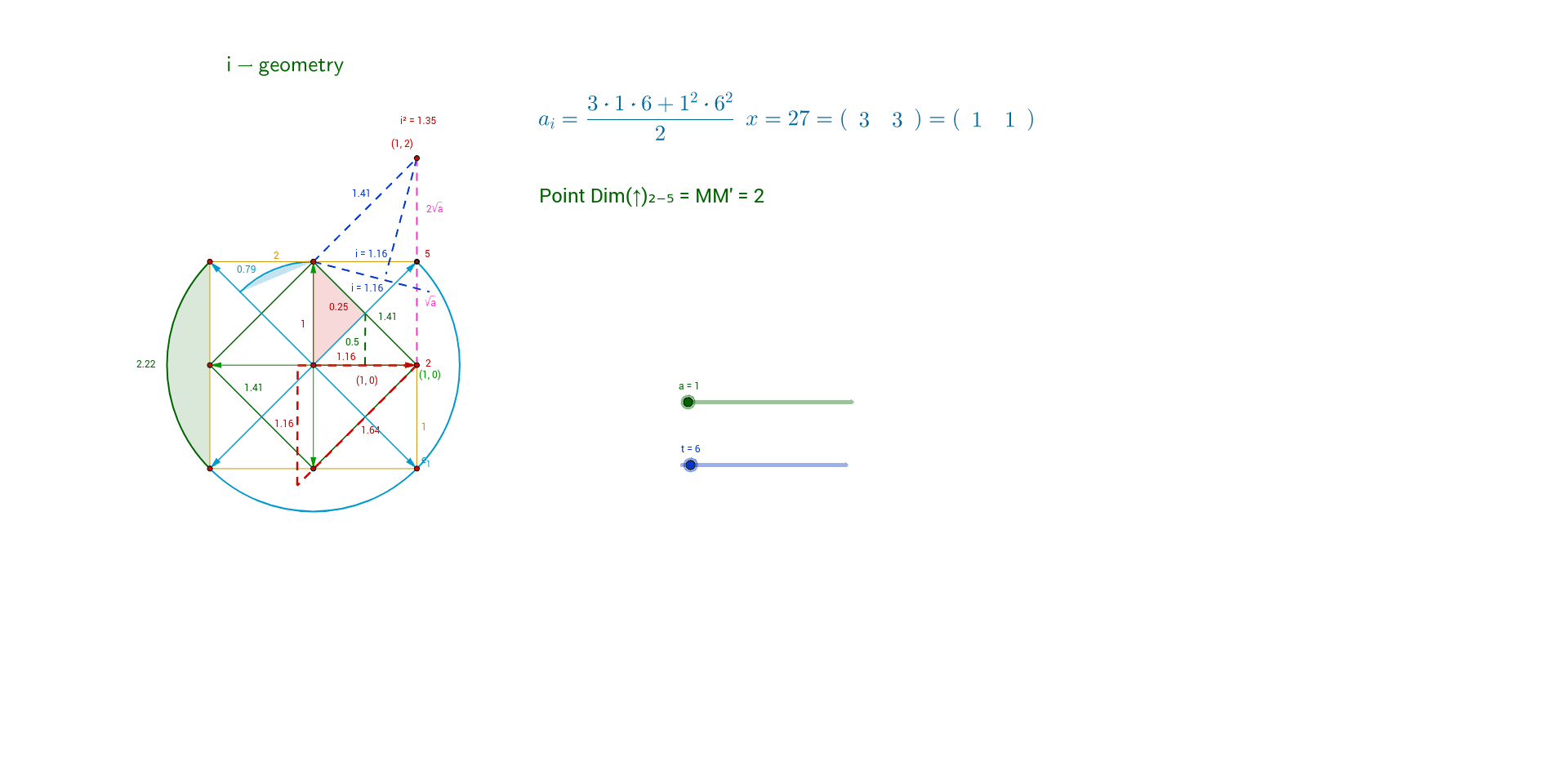
①本范例演示复数单位i在复平面上的几何表示及其与单位圆的关系;②涉及核心数学概念包括复数、单位圆、向量、几何变换;③作图要点:使用了Vector、Point、Line、Segment、Distance、Circle、Mirror、Polygon、Factors、ReducedRowEchelonForm、Angle、CircleArc、Intersect等GeoGebra命令与对象;④适合高中及以上数学学习者,用于理解复数几何意义和操作。
GeoGebra 命令及参数
Vector((0, 0), (1, 0)) → uVector((0, -0.007890188248790508), (a^(0.5), a^(0.5))) → dVector((0, 0), ((-a^(0.5)), (-a^(0.5)))) → eVector((0, 0), (a^(0.5), (-a^(0.5)))) → fVector((0, 0), ((-a^(0.5)), a^(0.5))) → gPoint(b) → CPoint(v) → DPoint(w) → EPoint(c) → FPoint(d) → GPoint(e) → HPoint(g) → IPoint(f) → JPoint(f) → KLine(G, w) → hPoint(v) → LVector((0, 0), (a^(0.5), 0)) → iPoint(i) → MSegment(M, G) → jSegment(D, E) → kSegment(E, C) → lSegment(C, F) → mSegment(F, D) → nSegment(G, I) → pSegment(I, H) → qSegment(H, J) → rSegment(J, M) → sPoint(k) → ADistance(K, A) → distanceKADistance(G, K) → distanceGKPoint(v) → BDistance(B, A) → distanceBASegment(B, A) → t_xCircle(K, H) → c_1Circle(K, C) → d_1Segment(I, J) → a_1Mirror(e, a_1) → e'Mirror(M, p) → M'Mirror(G, p) → G'Segment(M', G') → j'Distance(M, M') → distanceMM'Polygon(K, E, A) → poly1, a_2, k_1, e_2Point(d_1) → NPoint(d_1) → OSegment(N, O) → b_1Factors(o) → matrix1ReducedRowEchelonForm(matrix1) → matrix2Segment(E, M') → h_1Point(Circle[E, 1.16]) → PSegment(E, P) → g_1Point(Circle[P, 1.16]) → QSegment(P, Q) → i_1Point(Circle[E, 1.64]) → RSegment(E, R) → j_1Angle(M', E, R) → αPoint(Circle[M', 1.16]) → SSegment(M', S) → l_1Point(Circle[E, 1.16]) → TSegment(E, T) → m_1CircleArc(K, I, H) → p_1CircleArc(K, H, G) → e_1CircleArc(K, E, I) → q_1Intersect(j', h_1) → VPoint(Circle[M, 1.64]) → WSegment(M, W) → r_1Point(Circle[W, 1.16]) → ZSegment(W, Z) → s_1Point(Circle[Z, 1.16]) → A_1Segment(Z, A_1) → t_1