
正弦函数图像绘制与性质分析范例(以 f(x)=4sin x 为例)
几何画板及绘图内容加载中,请稍等……
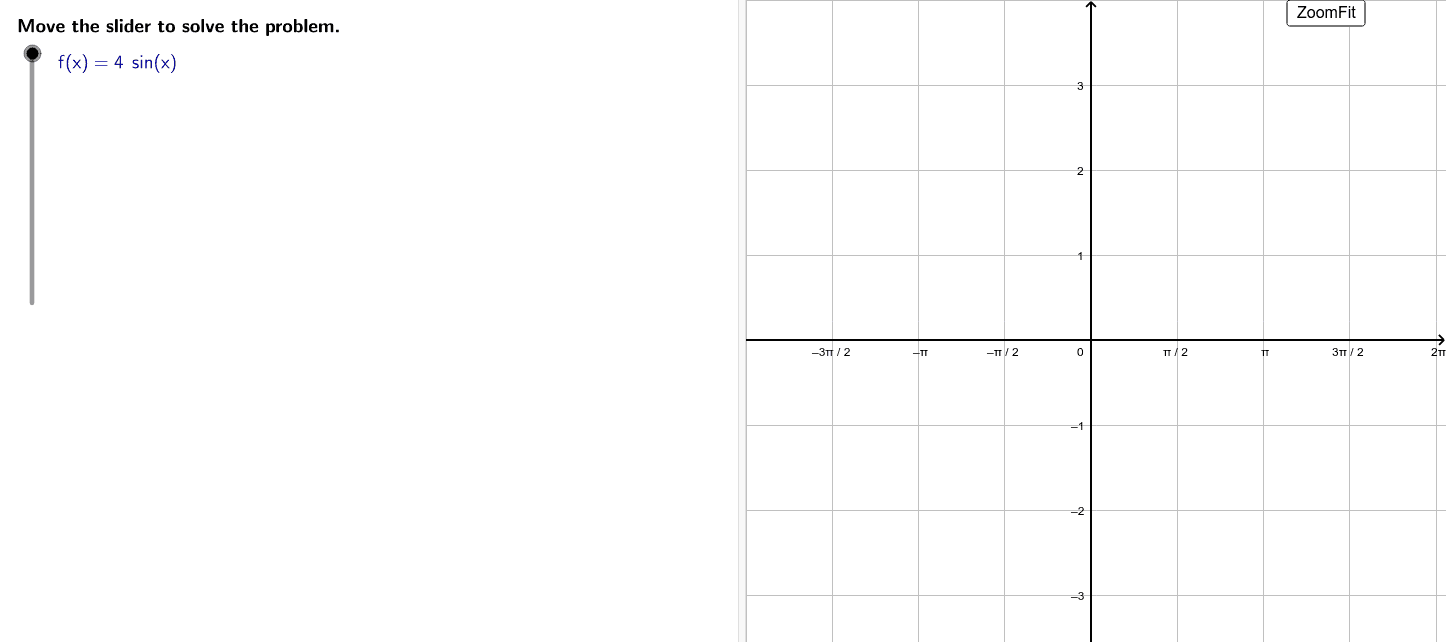
本 GeoGebra 范例演示了正弦函数 f(x) = 4 sin x 的周期性图像绘制与动态性质分析。核心数学概念包括三角函数(正弦曲线)、函数的振幅与周期变换、以及函数图像的几何特征。在作图要点上,该课件利用了 LaTeX 渲染数学公式,并结合 Corner、If、Mirror 等命令构建逻辑,通过 stepper、counter 等对象控制步骤,利用 ZoomFit 自动适配视图,并借助动态文本和交互按钮实时展示函数值。本范例适合高中三年级及同等学段的数学课堂,用于三角函数图像变换的教学与探究。
GeoGebra 命令及参数
LaTeX(steps) → counterLaTeX("\text{Move the slider to solve the problem.}") → text0Corner(1) → ACorner(3) → BIf(choose ≟ 1, Simplify[(a * sin((b * x)))], Simplify[(a * cos((b * x)))]) → fLaTeX((("\textcolor{#000099}{f(x)=" * f) * "}")) → ProblemLaTeX("\text{Graph several periods of }\textcolor{#000099}{f(x)}.") → text1If(choose ≟ 1, ((-π)) / ((2 * b)), 0) → leftIf(choose ≟ 1, π / ((2 * b)), π / b) → rightIf(choose ≟ 1, "-", "") → posnegIf(choose ≟ 1, LaTeX[(("-\frac{\pi}{" * Simplify[(2 * b)]) * "}")], "0") → leftTextIf(choose ≟ 1, LaTeX[(("\frac{\pi}{" * Simplify[(2 * b)]) * "}")], LaTeX[(("\frac{\pi}{" * Simplify[b]) * "}")]) → rightTextLaTeX("\text{Solve for the inverse function }\textcolor{#006633}{g(x)}\text{ algebraically.}") → text11LaTeX((("\textcolor{#000099}{f(x)=" * f) * "}")) → text14LaTeX("\text{Switch }\textcolor{#000099}{x}\text{ and }\textcolor{#000099}{f(x)}.") → text15If(choose ≟ 1, "sin", "cos") → functextLaTeX((("\text{Take the inverse " * functext) * " of both sides.}")) → text21LaTeX("\text{Simplify and use symmetry of equality.}") → text23If(b ≠ 1, LaTeX[Simplify[1 / b]], "") → invCoeffMirror(h, y = x) → InverseLaTeX((((((("\textcolor{#006633}{g(x)=\frac{" * functext) * "^{-1}\left(\frac{x}{") * a) * "}\right)}{") * b) * "}}")) → text26LaTeX((((((("\textcolor{#006633}{" * b) * "g(x)=") * functext) * "^{-1}\left(\frac{x}{") * a) * "}\right)}")) → text24LaTeX((((((((((("\textcolor{#006633}{" * functext) * "^{-1}\left(\frac{x}{") * a) * "}\right)=") * functext) * "^{-1}\left(") * functext) * "(") * b) * "g(x))\right)}")) → text22LaTeX((((("\textcolor{#006633}{\frac{x}{" * a) * "}=") * functext) * "(g(x))}")) → text20LaTeX("\text{Rename }\textcolor{#000099}{f(x)}\text{ as }\textcolor{#006633}{g(x)}.") → text17LaTeX((((((("\textcolor{#006633}{x=" * a) * "") * functext) * "(") * b) * "g(x))}")) → text18LaTeX((((((("\textcolor{#006633}{g(x)=" * invCoeff) * "") * functext) * "^{-1}\left(\frac{x}{") * a) * "}\right)}")) → invlabelLaTeX((("\text{Divide both sides by }\textcolor{#006633}{" * b) * "}.")) → text25LaTeX((("\textcolor{#000099}{f(x)=" * f) * "}")) → restrictlabelLaTeX((((((("\textcolor{#000099}{x=" * a) * " ") * functext) * "(") * b) * "f(x))}")) → text16If(choose ≟ 1, "sine", "cosine") → nameIf(choose ≟ 1, (((-3) * a / 4), asin((((-3) * a / 4)) / a) / b), (((-3) * a / 4), acos((((-3) * a / 4)) / a) / b)) → CLaTeX("\text{Use the buttons below to return to the original problem or}\cr\text{randomly generate a similar practice problem.}") → RandomizationTextLaTeX("\text{Determine the range of }\textcolor{#000099}{f(x)}\text{ within the restricted domain.}") → text8LaTeX((((((((("\text{The inverse function of }\textcolor{#000099}{f(x)=" * f) * "}\text{ is }\textcolor{#006633}{g(x)=") * invCoeff) * "") * functext) * "^{-1}\left(\frac{x}{") * a) * "}\right)}.")) → text27LaTeX("\text{The domain and range of an inverse function are the range and (restricted) }\cr\text{domain of the original function.}") → text29LaTeX((("\text{The trigonometric function }\textcolor{#000099}{f(x) = " * f) * "}\text{ is not fully invertible because}\cr\text{of its periodic nature. Viewing several periods of the function is the first step }\cr\text{toward identifying a restricted domain on which the function is invertible.}")) → text2LaTeX((((("\text{Notice that multiplying the " * name) * " function by }\textcolor{#000099}{") * a) * "}\text{ does not affect the}\cr\text{restricted domain.}")) → text6LaTeX((((((("\text{For the function }\textcolor{#000099}{f(x) = " * f) * "}\text{, this restricted domain is }\textcolor{#CC0000}{\left[") * leftText) * ",") * rightText) * "\right]}.")) → text5LaTeX("\text{Adjust the window properties to display the graph only for }\textcolor{#000099}{x}\text{-values}\cr\text{in the restricted domain. Make sure you do not change the }\textcolor{#000099}{y}\text{-axis}\cr\text{window settings.}") → text7LaTeX("\text{Look at the graph of }\textcolor{#000099}{f(x)}\text{ on its restricted domain, and identify the range}\cr\text{of }\textcolor{#000099}{y}\text{-values that are visible for the function.}") → text9LaTeX("\text{Original function }\textcolor{#000099}{f(x)}") → text13LaTeX((("\text{Divide both sides by }\textcolor{#006633}{" * a) * "}.")) → text19LaTeX("\text{Determine the domain and range of the inverse }\text{function }\textcolor{#006633}{g(x)}.") → text28LaTeX("\text{Restrict the domain until there is a one-to-one correspondence. }") → text3LaTeX("\text{Look at the graph of }\textcolor{#000099}{f(x)}\text{ to find the widest possible }\textcolor{#000099}{x}\text{-interval containing }\cr\textcolor{#000099}{x = 0}\text{ for which no }\textcolor{#000099}{y}\text{-value is repeated.}") → text4LaTeX((((((((((((((("\text{For the function }\textcolor{#000099}{f(x) = " * f) * "}\text{ on the restricted domain }\textcolor{#000099}{\left[") * leftText) * ",") * rightText) * "\right]}\text{, }\cr\textcolor{#000099}{y}\text{-values on the visible part of the function range from }\textcolor{#000099}{–") * a) * "}\text{ to }\textcolor{#000099}{") * a) * "}\text{.}\cr\text{Therefore, the range of }\textcolor{#000099}{f(x)}\text{ within the restricted domain is }\textcolor{#000099}{\left[–") * a) * ", ") * a) * "\right]}.")) → text10LaTeX((((((((((((((((((((((((("\text{For the original function }\textcolor{#000099}{f(x) = " * f) * "}\text{, the restricted domain is }\cr\textcolor{#000099}{\left[") * leftText) * ",") * rightText) * "\right]}\text{ and the range is }\textcolor{#000099}{[-") * a) * ",") * a) * "]}\text{.}\cr\text{Therefore, for the inverse function }\textcolor{#006633}{g(x)=") * invCoeff) * "") * functext) * "^{-1}\left(\frac{x}{") * a) * "}\right)}\text{, }\cr\text{the domain is }\textcolor{#006633}{[–") * a) * ", ") * a) * "]}\text{ and the range is }\textcolor{#006633}{\left[") * leftText) * ",") * rightText) * "\right]}.")) → text30LaTeX("\text{Recall that you can find the inverse of a function }\textcolor{#000099}{f(x)}\text{ by switching the domain}\cr\text{and function variables, renaming the function as }\textcolor{#006633}{g(x)}\text{, and then solving for }\textcolor{#006633}{g(x)}.") → text12