
已知 cosθ=4/5 且 θ 在第一象限,求 cotθ 的 GeoGebra 演示
几何画板及绘图内容加载中,请稍等……
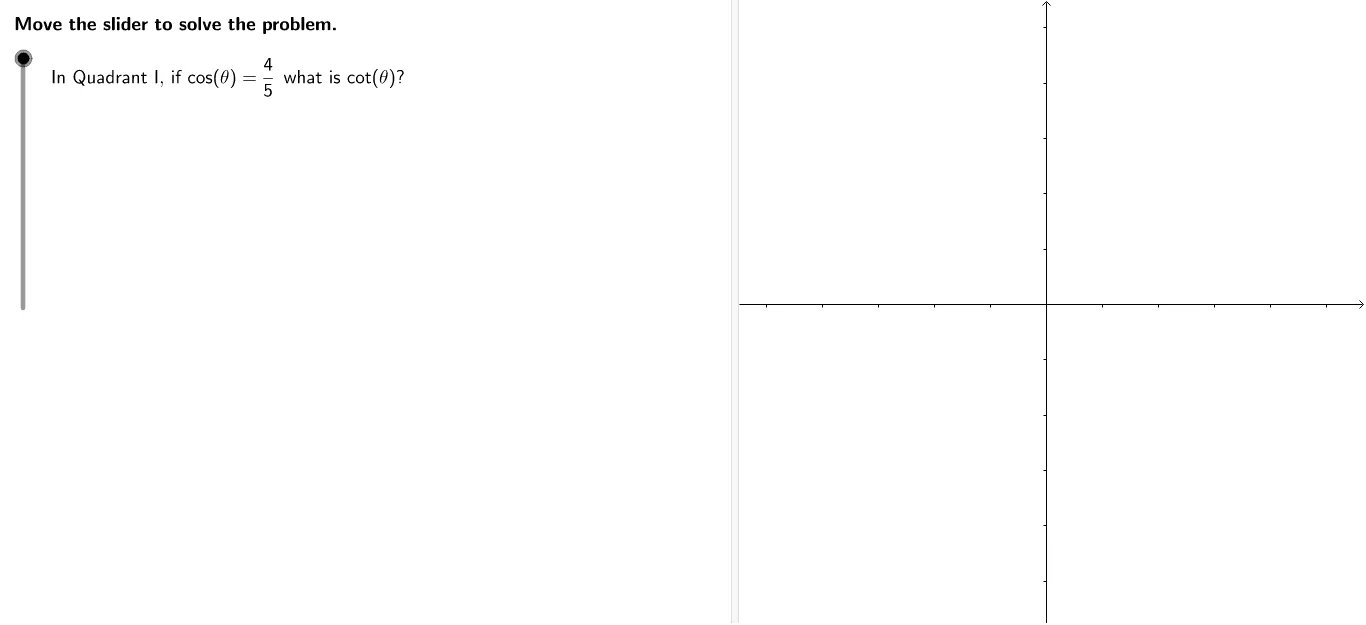
① 本范例演示在已知 cosθ = 4/5 且 θ 位于第一象限时,如何利用三角恒等式求出 cotθ 的值。② 涉及核心数学概念包括三角函数的定义、象限符号、余弦与正切的关系以及勾股定理在单位圆上的应用。③ 作图要点:使用 LaTeX 显示公式,If 与 Element 控制步骤显示,Segment、Circle、Angle 绘制参考三角形与角标记;对象 stepMax、stepper、steps、counter 实现分步动画,numer、denom、funcs、funcnum1、third 等存储中间计算,A、B、C、quadrant 定义顶点与象限,button1、text3、text5 提供交互按钮与说明,θ、θ_ref、scale、ratio 等参数控制比例与坐标范围。④ 适合高中三角函数教学、自学复习或课堂演示,帮助学生直观理解象限对三角函数符号的影响。
GeoGebra 命令及参数
LaTeX(steps) → counterIf(quadrant ≟ "I", {(Element[third, funcnum1], numer), (numer, Element[third, funcnum1]), (denom, numer), (Element[third, funcnum1], denom), (denom, Element[third, funcnum1]), (numer, denom)}, If[quadrant ≟ "II", {((-Element[third, funcnum1]), numer), ((-numer), Element[third, funcnum1]), ((-denom), numer), ((-Element[third, funcnum1]), denom), ((-denom), Element[third, funcnum1]), ((-numer), denom)}, If[quadrant ≟ "III", {((-Element[third, funcnum1]), (-numer)), ((-numer), (-Element[third, funcnum1])), ((-denom), (-numer)), ((-Element[third, funcnum1]), (-denom)), ((-denom), (-Element[third, funcnum1])), ((-numer), (-denom))}, {(Element[third, funcnum1], (-numer)), (numer, (-Element[third, funcnum1])), (denom, (-numer)), (Element[third, funcnum1], (-denom)), (denom, (-Element[third, funcnum1])), (numer, (-denom))}]]) → BoptionsElement(Boptions, funcnum1) → BIf(quadrant ≟ "I", {"", "", "", "", "", ""}, If[quadrant ≟ "II", {"", "-", "-", "", "-", "-"}, If[quadrant ≟ "III", {"-", "-", "", "-", "-", ""}, {"-", "", "-", "-", "", "-"}]]) → signOptionsSegment(A, C) → aSegment(A, B) → bSegment(C, B) → cCircle(A, B) → dElement(denomLabelPtOpt, funcnum1) → denomLabelPtElement(numerLabelPtOpt, funcnum1) → numerLabelPtLaTeX(numer) → numerLabelLaTeX(denom) → denomLabelAngle((Length[b], 0), A, B) → θAngle(C, A, B) → θ_{ref}If(funcnum1 ≟ 1, LaTeX["\sin(\theta)=\frac{\text{length of opposite side}}{\text{length of hypotenuse}}"], If[funcnum1 ≟ 2, LaTeX["\cos(\theta)=\frac{\text{length of adjacent side}}{\text{length of hypotenuse}}"], If[funcnum1 ≟ 3, LaTeX["\tan(\theta)=\frac{\text{length of opposite side}}{\text{length of adjacent side}}"], If[funcnum1 ≟ 4, LaTeX["\csc(\theta)=\frac{\text{length of hypotenuse}}{\text{length of opposite side}}"], If[funcnum1 ≟ 5, LaTeX["\sec(\theta)=\frac{\text{length of hypotenuse}}{\text{length of adjacent side}}"], LaTeX["\cot(\theta)=\frac{\text{length of adjacent side}}{\text{length of opposite side}}"]]]]]) → text3If(funcnum1 ≟ 1, LaTeX[((((("c^2=a^2+b^2 \cr a^2=c^2-b^2 \cr a=\sqrt{c^2-b^2} \cr a=\sqrt{" * denom) * "^2-") * numer) * "^2}=") * Element[third, 1])], If[funcnum1 ≟ 2, LaTeX[((((("c^2=a^2+b^2 \cr b^2=c^2-a^2 \cr b=\sqrt{c^2-a^2} \cr b=\sqrt{" * denom) * "^2-") * numer) * "^2}=") * Element[third, 2])], If[funcnum1 ≟ 3, LaTeX[((((("c^2=a^2+b^2 \cr c=\sqrt{a^2+b^2} \cr c=\sqrt{" * denom) * "^2+") * numer) * "^2}=") * Element[third, 3])], If[funcnum1 ≟ 4, LaTeX[((((("c^2=a^2+b^2 \cr a^2=c^2-b^2 \cr a=\sqrt{c^2-b^2} \cr a=\sqrt{" * numer) * "^2-") * denom) * "^2}=") * Element[third, 4])], If[funcnum1 ≟ 5, LaTeX[((((("c^2=a^2+b^2 \cr b^2=c^2-b^2 \cr b=\sqrt{c^2-a^2} \cr b=\sqrt{" * numer) * "^2-") * denom) * "^2}=") * Element[third, 5])], LaTeX[((((("c^2=a^2+b^2 \cr c=\sqrt{a^2+b^2} \cr c=\sqrt{" * numer) * "^2+") * denom) * "^2}=") * Element[third, 6])]]]]]) → text5Element(thirdLabelPtOpt, funcnum1) → thirdLabelPtLaTeX(Element[third, funcnum1]) → thirdLabelLaTeX((("\text{The length of the third side is " * Element[third, funcnum1]) * " units.}")) → text6Element(adjacentOptions, funcnum1) → adjElement(oppositeOptions, funcnum1) → oppElement(hypotenuseOptions, funcnum1) → hypLaTeX(((Element[funcs, funcnum2] * "(\theta_{ref})=") * Element[ansOpts, funcnum2])) → text10If(funcnum2 ≟ 1, LaTeX["\sin(\theta)=\frac{\text{length of opposite side}}{\text{length of hypotenuse}}"], If[funcnum2 ≟ 2, LaTeX["\cos(\theta)=\frac{\text{length of adjacent side}}{\text{length of hypotenuse}}"], If[funcnum2 ≟ 3, LaTeX["\tan(\theta)=\frac{\text{length of opposite side}}{\text{length of adjacent side}}"], If[funcnum2 ≟ 4, LaTeX["\csc(\theta)=\frac{\text{length of hypotenuse}}{\text{length of opposite side}}"], If[funcnum2 ≟ 5, LaTeX["\sec(\theta)=\frac{\text{length of hypotenuse}}{\text{length of adjacent side}}"], LaTeX["\cot(\theta_{ref})=\frac{\text{length of adjacent side}}{\text{length of opposite side}}"]]]]]) → text9LaTeX((("\text{Find }" * Element[funcs, funcnum2]) * "(\theta).")) → text7LaTeX("\text{Move the slider to solve the problem.}") → text0LaTeX("\text{Use the buttons below to return to the original problem or}\cr\text{randomly generate a similar practice problem.}") → text12LaTeX("\text{The lengths of two sides of the reference triangle are given by the magnitudes}\cr\text{of the numerator and denominator of the value of the trigonometric function.}") → text2LaTeX("\text{Use the Pythagorean Theorem to find the length of the third side.}") → text4LaTeX((("\text{Use the values from the triangle to determine }" * Element[funcs, funcnum2]) * "(\theta_{ref}).")) → text8LaTeX((((((((((("\text{Since }\theta\text{ lies in Quadrant }" * quadrant) * "\text{, }") * Element[funcs, funcnum2]) * "(\theta)=") * Element[signOptions, funcnum2]) * Element[funcs, funcnum2]) * "(\theta_{ref})=") * Element[signOptions, funcnum2]) * Element[ansOpts, funcnum2]) * ".")) → text11LaTeX((((((((((((("\text{In Quadrant " * quadrant) * ", if }") * Element[funcs, funcnum1]) * "(\theta)=") * Element[signOptions, funcnum1]) * "\frac{") * numer) * "}{") * denom) * "}\text{ what is }") * Element[funcs, funcnum2]) * "(\theta)?")) → ProblemLaTeX("\text{Sketch angle }θ\text{ (measured counterclockwise from the positive x-axis),}\cr\text{the associated triangle, and the reference angle }\theta_{ref}\text{ (the acute angle}\cr\text{the terminal side makes with the x-axis).}") → text1