
复数运算的几何解释
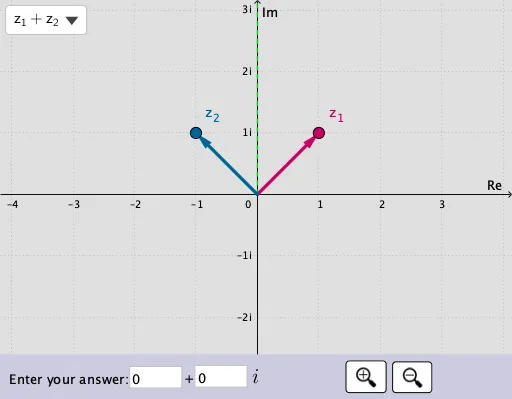
几何画板及绘图内容加载中,请稍等……
这个范例演示了复数运算的几何解释。它涉及复数的加减法、旋转和平移等核心数学概念。通过使用GeoGebra命令如If, Textfield, Segment, Vector等,可以直观地展示复数的几何意义。适合高中数学教学和学习。
GeoGebra 命令及参数
If(form ≟ true, ((const1 * x(Apolar)) + (const2 * x(Bpolar)), (const1 * y(Apolar)) + (const2 * y(Bpolar))), ((const1 * a) + (const2 * c), (const1 * b) + (const2 * d))) → Z5If(form ≟ true, (((x(Apolar) * x(Bpolar)) + (y(Apolar) * y(Bpolar))) / (x(Bpolar)^(2) + y(Bpolar)^(2)), ((y(Apolar) * x(Bpolar)) - (x(Apolar) * y(Bpolar))) / (x(Bpolar)^(2) + y(Bpolar)^(2))), (((a * c) + (b * d)) / (c^(2) + d^(2)), ((b * c) - (a * d)) / (c^(2) + d^(2)))) → Z4If(form ≟ true, ((x(Apolar) * x(Bpolar)) - (y(Apolar) * y(Bpolar)), (y(Apolar) * x(Bpolar)) + (x(Apolar) * y(Bpolar))), ((a * c) - (b * d), (b * c) + (a * d))) → Z3If(form ≟ true, (x(Apolar) - x(Bpolar), y(Apolar) - y(Bpolar)), (a - c, b - d)) → Z2Textfield(xA) → InputBox1Textfield(yA) → InputBox2Textfield(xB) → InputBox3Textfield(yB) → InputBox4Segment((0, 0), A) → rASegment((0, 0), B) → rBIf(form ≟ true, (x(Apolar) + x(Bpolar), y(Apolar) + y(Bpolar)), (a + c, b + d)) → Z1Segment((0, 0), Z1) → rZ1Segment((0, 0), Z2) → rZ2Segment((0, 0), Z3) → rZ3Segment((0, 0), Z4) → rZ4Vector((0, 0), A) → uAVector((0, 0), B) → uBVector((0, 0), Z1) → uZ1Vector((0, 0), Z2) → uZ2Vector((0, 0), Z3) → uZ3Vector((0, 0), Z4) → uZ4SelectedIndex(operation) → indexopAngle((1000, 0), (0, 0), Element[points, indexop]) → εAngle(Element[points, indexop], (0, 0), (1000, 0)) → ζSegment(B', Z1) → fSegment(A', Z1) → gVector((0, 0), A') → uA'Vector((0, 0), B') → uB'Mirror(uB', (0, 0)) → uB''Segment(A', Z2) → hSegment(Z2, Bminus) → iTextfield(guessx) → InputBox5Textfield(guessy) → InputBox6Ray((0, 0), Element[points, indexop]) → RayzVector((0, 0), Z5) → uZ5Vector((0, 0), A'') → uA''Vector((0, 0), B'') → uB3Vector((0, 0), A) → uVector((0, 0), B) → vTextfield(const1) → InputBox7Textfield(const2) → InputBox8Segment(Z5, A'') → jSegment(Z5, B'') → kAngle((1000, 0), (0, 0), Apolar) → αAngle(Apolar, (0, 0), (1000, 0)) → βAngle((1000, 0), (0, 0), Bpolar) → γAngle(Bpolar, (0, 0), (1000, 0)) → δIf(form ≟ true, (x(Apolar) + x(Bpolar), y(Apolar) + y(Bpolar)), (a + c, b + d)) → ZZVector((0, 0), Apolar) → upolarVector((0, 0), Bpolar) → vpolarVector((0, 0), Apolar') → wVector((0, 0), Bpolar') → eVector((0, 0), Apolar) → lVector((0, 0), Bpolar) → mVector((0, 0), Bpolarminus) → nTextfield(theta1) → InputBox9Textfield(theta2) → InputBox11Textfield(mod1) → InputBox10Textfield(mod2) → InputBox12Line(C, xAxis) → pLine(D, p) → qSegment((0, 0), Z5) → rZ5Segment(Bpolar', Z5) → rSegment(Apolar', Z5) → sTableText({{LaTeX[A, true, true]}, {LaTeX[B, true, true]}}) → CartesianPointsTableText({{LaTeX[Apolar, true, true]}, {LaTeX[Bpolar, true, true]}}) → PolarPoints