
求根式函数 f(x)=∛(x+2) 的反函数及其定义域
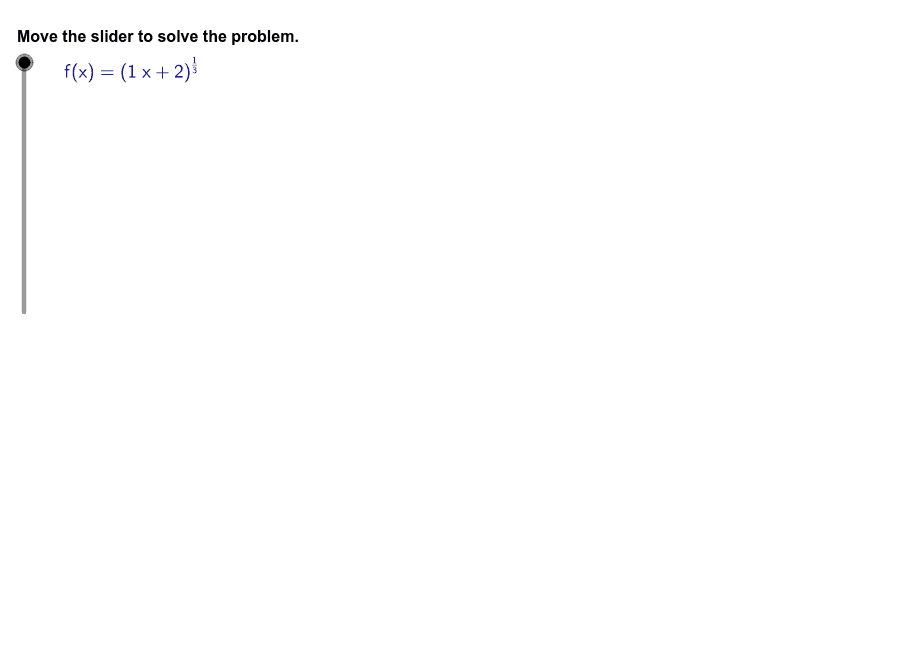
几何画板及绘图内容加载中,请稍等……
① 本范例演示如何求立方根函数 f(x)=∛(x+2) 的反函数,并展示函数与其反函数关于直线 y=x 对称的图像。② 涉及核心数学概念:根式函数、反函数的定义与存在性、定义域与值域的相互转换、函数图像的镜像变换。③ 作图要点:使用 LaTeX 显示公式,Simplify 进行代数化简,If 实现分段判断,TableText 生成步骤表;利用 stepper、steps、counter 等滑块对象控制动画步进,button1、button2 提供交互按钮,mirror 对象实现关于 y=x 的镜像绘制,inversefront、inversemid、inversefunc 等对象分别表示反函数的不同绘制阶段。④ 适合高中代数或大学预科课程,作为函数与反函数教学演示、自学探究或考试复习素材。
GeoGebra 命令及参数
LaTeX(steps) → counterSimplify(((a * x) + b)^(1 / 3)) → fLaTeX((("\textcolor{#000099}{f(x)=" * f) * "}")) → ProblemLaTeX((("\text{Since the inverse function results from switching the input and output variables}\cr\text{of the original function, identify which variable represents the input and which}\cr\text{represents the output. For the function }\textcolor{#000099}{f(x) = " * f) * "}\text{, }\textcolor{#000099}{x}\text{ is the input (independent)}\cr\text{variable, and }\textcolor{#000099}{f(x)}\text{ is the output (dependent) variable. Therefore, swap }\textcolor{#000099}{f(x)}\text{ and }\textcolor{#000099}{x}.")) → text2LaTeX("\text{Determine the domain of }\textcolor{#000099}{f(x)}.") → text16LaTeX("\text{Determine whether the function }\textcolor{#000099}{f(x)}\text{ exhibits one-to-one correspondence.}") → text18LaTeX("\text{Determine the range of }\textcolor{#000099}{f(x)}.") → text21LaTeX("\text{Match domains to ranges to find the inverse(s) of }\textcolor{#000099}{f(x)}.") → text23LaTeX("\text{Check that the range of }\textcolor{#000099}{f(x)}\text{ matches the domain of }\textcolor{#006633}{g(x)}.") → text25Simplify((x^(3) - b) / a) → gLaTeX("\text{Switch the domain and function variables, and then rename }\textcolor{#000099}{f(x)}\text{ as }\textcolor{#006633}{f^{-1}(x).}") → text1LaTeX("\text{Next, rename }\textcolor{#000099}{f(x)}\text{ as }\textcolor{#006633}{f^{-1}(x)}\text{, since this new relation represents the inverse of the}\cr\text{original function.}") → text4If(a ≟ 1, LaTeX["f^{-1}(x)"], If[a ≟ -1, LaTeX["-f^{-1}(x)"], LaTeX[(a * "f^{-1}(x)")]]) → inversefrontIf(b ≟ 0, LaTeX[""], If[b < 0, LaTeX[("-" * abs(b))], LaTeX[("+" * abs(b))]]) → inversemidIf(a ≟ 1, LaTeX[(("\sqrt[3]{f^{-1}(x)" * inversemid) * "}")], If[a ≟ -1, LaTeX[(("\sqrt[3]{-f^{-1}(x)" * inversemid) * "}")], LaTeX[(((("\sqrt[3]{" * a) * "f^{-1}(x)") * inversemid) * "}")]]) → inversefuncLaTeX((((("\text{The resulting inverse relation, }\textcolor{#006633}{x = " * inversefunc) * "}\text{, is the possible inverse function of}\cr\text{the original function. It must be evaluated to determine whether it has }\cr\text{one-to-one correspondence with the original function, }\textcolor{#000099}{f(x) = ") * f) * "}.")) → text6LaTeX("f(x)") → inversefrontaIf(b ≟ 1, LaTeX["f(x)"], If[b ≟ -1, LaTeX["-f(x)"], LaTeX[(b * "f(x)")]]) → inversemidaIf(a ≟ 1, LaTeX[(("\sqrt[3]{f(x)" * inversemid) * "}")], If[a ≟ -1, LaTeX[(("\sqrt[3]{-f(x)" * inversemid) * "}")], LaTeX[(((("\sqrt[3]{" * a) * "f(x)") * inversemid) * "}")]]) → inversefuncaLaTeX("\text{Solve the possible inverse for }\textcolor{#006633}{f^{-1}(x)}.") → text7LaTeX("\text{Determine the domain of }\textcolor{#006633}{f^{-1}(x)}.") → text9LaTeX("\text{Determine the range of }\textcolor{#006633}{f^{-1}(x)}.") → text13LaTeX("\text{We need to compare the range of }\textcolor{#006633}{f^{-1}(x)}\text{ to the domain of }\textcolor{#000099}{f(x)}.") → text14LaTeX("\text{The function }\textcolor{#000099}{f(x)}\text{ can only have an inverse over the parts of its domain where it exhibits}\cr\text{one-to-one correspondence.}") → text19LaTeX("\text{The function }\textcolor{#006633}{f^{-1}(x)}\text{ is a polynomial function so its domain is all real numbers.}") → text11LaTeX("\text{The range of }\textcolor{#000099}{f(x)}\text{ is }\textcolor{#000099}{(-\infty,+\infty)}\text{. The domain of }\textcolor{#006633}{f^{-1}(x)}\text{ is }\textcolor{#006633}{(-\infty,+\infty)}.") → text26LaTeX("\text{Check that }\textcolor{#000099}{f(x)}\text{ is one-to-one with the horizontal line test.}") → text27LaTeX("\text{Check that }\textcolor{#006633}{f^{-1}(x)}\text{ is a function using the vertical line test.}") → text28LaTeX((((("\text{The inverse of }\textcolor{#000099}{f(x)=" * f) * "}\text{ is }\textcolor{#006633}{f^{-1}(x)=") * g) * "}.")) → text29LaTeX((("\text{We can determine that the function }\textcolor{#000099}{f(x) =" * f) * "}\text{ does show one-to-one}\cr\text{correspondence for all domain values by noting that cube roots, and other odd roots,}\cr\text{preserve negative signs so that no two values of }\textcolor{#000099}{x}\text{ can produce the same }\textcolor{#000099}{f(x)}\text{ value.}")) → text20LaTeX("\text{Use the buttons below to return to the original problem or}\cr\text{randomly generate a similar practice problem.}") → text31TableText({{LaTeX[(("\textcolor{#000099}{x=" * inversefunca) * "}")], LaTeX["\text{Equation with variables switched}"]}, {LaTeX[(("\textcolor{#006633}{x=" * inversefunc) * "}")], LaTeX["\text{Rename }\textcolor{#000099}{f(x)}\text{ as }\textcolor{#006633}{f^{-1}(x)}."]}}) → text5TableText({{LaTeX[(("\textcolor{#000099}{f(x)=" * f) * "}")], LaTeX["\text{Original function}"]}, {LaTeX[(("\textcolor{#000099}{x=" * inversefunca) * "}")], LaTeX["\text{Switch }\textcolor{#000099}{f(x)}\text{ and }\textcolor{#000099}{x}."]}}) → text3LaTeX("\text{In other words, the domain of }\textcolor{#006633}{f^{-1}(x)} \text{ is }\textcolor{#006633}{(-\infty,+\infty)}.") → text12TableText({{LaTeX[(("\textcolor{#006633}{x=" * inversefunc) * "}")], LaTeX["\text{Possible inverse}"]}, {LaTeX[(((("\textcolor{#006633}{x^3=(" * a) * ")f^{-1}(x)+(") * b) * ")}")], LaTeX["\text{Cube both sides.}"]}, {LaTeX[(((("\textcolor{#006633}{" * Simplify[x^(3) - b]) * "=(") * a) * ")f^{-1}(x) }")], LaTeX[(("\text{Subtract }\textcolor{#006633}{" * b) * "}\text{ from both sides.}")]}, {LaTeX[(((("\textcolor{#006633}{\frac{" * Simplify[x^(3) - b]) * "}{") * a) * "}=f^{-1}(x)}")], LaTeX[(("\text{Divide both sides by }\textcolor{#006633}{" * a) * "}.")]}, {LaTeX[(("\textcolor{#006633}{f^{-1}(x)=" * g) * "}")], LaTeX["\text{Simplify and use the Symmetric Property of Equality.}"]}}) → text8LaTeX("\text{We need to know where }\textcolor{#006633}{f^{-1}(x)}\text{ is defined in order to know its domain, which we}\cr\text{want to compare to the range of }\textcolor{#000099}{f(x)}.") → text10LaTeX("\text{There are no limitations on the output values; therefore, the range of }\textcolor{#006633}{f^{-1}(x)}\text{ is }\cr\textcolor{#006633}{(−\infty, +\infty)}.") → text15LaTeX("\text{There are no limitations on the input values; therefore, the domain }\text{of }\textcolor{#000099}{f(x)}\text{ is }\textcolor{#000099}{(−\infty, +\infty)}.") → text17LaTeX("\text{There is no limitation on the values }\textcolor{#000099}{f(x)}\text{ can have, so its range is }\textcolor{#000099}{(-\infty,+\infty)}.") → text22TableText({{LaTeX["\text{Domain of }\textcolor{#000099}{f(x)}\text{:}"], LaTeX["\text{Inverse function with matching range:}"]}, {LaTeX["\textcolor{#000099}{(-\infty,+\infty)}"], LaTeX[(("\textcolor{#006633}{f^{-1}(x)=" * g) * "}")]}}) → text24
AI 绘图提示语参考
绘制一个坐标系,显示立方根函数f(x)=³√(x+2)的蓝色曲线及其绿色反函数曲线,两曲线关于y=x镜像对称。图中包含y=x对称线、用彩色公式标注的函数表达式、分步骤展示变量互换与求逆过程的表格、滑块控制动画进度、按钮提供交互操作,并标注原函数与反函数的定义域和值域均为全体实数。
以上提示语为根据原始绘图命令整理而来,仅供参考。