
圆内接四边形动态关系演示
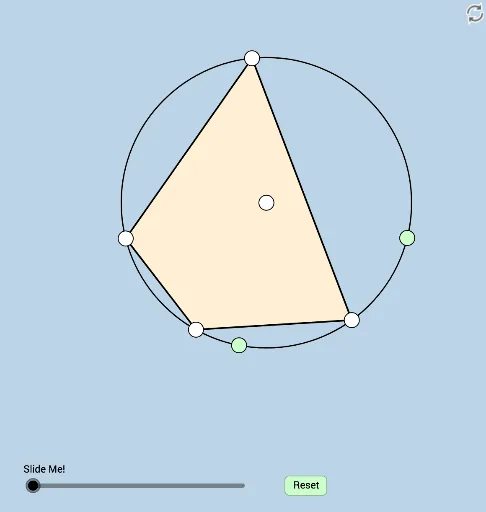
几何画板及绘图内容加载中,请稍等……
①本范例演示圆内接四边形中动态可调的关系与现象;②涉及核心数学概念包括圆、四边形、旋转、相似变换、向量与轨迹;③构造中运用了Circle(圆)、Point(点)、Rotate(旋转)、CircleArc(圆弧)、Segment(线段)、Intersect(交点)、Dilate(缩放)、Vector(向量)、Translate(平移)、Angle(角度)、Ray(射线)、Polygon(多边形)、Line(直线)、OrthogonalLine(垂线)、LineBisector(角平分线)等命令与对象;④适合高中及以上数学学习者和教师用于探索几何变换与动态几何关系。
GeoGebra 命令及参数
Circle(A_1, B_1) → cPoint(c) → C_1Rotate(C_1, 2°, A_1) → C'CircleArc(A_1, C', C_1) → dPoint(d) → DCircleArc(A_1, D, C_1) → ePoint(e) → CCircleArc(A_1, C, C_1) → fPoint(f) → BCircleArc(A_1, B, C_1) → gPoint(g) → ASegment(D, C) → bSegment(C, B) → hSegment(D, A) → aSegment(A, B) → iCircle(B, (0.2 * Distance[A_1, B_1])) → kCircle(C, (0.2 * Distance[A_1, B_1])) → pCircle(A, (0.2 * Distance[A_1, B_1])) → qCircle(D, (0.2 * Distance[A_1, B_1])) → rIntersect(k, i, 1) → H_1Intersect(k, h, 1) → IIntersect(p, h, 1) → JIntersect(p, b, 1) → KIntersect(r, a, 1) → LIntersect(r, b, 1) → MIntersect(q, a, 1) → NIntersect(q, i, 1) → OCircle(A_1, B_1) → e_1Dilate(C, If[0 < j ≤ 1, 1 - j, 0], A) → E'Vector(C, E') → uTranslate(J, u) → J'Angle(O, A, J') → αRay(D, A) → lPoint(l) → PDilate(B, If[2 < j ≤ 3, 3 - j, 0], D) → F'Vector(B, F') → vRay(A, D) → nPoint(n) → QTranslate(I, v) → I'Angle(I', D, M) → βPolygon(A, D, C, B) → poly1, g_2, d_2, e_2, f_2Line(C, D) → i_1OrthogonalLine(A, i_1) → j_1OrthogonalLine(B, i_1) → l_1Intersect(i_1, j_1) → EIntersect(i_1, l_1) → FLine(B, A) → m_1OrthogonalLine(D, m_1) → n_1OrthogonalLine(C, m_1) → p_1Intersect(p_1, m_1) → GIntersect(n_1, m_1) → HCircle(H, G, F) → q_1Dilate(A, If[0 < j ≤ 1, 1 - j, 0], E) → A'Dilate(D, If[0 < j ≤ 1, 1 - j, 0], E) → D'Segment(D, D') → sSegment(A, A') → tAngle(C, E, A) → γDilate(B, If[1 < j ≤ 2, 2 - j, 0], F) → B'Dilate(C, If[1 < j ≤ 2, 2 - j, 0], F) → C'_1Segment(C, C'_1) → f_1Segment(B, B') → g_1Angle(B, F, D) → δDilate(C, If[2 < j ≤ 3, 3 - j, 0], G) → C'_2Dilate(B, If[2 < j ≤ 3, 3 - j, 0], G) → B'_1Segment(C, C'_2) → mSegment(B, B'_1) → h_1Angle(A, G, C) → εDilate(D, If[3 < j ≤ 4, 4 - j, 0], H) → D'_1Dilate(A, If[3 < j ≤ 4, 4 - j, 0], H) → A'_1Segment(D, D'_1) → k_1Segment(A, A'_1) → r_1Angle(D, H, B) → ζLineBisector(G, F) → s_1LineBisector(E, H) → t_1Intersect(s_1, t_1) → RDilate(R, If[5 < j ≤ 6, 6 - j, 0], G) → R'Circle(R, R') → c_1Segment(R, R') → a_1Circle(C, U, B) → d_1Circle(A, V, D) → c_2LineBisector(C, U) → b_1LineBisector(U, B) → h_2Intersect(b_1, h_2) → WLineBisector(V, D) → i_2LineBisector(V, A) → j_2Intersect(j_2, i_2) → ZDilate(C, If[8 < j ≤ 9, 9 - j, 0], W) → C'_3Dilate(A, If[8 < j ≤ 9, 9 - j, 0], Z) → A'_2Segment(C, C'_3) → k_2Segment(A, A'_2) → l_2Rotate(C, If[9 < j ≤ 10, ((-(j - 9)) * π), (-π)], W) → C'_4Rotate(C'_3, If[9 < j ≤ 10, ((-(j - 9)) * π), (-π)], W) → D_1Segment(C'_4, D_1) → m_2Rotate(A, If[9 < j ≤ 10, ((-(j - 9)) * π), (-π)], Z) → A'_3Rotate(A'_2, If[9 < j ≤ 10, ((-(j - 9)) * π), (-π)], Z) → E_1Segment(A'_3, E_1) → n_2Dilate(W, If[10 < j ≤ 11, 11 - j, 0], U) → W'Dilate(Z, If[11 < j ≤ 12, 12 - j, 0], T) → Z'Circle(W, W') → p_2Segment(W, W') → q_2Segment(Z, Z') → r_2Circle(Z, Z') → s_2