
圆锥截面演示 by amit.quackenbush
几何画板及绘图内容加载中,请稍等……
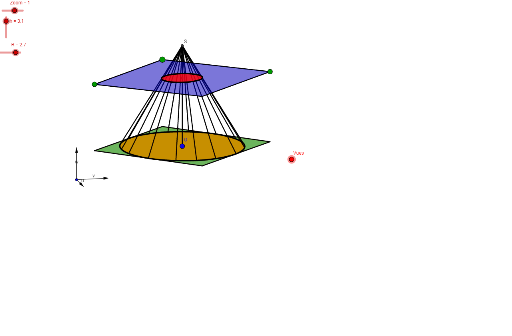
①本范例演示圆锥的截面图形变化;②涉及核心数学概念包括立体几何、三角函数、导数和极限;③构造要点:使用Vector(向量)、OrthogonalLine(垂线)、Translate(平移)、Mirror(镜像)、Polygon(多边形)、Midpoint(中点)、Conic(圆锥曲线)、Segment(线段)、Line(直线)、Point(点)、Intersect(交点)、AngularBisector(角平分线)等GeoGebra命令和对象;④适合高中及以上学生及数学爱好者学习圆锥截面性质及几何作图。
GeoGebra 命令及参数
Vector(B_1, X) → uVector(B_1, Z) → wOrthogonalLine(Vues, yAxis) → aOrthogonalLine(Vues, xAxis) → bVector(B_1, Y) → vTranslate(O, Vector[(R * u)]) → O'_1Translate(O, Vector[(R * v)]) → O'_2Mirror(O'_2, O) → O''Mirror(O'_1, O) → APolygon(A, O'_2, O'_1, O'') → poly1, a_1, o', o'_1, o''Midpoint(a_1) → BMidpoint(o'') → CMidpoint(o'_1) → DMidpoint(o') → EConic(E, B, C, D, E) → dMidpoint(O, O'_2) → FMidpoint(F, B) → GMidpoint(O, G) → HMidpoint(O, G) → IMidpoint(G, I) → JMirror(J, G) → J'Conic(E, J', B, C, D) → eTranslate(O, Vector[(h * w)]) → SSegment(S, O) → fLine(O'_2, f) → iLine(A, f) → jLine(O'', f) → lPoint(j) → KPoint(i) → LPoint(l) → MSegment(K, L) → mSegment(K, M) → nLine(L, n) → pLine(M, m) → qIntersect(p, q) → NPolygon(K, L, N, M) → poly2, k_1, l_1, n_1, m_1Midpoint(k_1) → PMidpoint(l_1) → QMidpoint(m_1) → S_2Midpoint(n_1) → TLine(S, E) → rLine(B, S) → sLine(S, D) → tLine(S, C) → b_1Line(S_2, Q) → c_1Line(P, T) → d_1Intersect(c_1, r) → UIntersect(c_1, b_1) → VIntersect(s, d_1) → WIntersect(t, d_1) → A_1Segment(S, D) → e_1Segment(S, C) → f_1Segment(S, B) → g_1Segment(S, E) → h_1Line(V, m_1) → i_1Line(W, k_1) → j_1Line(U, l_1) → p_1Line(A_1, n_1) → q_1Intersect(p_1, j_1) → C_1Intersect(i_1, j_1) → D_1Intersect(q_1, i_1) → E_1Intersect(q_1, p_1) → F_1Polygon(D_1, C_1, F_1, E_1) → poly3, d_2, c_2, f_2, e_2Midpoint(C_1, E_1) → G_1Mirror(V, G_1) → V'Conic(U, V', W, V, A_1) → r_1Segment(O'_1, A) → s_1Segment(O'_2, O'') → t_1Intersect(e, s_1) → H_1, I_1Intersect(e, t_1) → J_1, K_1Segment(S, I_1) → a_2Segment(S, J_1) → b_2Segment(S, H_1) → g_2Segment(S, K_1) → h_2AngularBisector(O'_2, O, B) → i_2AngularBisector(A, O, B) → j_2AngularBisector(C, O, A) → k_2AngularBisector(O'', O, C) → l_2Midpoint(B, A) → L_1Midpoint(O'_2, B) → M_1Midpoint(O'_2, E) → N_1Midpoint(A, C) → O_1Line(O, L_1) → m_2Line(N_1, O) → n_2Line(M_1, O) → p_2Line(O_1, O) → q_2Intersect(e, p_2) → P_1, Q_1Intersect(e, m_2) → R_1, S_1Intersect(e, q_2) → T_1, U_1Intersect(e, n_2) → V_1, W_1Segment(Q_1, S) → r_2Segment(W_1, S) → s_2Segment(T_1, S) → t_2Segment(S_1, S) → a_3Segment(R_1, S) → b_3Segment(U_1, S) → c_3Segment(S, V_1) → d_3Segment(P_1, S) → e_3Intersect(e, r_1) → Z_1, A_2, B_2, C_2Conic(E, J', B, C, D) → f_3Conic(U, V', W, V, A_1) → g_3Polygon(K, L, N, M) → poly4, k_3, l_3, n_3, m_3Polygon(A, O'_2, O'_1, O'') → poly5, a_4, o'_2, o'_3, o''_1