
有放回与无放回的概率可能性比较
几何画板及绘图内容加载中,请稍等……
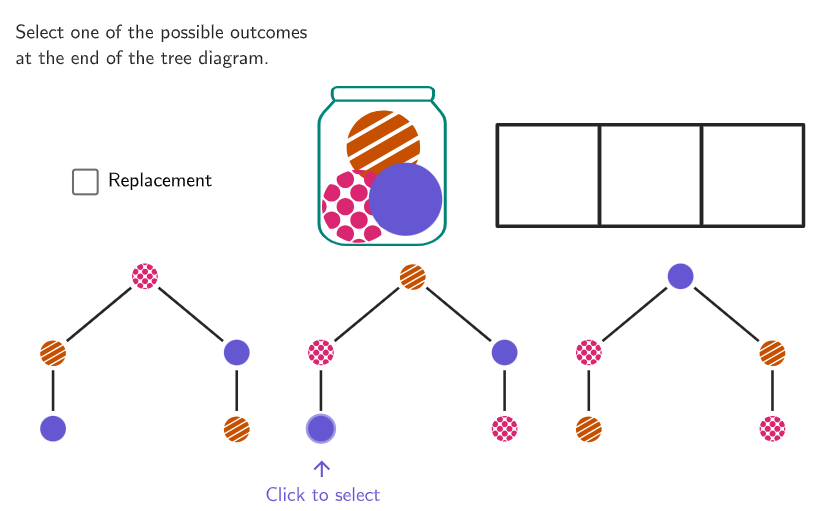
本范例通过树状图演示了在有放回和无放回两种情况下复合概率的差异。涉及的核心数学概念包括概率计算、复合事件、条件概率等。作图要点使用了GeoGebra命令如Corner, Sequence, Flatten, Zip, Dilate, Translate, Polygon, If等,通过这些命令构建了树状图并展示了不同情况下的概率路径。适合6-8年级学生学习如何确定有放回和无放回的复合事件概率。
GeoGebra 命令及参数
Corner(5) → AppSizeSequence(((ii * 5.25), 2), ii, 0, 2) → IniPointsFlatten(Zip[{Segment[PP, PP - (sep1, 1.5)], Segment[PP, PP - (0, 1.5)], Segment[PP, PP - ((-sep1), 1.5)]}, PP, IniPoints]) → segsAboveZip(Vertex[SS, 2], SS, segsAbove) → MidPointsFlatten(Zip[{Segment[PP, PP - (sep2, 1.5)], Segment[PP, PP - (0, 1.5)], Segment[PP, PP - ((-sep2), 1.5)]}, PP, MidPoints]) → segsBelowZip(Vertex[SS, 2], SS, segsBelow) → EndPointsFlatten(Zip[{Segment[PP, PP - (sep1, 1.5)], Segment[PP, PP - ((-sep1), 1.5)]}, PP, IniPoints]) → segsAboveNRZip(Vertex[SS, 2], SS, segsAboveNR) → MidPointsNRZip(Segment[PP, PP - (0, 1.5)], PP, MidPointsNR) → segsBelowNRZip(Vertex[SS, 2], SS, segsBelowNR) → EndPointsNRZip({PP - (sep2 / 2, sep2 / 2), PP - (((-sep2)) / 2, sep2 / 2)}, PP, EndPoints) → m1Dilate(pic1, 0.35, A) → pic1smallTranslate(pic1small, Vector[A, EndPoints(1)]) → pic1B11Translate(pic1small, Vector[A, EndPoints(4)]) → pic1B12Translate(pic1small, Vector[A, EndPoints(7)]) → pic1B13Translate(pic1small, Vector[A, EndPoints(10)]) → pic1B21Translate(pic1small, Vector[A, EndPoints(13)]) → pic1B22Translate(pic1small, Vector[A, EndPoints(16)]) → pic1B23Translate(pic1small, Vector[A, EndPoints(19)]) → pic1B31Translate(pic1small, Vector[A, EndPoints(22)]) → pic1B32Translate(pic1small, Vector[A, EndPoints(25)]) → pic1B33Dilate(pic2, 0.35, B) → pic2smallTranslate(pic2small, Vector[B, EndPoints(2)]) → pic2B11Translate(pic2small, Vector[B, EndPoints(5)]) → pic2B12Translate(pic2small, Vector[B, EndPoints(8)]) → pic2B13Translate(pic2small, Vector[B, EndPoints(11)]) → pic2B21Translate(pic2small, Vector[B, EndPoints(14)]) → pic2B22Translate(pic2small, Vector[B, EndPoints(17)]) → pic2B23Translate(pic2small, Vector[B, EndPoints(20)]) → pic2B31Translate(pic2small, Vector[B, EndPoints(23)]) → pic2B32Translate(pic2small, Vector[B, EndPoints(26)]) → pic2B33Dilate(pic3, 0.35, C) → pic3smallTranslate(pic3small, Vector[C, EndPoints(3)]) → pic3B11Translate(pic3small, Vector[C, EndPoints(6)]) → pic3B12Translate(pic3small, Vector[C, EndPoints(9)]) → pic3B13Translate(pic3small, Vector[C, EndPoints(12)]) → pic3B21Translate(pic3small, Vector[C, EndPoints(15)]) → pic3B22Translate(pic3small, Vector[C, EndPoints(18)]) → pic3B23Translate(pic3small, Vector[C, EndPoints(21)]) → pic3B31Translate(pic3small, Vector[C, EndPoints(24)]) → pic3B32Translate(pic3small, Vector[C, EndPoints(27)]) → pic3B33Translate(pic3small, Vector[C, MidPoints(3)]) → pic3M1Translate(pic3small, Vector[C, MidPoints(6)]) → pic3M2Translate(pic3small, Vector[C, MidPoints(9)]) → pic3M3Translate(pic2small, Vector[B, MidPoints(2)]) → pic2M1Translate(pic2small, Vector[B, MidPoints(5)]) → pic2M2Translate(pic2small, Vector[B, MidPoints(8)]) → pic2M3Translate(pic1small, Vector[A, MidPoints(1)]) → pic1M1Translate(pic1small, Vector[A, MidPoints(4)]) → pic1M2Translate(pic1small, Vector[A, MidPoints(7)]) → pic1M3Translate(pic1small, Vector[A, IniPoints(1)]) → pic1TTranslate(pic2small, Vector[B, IniPoints(2)]) → pic2TTranslate(pic3small, Vector[C, IniPoints(3)]) → pic3TZip(Circle[PP, 0.35], PP, IniPoints) → l1Zip(Circle[PP, 0.35], PP, If[repYESNO, MidPoints, MidPointsNR]) → l2Zip(Circle[PP, 0.35], PP, If[repYESNO, EndPoints, EndPointsNR]) → l3Translate(pic1small, Vector[A, MidPointsNR(3)]) → pic1M2NRTranslate(pic1small, Vector[A, MidPointsNR(5)]) → pic1M3NRTranslate(pic2small, Vector[B, MidPointsNR(1)]) → pic2M1NRTranslate(pic2small, Vector[B, MidPointsNR(6)]) → pic2M3NRTranslate(pic3small, Vector[C, MidPointsNR(2)]) → pic3M1NRTranslate(pic3small, Vector[C, MidPointsNR(4)]) → pic3M2NRTranslate(pic3small, Vector[C, EndPointsNR(1)]) → pic3B11NRTranslate(pic3small, Vector[C, EndPointsNR(3)]) → pic3B21NRTranslate(pic2small, Vector[B, EndPointsNR(2)]) → pic2B12NRTranslate(pic2small, Vector[B, EndPointsNR(5)]) → pic2B31NRTranslate(pic1small, Vector[A, EndPointsNR(4)]) → pic1B22NRTranslate(pic1small, Vector[A, EndPointsNR(6)]) → pic1B32NRPolygon({D, D + (2, 0), D + (2, 2), D + (0, 2)}) → q1Translate(q1, (2, 0)) → q2Translate(q1, (4, 0)) → q3Translate(pic1, Vector[CP11, D]) → pic1T1Translate(pic1, Vector[CP11, Vertex[q2, 1]]) → pic1T2Translate(pic1, Vector[CP11, Vertex[q3, 1]]) → pic1T3Translate(pic2, Vector[CP21, D]) → pic2T1Translate(pic2, Vector[CP21, Vertex[q2, 1]]) → pic2T2Translate(pic2, Vector[CP21, Vertex[q3, 1]]) → pic2T3Translate(pic3, Vector[CP31, Vertex[q3, 1]]) → pic3T3Translate(pic3, Vector[CP31, Vertex[q2, 1]]) → pic3T2Translate(pic3, Vector[CP31, D]) → pic3T1If(repYESNO, g(anim), anim - floor(anim)) → timeTranslate(pic1, Vector[CP11, PAnim1]) → pic1'Translate(pic2, Vector[CP21, PAnim2]) → pic2'Translate(pic3, Vector[CP31, PAnim3]) → pic3'If(repYESNO, 1 / 2, 1) → speedTranslate(Element[{pic1small, pic2small, pic3small}, orderAnim(1)], Vector[Element[{A, B, C}, orderAnim(1)], E]) → pic4Translate(Element[{pic1small, pic2small, pic3small}, orderAnim(2)], Vector[Element[{A, B, C}, orderAnim(2)], F]) → pic5Translate(Element[{pic1small, pic2small, pic3small}, orderAnim(3)], Vector[Element[{A, B, C}, orderAnim(3)], G]) → pic6If(repYESNO, index3R, index3NR) → index3If(repYESNO, index2R, index2NR) → index2If(repYESNO, segsAbove(index2), segsAboveNR(index2)) → fIf(repYESNO, segsBelow(index3), segsBelowNR(index3)) → hIf(repYESNO, 328, 301) → onboardingX_{1}onboardingTextOffset(Corner[onboardingText_{1}, 1], Corner[onboardingText_{1}, 3], onboardingCase_{1}, Corner[1], Corner[3], Corner[5]) → OnboardingTextOffset_{1}If(repYESNO, EndPoints(12), EndPointsNR(3)) → InputPointcirclePixels(InputPoint, 12 + (7 * pulsing), Cor1, Cor3, (800, 500)) → pulsingObjectCircle(Center1, 0.75) → CircleWhite1Circle(Center2, 0.75) → CircleWhite2Circle(Center3, 0.75) → CircleWhite3
AI 绘图提示语参考
请绘制一个概率树状图,展示有放回与无放回两种情况下的结果路径。图中应包含多个节点和连线,节点从上到下排列,连线表示事件发生的顺序。构造时先创建根节点,然后逐步添加子节点,最后连接各节点之间的线段,以清晰展示不同概率路径。
以上提示语为根据原始绘图命令整理而来,仅供参考。