
弦的性质
几何画板及绘图内容加载中,请稍等……
所属专题
Mathematics Form 2
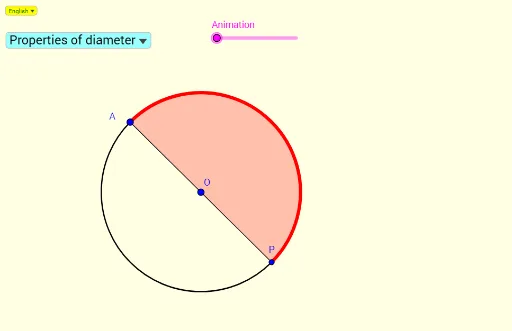
①本范例演示圆中弦的性质,包括弦与圆心、弦心距、圆周角的关系;②涉及核心数学概念有圆、相似三角形、圆周角定理、弦心距公式;③作图要点提炼自构造摘要,使用了Circle(圆)、Point(点)、Segment(线段)、Intersect(交点)、OrthogonalLine(垂线)、Angle(角度)、If(条件判断)、CircleArc(圆弧)、Line(直线)、Semicircle(半圆)、Rotate(旋转)、DynamicCoordinates(动态坐标)、Distance(距离)、Length(长度)、LineBisector(角平分线)等GeoGebra命令/对象;④适合高中阶段学习圆的性质、几何作图及动态几何演示的师生使用。
GeoGebra 命令及参数
SelectedIndex(Bahasa) → nnCircle(O, Rd) → cPoint(c) → DPoint(c) → BPoint(c) → ASegment(A, B) → gCircle(D, g) → eIntersect(c, e, 1) → JSegment(D, J) → nOrthogonalLine(O, n) → qIntersect(q, n) → LOrthogonalLine(O, g) → iIntersect(i, g) → KAngle(K, O, L) → γAngle(A, O, B) → αIf(α ≤ 180°, A, B) → MIf(α ≤ 180°, B, A) → NIf(γ > 180°, Rotate[N, ((-a) * (360° - γ)), O], Rotate[N, (a * γ), O]) → SIf(γ > 180°, Rotate[M, ((-a) * (360° - γ)), O], Rotate[M, (a * γ), O]) → RCircleArc(O, M, N) → Arc1Point(Arc1) → GIntersect(Arc1, i) → F, E_1Line(O, A) → fIntersect(c, f, 2) → PSemicircle(A, P) → dRotate(d, ((a * 180))°, O) → d'If(Distance[G, F] < 0.2, F, G) → TIf(nn ≟ 1, {"Properties of diameter", "Properties of chord 1", "Properties of chord 2", "Properties of chord 3", "Properties of chord 4"}, {"Sifat diameter", "Sifat perentas 1", "Sifat perentas 2", "Sifat perentas 3", "Sifat perentas 4"}) → SifatSelectedIndex(Sifat) → mDynamicCoordinates(G, x(T), y(T)) → CLine(C, O) → hIntersect(h, g) → EIf(α > 180°, Rotate[B, (((-a) * 180))°, E], Rotate[B, ((a * 180))°, E]) → B'Segment(E, B') → jAngle(A, E, O) → βCircleArc(O, R, S) → pSegment(C, O) → lIf(γ > 180°, Rotate[K, ((-u) * (360° - γ)), O], Rotate[K, (u * γ), O]) → WSegment(O, W) → tSegment(R, S) → f_1Angle(O, K, B) → εAngle(O, L, D) → ζIf(γ > 180°, Rotate[M, (-(360° - γ)), O], Rotate[M, γ, O]) → UIf(γ > 180°, Rotate[N, (-(360° - γ)), O], Rotate[N, γ, O]) → VCircleArc(O, U, V) → Arc2Distance(R, S) → RSLength(p) → PLDistance(O, W) → OWPoint(c) → ZSegment(D, Z) → bLineBisector(D, Z) → g_1LineBisector(B, A) → h_1Intersect(g_1, b) → A_1Intersect(h_1, g) → B_1Angle(O, A_1, D) → ηAngle(O, B_1, A) → θSegment(A, P) → k