
CCGPS AA 5.2.3 示例3:根据图像写出函数方程
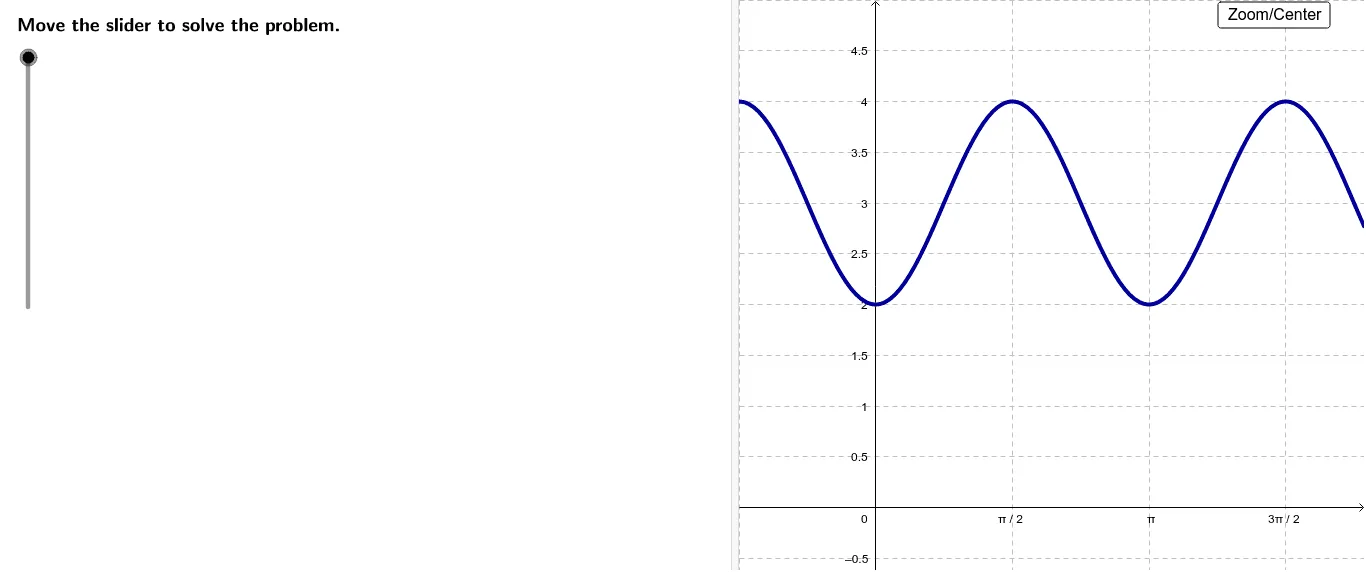
几何画板及绘图内容加载中,请稍等……
本范例演示如何根据给定的函数图像写出其对应的方程,重点针对正切函数(tangent function)的图像特征进行解析。核心数学概念包括正切函数的周期、振幅、相位移动和垂直移动,以及如何从图像中提取这些参数来构建函数表达式。作图要点方面,构造摘要显示使用了LaTeX文本、线段(Segment)、条件判断(If)、向量(Vector)、最小值/最大值(Min/Max)、表格文本(TableText)等GeoGebra命令,并涉及多个滑块(如stepMax、stepper、steps、counter)和参数(a、b、cmult、d、f、period、c、amplitude等)来动态调整函数参数,同时通过文本对象(如text1、cosshiftText、sincmult、sinshiftText等)展示方程推导过程。该范例适合高中或大学预科阶段学习三角函数图像变换的学生,也可用于教师课堂演示如何从图像反推函数方程,培养数形结合与逆向思维。
GeoGebra 命令及参数
LaTeX(steps) → counterSegment(A, B) → periodSegment(C, A) → amplitudeLaTeX("\text{Choose to use either the sine or cosine form.}") → text1If(cmult > 0, LaTeX["\text{ to the right}"], If[cmult < 0, LaTeX["\text{ to the left}"], ""]) → cosshiftTextIf(sincmult > 0, LaTeX["\text{ to the right}"], If[sincmult < 0, LaTeX["\text{ to the left}"], ""]) → sinshiftTextLaTeX("\text{Determine the value of a.}") → text7LaTeX("\text{Determine the value of b.}") → text10LaTeX("\text{Determine the value of c.}") → text16LaTeX("\text{The variable c gives the horizontal shift.}") → text17Vector(E, A) → uVector(F, D) → vLaTeX("\text{Determine the value of d.}") → text24LaTeX("\text{The variable d gives the vertical shift.}") → text25If(d > 0, " up", If[d < 0, " down", ""]) → vertshiftTextIf(d > 0, "+", If[d < 0, "-", ""]) → vertshiftSignLaTeX((("\text{The value of d, the vertical shift, is " * d) * ".}")) → text27Vector(((3 * period / 8), 0), ((3 * period / 8), d)) → wLaTeX(("f(x)=" * f)) → text32LaTeX((((((((("f(x)=(" * a) * ")\cos\left[(") * b) * ")(x-") * FractionText[cmult]) * "\pi)\right]+(") * d) * ")")) → text31LaTeX((((((((("f(x)=(" * a) * ")\sin\left[(") * b) * ")(x-") * FractionText[cmult - 0.25]) * "\pi)\right]+(") * d) * ")")) → text35LaTeX(("f(x)=" * g)) → text36Min(0 - a, d - (2 * a)) → yminMax(0 + a, d + (2 * a)) → ymaxLaTeX((((((FractionText[cmult + 2 / b] * "\pi-") * FractionText[cmult]) * "\pi=") * FractionText[2 / b]) * "\pi")) → text13LaTeX("\text{Move the slider to solve the problem.}") → text0LaTeX("\text{This periodic function can be described by a sine function or a cosine function. }\cr\text{Either function will work.}") → text2LaTeX((((((("\text{There is an identifiable rising midpoint at x = }" * FractionText[sincmult]) * "\pi. \cr\text{Thus, this function can be described as a sine function }\cr\text{that has been shifted }") * FractionText[abs(sincmult)]) * "\pi\text{ units}") * sinshiftText) * ".")) → text6LaTeX((((((("\text{There is an identifiable maximum at x = }" * FractionText[cmult]) * "\pi. \cr\text{Thus, this function can be described as a cosine function }\cr\text{that has been shifted } ") * FractionText[abs(cmult)]) * "\pi\text{ units}") * cosshiftText) * ".")) → text4LaTeX("\text{The variable a is the amplitude, or how far the function rises above its midline.}") → text8LaTeX("\text{The period (the length of one cycle of the curve) is equal to }\frac{2\pi}{b}.") → text11LaTeX((((("\text{One cycle of this curve starts at x =}" * FractionText[cmult]) * "\pi\text{ and ends at x = }") * FractionText[cmult + 2 / b]) * "\pi. \cr\text{Subtract to find the length of one cycle of the curve.}")) → text12LaTeX((("\text{The period of the function is }" * FractionText[2 / b]) * "\pi. \cr\text{Substitute this value into the formula for the period of the}\cr\text{function and solve for b.}")) → text14LaTeX("\text{The value of the horizontal shift depends on whether the curve}\cr\text{is viewed as a cosine function or as a sine function.}") → text18LaTeX("\text{In either case, shifts to the right are designated as positive }\cr\text{and shifts to the left are designated as negative.}") → text19LaTeX("\text{Substitute a, b, c, and d into the general form of the cosine or sine function.}") → text28LaTeX("\text{Substitute the known values into the general form of the }\cr\text{cosine function and simplify.}") → text29LaTeX("\text{Use the buttons below to return to the original problem or}\cr\text{randomly generate a similar practice problem.}") → text37LaTeX((((((("\text{The midline is y = }" * d) * "\text{, and the function rises }") * a) * " \text{ unit(s) above its midline. }\cr\text{Therefore, the value of a, the amplitude, is }") * a) * ".")) → text9TableText({{LaTeX["\text{period}=\frac{2\pi}{b}"], LaTeX["\text{Formula for the period}"]}, {LaTeX[(FractionText[2 / b] * "\pi=\frac{2\pi}{b}")], LaTeX["\text{Substitute for the period.}"]}, {LaTeX[(("\left(" * FractionText[2 / b]) * "\pi\right)b=2\pi")], LaTeX["\text{Multiply both sides by b.}"]}, {LaTeX[(("b=\frac{2\pi}{" * FractionText[2 / b]) * "\pi}")], LaTeX["\text{Divide both sides by the period.}"]}, {LaTeX[("b=" * b)], LaTeX["\text{Simplify.}"]}}) → text15LaTeX("\text{As a cosine function:}") → text20LaTeX((("\text{}c=" * FractionText[cmult]) * "\pi")) → text21LaTeX("\text{As a sine function:}") → text22LaTeX((("\text{}c=" * FractionText[cmult - 0.25]) * "\pi")) → text23LaTeX((((((((((("\text{The midline is y = }" * d) * "\text{; thus, the function has been shifted") * vertshiftText) * " ") * abs(d)) * " units (") * vertshiftSign) * "") * d) * ").}")) → text26LaTeX("\text{f(x) = a cos [b(x – c)] + d}") → text30LaTeX("\text{Or, substitute the known values into the general form of the }\cr\text{sine function and simplify.}") → text33LaTeX("\text{f(x) = a sin [b(x – c)] + d}") → text34LaTeX("\text{For cosine form:}") → text3LaTeX("\text{For sine form:}") → text5
AI 绘图提示语参考
画一个正切函数的图像,并展示如何从图像中提取周期、振幅、相位移动和垂直移动参数来构建函数表达式。使用滑动条动态调整这些参数,并显示推导过程和最终函数表达式。图像应包含多个文本对象,解释每个参数的意义和推导步骤。
以上提示语为根据原始绘图命令整理而来,仅供参考。