
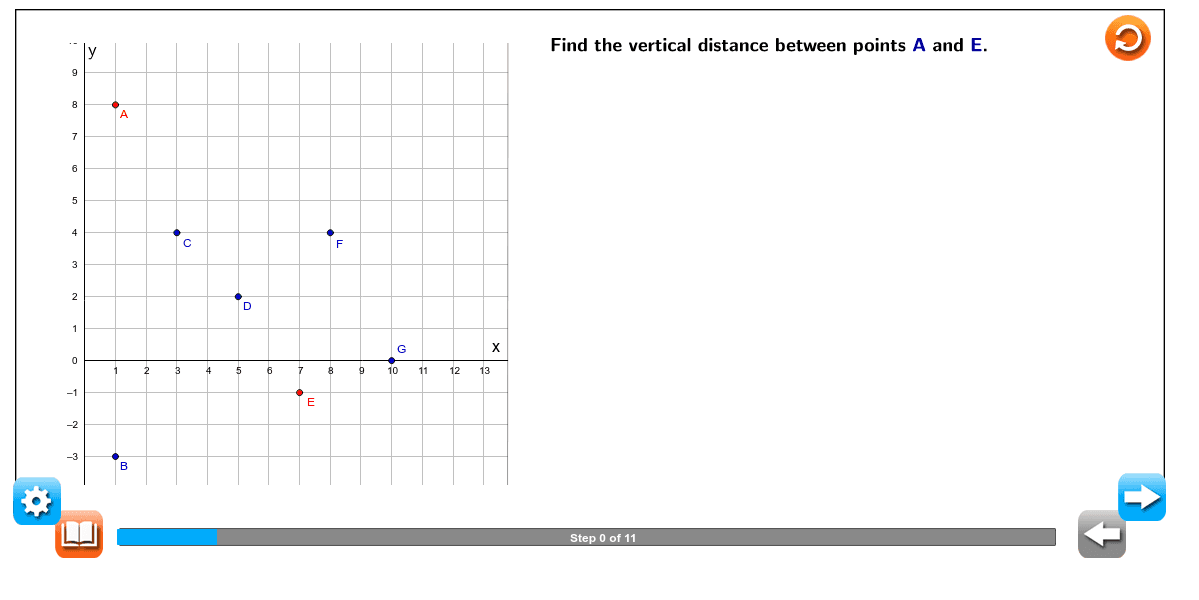
解析几何:求点A与点E的垂直距离
几何画板及绘图内容加载中,请稍等……
本范例演示在平面直角坐标系中求解两点间的垂直距离。核心数学概念包括坐标平面、点坐标、垂直距离公式及一次函数(线性方程)的应用。构造要点:利用Polygon绘制梯形(Trapezoid)辅助图形,通过Point命令确定关键点A和E的坐标,使用Segment绘制线段展示垂直关系,借助Slider动画演示参数变化,LaTeX命令展示垂直距离的精确计算公式。本范例适合初中至高中数学教学,可用于解析几何入门、距离公式推导及一次函数图像的教学演示。
GeoGebra 命令及参数
SelectedIndex(Y_2) → Y2SelectedIndex(X_2) → X2SelectedIndex(X_1) → X1Polygon(WhiteA, WhiteB, WhiteC, WhiteD) → White, Whitea, Whiteb, Whitec, WhitedLaTeX("\text{Use the buttons below to return to the original problem or}") → Final1LaTeX("\text{randomly generate a similar practice problem.}") → Final2LaTeX("\text{Take the absolute value of the difference.}") → Ans1_8LaTeX("\text{Subtract the values of the \textcolor{#000099}{y}-coordinates.}") → Ans1_3LaTeX((("\text{The difference of the \textcolor{#000099}{y}-coordinates is \textcolor{#000099}{" * nine) * "}.}")) → Ans1_7LaTeX("\text{number line.}") → Ans1_{10}LaTeX("\text{The absolute value is a number’s distance from \textcolor{#000099}{0} on a }") → Ans1_9LaTeX((("\text{The vertical distance between points \textcolor{#000099}{A} and \textcolor{#000099}{E} is \textcolor{#000099}{" * nine) * "} units.}")) → Ans1_{12}LaTeX("\text{y}") → text1_1LaTeX("\text{Find the vertical distance between points \textcolor{#000099}{A} and \textcolor{#000099}{E}.}") → Question1Point(Whited) → HLaTeX((((((((("\text{Because \textcolor{#000099}{" * nine) * "} is \textcolor{#000099}{") * nine) * "} units away from \textcolor{#000099}{0}, |\textcolor{#000099}{") * nine) * "}|=\textcolor{#000099}{") * nine) * "}.}")) → Ans1_{11}LaTeX("\text{Identify the \textcolor{#000099}{y}-coordinate of both points.}") → Ans1Polygon(WhiteA_1, WhiteB_1, WhiteC_1, WhiteD_1) → White_1, Whitea_1, Whiteb_1, Whitec_1, Whited_1Segment(M, N) → aSegment(N, O) → bSegment(O, P) → cPolygon(Graph_hi, Graph_hi2, Graph_hi4, Graph_hi3) → Graph, e_1, f_1, g_1, h_1Element(X_1, SelectedIndex[X_1]) → numSelectedIndex(Y_1) → Y1LaTeX((("\text{The \textcolor{#000099}{y}-coordinate of point \textcolor{#000099}{A} is \textcolor{#000099}{" * X2) * "},and the \textcolor{#000099}{y}-coordinate of}")) → Ans1_4LaTeX((((((("\text{Point \textcolor{#000099}{A} is located at (\textcolor{#000099}{" * X1) * "}, \textcolor{#000099}{") * X2) * "}).Therefore,its \textcolor{#000099}{y}-coordinate is \textcolor{#000099}{") * X2) * "}.}")) → Ans1_1LaTeX((((((("\text{Point \textcolor{#000099}{E} is located at (\textcolor{#000099}{" * Y1) * "}, \textcolor{#000099}{–") * Y2) * "}).Therefore,its \textcolor{#000099}{y}-coordinate is \textcolor{#000099}{–") * Y2) * "}.}")) → Ans1_2LaTeX((((((("\text{\textcolor{#000099}{" * X2) * "} – (\textcolor{#000099}{–") * Y2) * "}) = \textcolor{#000099}{") * nine) * "}}")) → Ans1_6LaTeX("\text{Select coordinates for A and E:}") → text3LaTeX("\text{DATA KIT}") → text2LaTeX((("\text{point \textcolor{#000099}{E} is \textcolor{#000099}{–" * Y2) * "}. Subtract to find the difference.}")) → Ans1_5Polygon(E_2, F_2, G_2, H_2) → poly1, e_2, f_2, g_2, h_2Polygon(I_2, H_2, J_2, K_2) → poly2, i_2, h_3, j_2, k_2Polygon(O_2, T_2, U_2, V_2) → poly3, o_2, t_2, u_2, v_2Polygon(W_2, Z_2, A_3, B_3) → poly4, w_2, z_2, a_3, b_3LaTeX("\text{Quantitative variables are variables measured on a }") → text5_1LaTeX("\text{numeric scale. }") → text5_2LaTeX("\text{Quantitative variables: }") → text5