
Animation 204: Composite Demonstration of Geometric Transformations and Probabil
几何画板及绘图内容加载中,请稍等……
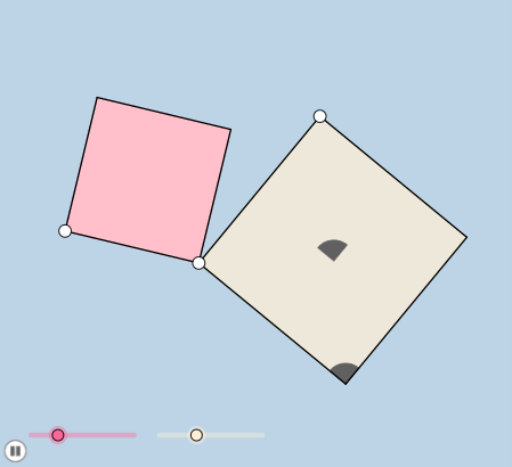
This GeoGebra example presents a composite animation that integrates geometric constructions with probability statistics, featuring shapes such as squares, rhombi, circles, sectors, and polygons, along with concepts like binomial distribution, special points, and equations. The construction employs commands including Circle, Point, Polygon, Dilate, Segment, Rotate, Min, Intersect, CircleSector, Vector, Translate, Line, Angle, Midpoint, and OrthogonalLine, creating numerous points, segments, polygons, and transformed objects, with dynamic changes driven by sliders or animation. It is suitable for high school and above to explore the visual connection between geometric transformations (rotation, translation, scaling) and probability distributions (binomial), and can serve as a teaching tool for demonstrating the combination of dynamic geometry and statistical simulation.
GeoGebra 命令及参数
Circle(A, b) → dPoint(d) → BCircle(B, c) → ePoint(e) → CPolygon(A, B, 4) → poly1, f, g, h, i, D, EPolygon(C, B, 4) → poly2, j, k, l, m, F, GDilate(B, If[0 < a ≤ 1, 1 - a, 0], A) → B'Dilate(B, If[0 < a ≤ 1, 1 - a, 0], F) → B'_1Segment(B, B') → nSegment(B, B'_1) → pRotate(B, If[1 < a ≤ 2, ((-(a - 1)) * π / 2), ((-π)) / 2], F) → B'_2Rotate(B'_1, If[1 < a ≤ 2, ((-(a - 1)) * π / 2), ((-π)) / 2], F) → LSegment(B'_2, L) → p'Rotate(B, If[1 < a ≤ 2, ((a - 1) * π / 2), π / 2], A) → B'_3Rotate(B', If[1 < a ≤ 2, ((a - 1) * π / 2), π / 2], A) → B''Segment(B'_3, B'') → n'Rotate(B'_2, If[2 < a ≤ 3, ((-(a - 2)) * π / 2), ((-π)) / 2], G) → MRotate(L, If[2 < a ≤ 3, ((-(a - 2)) * π / 2), ((-π)) / 2], G) → L'Segment(M, L') → p''Rotate(B'_3, If[2 < a ≤ 3, ((a - 2) * π / 2), π / 2], E) → NRotate(B'', If[2 < a ≤ 3, ((a - 2) * π / 2), π / 2], E) → B'''Segment(N, B''') → n''Rotate(N, If[3 < a ≤ 4, ((a - 3) * π / 2), π / 2], D) → N'Rotate(B''', If[3 < a ≤ 4, ((a - 3) * π / 2), π / 2], D) → OSegment(N', O) → n'''Rotate(M, If[3 < a ≤ 4, ((-(a - 3)) * π / 2), ((-π)) / 2], C) → M'Rotate(L', If[3 < a ≤ 4, ((-(a - 3)) * π / 2), ((-π)) / 2], C) → L''Segment(M', L'') → p'''Segment(F, G) → qSegment(F, B) → rSegment(A, B) → sMin(r, s) → oCircle(F, (0.15 * o)) → tIntersect(l, q) → PIntersect(t, q) → Q,Intersect(t, r) → R,CircleSector(F, Q, R) → c_1Dilate(F, If[4 < a ≤ 5, 5 - a, 0], C) → F'Vector(F, F') → uTranslate(c_1, u) → d_1Rotate(d_1, If[5 < a ≤ 6, ((a - 5) * π), π], C) → e_1Dilate(F, If[6 < a ≤ 7, 7 - a, 0], A) → F'_1Dilate(C, If[6 < a ≤ 7, 7 - a, 0], E) → C'Vector(F, F'_1) → vVector(C, C') → wTranslate(e_1, w) → f_1Translate(c_1, v) → g_1Line(A, p) → h_1Line(E, p''') → i_1Point(h_1) → SAngle(S, A, E) → αRotate(g_1, If[7 < a ≤ 8, ((-(a - 7)) * ((2 * π) - α)), (-((2 * π) - α))], A) → k_1Line(E, h_1) → j_1Point(j_1) → TAngle(D, E, T) → βRotate(f_1, If[7 < a ≤ 8, ((-(a - 7)) * β), (-β)], E) → p_1Dilate(E, If[8 < a ≤ 9, 9 - a, 0], G) → E'Dilate(F, If[8 < a ≤ 9, 9 - a, 0], D) → F'_2Vector(E, E') → u_1Vector(F, F'_2) → v_1Translate(p_1, u_1) → q_1Translate(c_1, v_1) → r_1Line(G, n'') → l_1Point(l_1) → ULine(G, n') → m_1Point(m_1) → VAngle(C, G, V) → γRotate(q_1, If[8 < a ≤ 9, ((-(a - 8)) * γ), (-γ)], E') → s_1Line(D, p) → n_1Point(n_1) → WAngle(W, D, B) → δRotate(r_1, If[8 < a ≤ 9, ((a - 8) * δ), δ], F'_2) → t_1Midpoint(A, B) → ZMidpoint(B, C) → A_1Midpoint(Z, B) → B_1Midpoint(A_1, B) → C_1Dilate(C, If[9 < a ≤ 10, 10 - a, 0], C_1) → C'_1Dilate(A, If[9 < a ≤ 10, 10 - a, 0], B_1) → A'Vector(A, A') → w_1Vector(C, C'_1) → a_1Translate(e_1, a_1) → c_2Translate(k_1, w_1) → d_2Rotate(d_2, If[10 < a ≤ 11, ((a - 10) * π / 2), π / 2], B_1) → e_2Rotate(c_2, If[10 < a ≤ 11, ((a - 10) * π / 2), π / 2], C_1) → f_2Dilate(C_1, If[11 < a ≤ 12, 12 - a, 0], B) → D_1Dilate(B_1, If[11 < a ≤ 12, 12 - a, 0], B) → E_1Vector(B_1, E_1) → b_1Vector(C_1, D_1) → u_2Translate(e_2, b_1) → g_2Translate(f_2, u_2) → h_2Segment(D, C) → a_3Segment(A, F) → b_3Line(A, B) → f_4Polygon(A, F, B) → poly4, b_4, a_4, f_5Polygon(B, C, D) → poly5, d_4, b_5, c_4OrthogonalLine(F, f_4) → h_4Line(D, B) → g_4OrthogonalLine(C, g_4) → i_4Intersect(f_4, h_4) → R_1Intersect(g_4, i_4) → S_1Dilate(B, If[13 < a ≤ 14, 14 - a, 0], R_1) → B'_4Dilate(F, If[13 < a ≤ 14, 14 - a, 0], R_1) → F'_3Angle(B, R_1, F) → εSegment(B, B'_4) → i_2Segment(F, F'_3) → j_2Dilate(A, If[12 < a ≤ 13, 13 - a, 0], F) → A'_1Dilate(D, If[12 < a ≤ 13, 13 - a, 0], C) → D'Segment(D, D') → k_2Segment(A, A'_1) → l_2Dilate(C, If[14 < a ≤ 15, 15 - a, 0], S_1) → C'_2Dilate(D, If[14 < a ≤ 15, 15 - a, 0], S_1) → D'_1Segment(D, D'_1) → m_2Segment(C, C'_2) → n_2Angle(D, S_1, C) → ζDilate(F'_3, If[15 < a ≤ 16, 16 - a, 0], C) → HVector(F'_3, H) → v_2Translate(F, v_2) → F'_4Translate(F'_3, v_2) → ISegment(F'_4, I) → p_2Line(C, j_2) → q_2Point(q_2) → JAngle(J, C, C'_2) → ηRotate(F'_4, If[16 < a ≤ 17, ((a - 16) * η), η], C) → KRotate(I, If[16 < a ≤ 17, ((a - 16) * η), η], C) → I'Segment(K, I') → r_2
AI 绘图提示语参考
绘制一个由两个正方形共享一条边构成的复合图形,其中一个正方形以另一个正方形的顶点为圆心旋转,形成动态的折叠效果。图形中包含圆形、扇形、多边形和线段,并随参数变化展示平移、旋转和缩放。在特定阶段,一个扇形沿向量平移并旋转,同时两个点沿直线移动,形成概率统计的视觉模拟。整体构图强调几何变换与动态过程的结合,适合教学演示。
以上提示语为根据原始绘图命令整理而来,仅供参考。