
三维静力学:向量与平衡等式的几何模拟
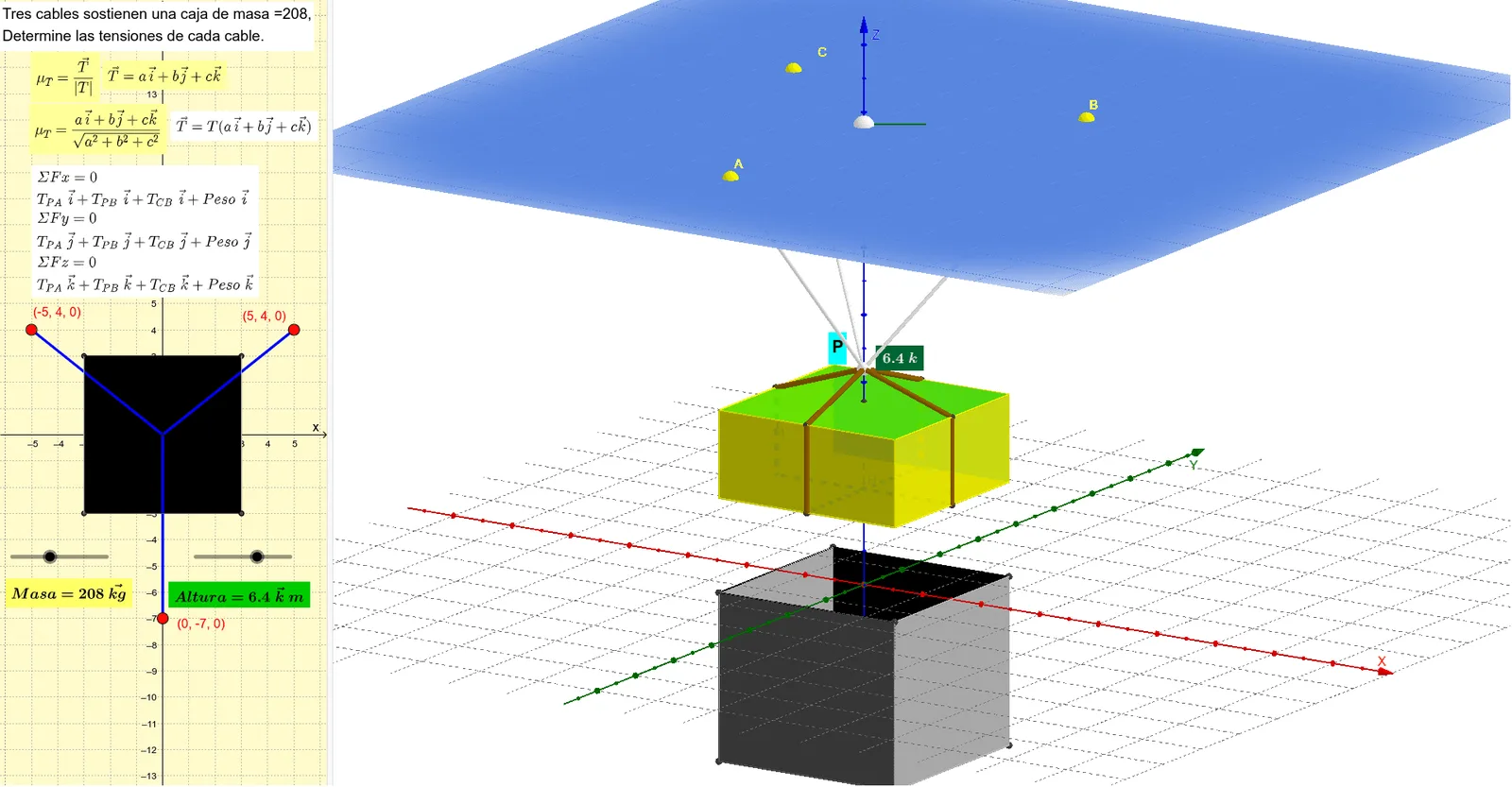
几何画板及绘图内容加载中,请稍等……
该范例用GeoGebra在三维空间中演示静力学平衡问题:通过多个空间向量的方向与分量关系,观察“平衡”条件如何在几何构型中呈现。核心数学概念包括三维向量(方向、模与运算)、向量的乘法与线性组合、直角三角形的构造、以及矩阵/比例关系在分量表达中的应用(配合MCM/MCD等整数运算思想用于比例标定)。作图要点是先在平面与空间中建立点、线与分段,再生成圆与正交线以确定直角/投影约束,随后用多边形与棱柱形成立体构型,并通过中点、平面、直线的交点来确定向量的几何位置。构造摘要中体现的GeoGebra命令/对象包括:Intersect(交点)、Circle(圆)、OrthogonalLine(正交线)、Line(直线)、Prism(棱柱/立体)、Point(点)、Plane(平面)、Midpoint(中点)、Segment(线段)、Polygon(多边形),以及用于标注与维度控制的ALTURA/ANCHO等对象与多组点(如h_1、A_3、B_3、C_3、D、E、F、G、H、I等)。适合中学到大学的物理/数学教学与自学,用于3D向量运算、静力学平衡建模与几何可视化训练。
GeoGebra 命令及参数
Intersect(yAxis, xAxis) → A_3Circle(A_3, ANCHO) → cIntersect(c, yAxis) → B_3, C_3Intersect(c, xAxis) → D, EOrthogonalLine(C_3, yAxis) → fOrthogonalLine(B_3, yAxis) → gOrthogonalLine(D, xAxis) → hOrthogonalLine(E, xAxis) → iIntersect(h, f) → FIntersect(i, f) → GIntersect(h, g) → ILine(I, G) → kLine(I, zAxis) → lLine(F, zAxis) → mLine(G, zAxis) → nLine(H, zAxis) → pLine(F, A_3) → jIntersect(g, j) → JCircle(H, ALTURA, xAxis) → dIntersect(p, d) → K, LLine(J, n) → qLine(H, j) → rIntersect(r, m) → OIntersect(q, r) → PLine(H, k) → sIntersect(s, l) → QIntersect(s, n) → RLine(K, j) → tIntersect(t, m) → SIntersect(q, t) → TLine(K, k) → aIntersect(a, l) → UIntersect(n, a) → VPrism(Q, P, R, O, U) → b, W, aristaPQ, aristaPR, aristaOR, aristaOQ, aristaQU, aristaPW, aristaRZ, arista1, aristaUW, aristaWZ, Z, arista3, arista2, A_1, caraOQPR, caraPQUW, caraPRZW, cara2, cara1, cara3Point(zAxis) → MPlane(M, xOyPlane) → eMidpoint(O, Q) → NMidpoint(S, U) → B_1Segment(B_1, N) → f_1Segment(B_1, N) → g_1Midpoint(Q, P) → C_1Midpoint(U, T) → D_1Segment(C_1, D_1) → i_1Midpoint(P, R) → E_1Midpoint(T, V) → F_1Segment(E_1, F_1) → j_1Midpoint(R, O) → G_1Midpoint(G, F) → H_1Midpoint(V, S) → I_1Segment(G_1, I_1) → k_1Segment(C_1, G_1) → q_1Segment(E_1, N) → r_1Line(K_1, zAxis) → s_1Line(M_1, zAxis) → t_1Line(L_1, t_1) → a_1Intersect(yAxis, xAxis) → N_1Segment(K_1, N_1) → b_1Segment(N_1, L_1) → c_1Segment(N_1, M_1) → d_1Line(M, b_1) → e_1Intersect(e_1, s_1) → O_1Intersect(s_1, e_1) → CLine(M, d_1) → f_2Intersect(t_1, f_2) → ALine(M, c_1) → g_2Intersect(g_2, a_1) → BCircle(K, 1, yAxis) → c_2Intersect(zAxis, c_2) → J_1, S_1Segment(B_1, J_1) → l_1Segment(D_1, J_1) → m_1Segment(F_1, J_1) → n_1Segment(I_1, J_1) → p_1Segment(J_1, A) → h_2Segment(J_1, C) → i_2Segment(J_1, B) → j_2Segment(F, G) → k_2Segment(J, G) → l_2Segment(J, I) → m_2Segment(I, F) → n_2Intersect(l_2, m_2) → T_1Polygon(F, G, T_1, I) → polígono1, f_3, g_3, t_2, i_3Point(zAxis) → U_1Line(U_1, s) → p_2Line(U_1, r) → q_2Intersect(q, q_2) → V_1Intersect(p_2, n) → W_1Intersect(m, q_2) → Z_1Intersect(m, q_2) → A_2Intersect(p_2, l) → B_2Intersect(q, q_2) → C_2Polygon(F, I, B_2, A_2) → polígono2, f_4, i_4, b_2, a_2Polygon(A_2, W_1, C_2, B_2) → polígono3, a_3, w_1, c_3, b_3Intersect(c_3, w_1) → D_2Polygon(C_2, B_2, I, T_1) → polígono4, c_4, b_4, i_5, t_3Polygon(G, F, A_2, W_1) → polígono5, g_4, f_5, a_4, w_2Polygon(T_1, G, W_1, C_2) → polígono6, t_4, g_5, w_3, c_5
AI 绘图提示语参考
绘制一个三维静力学模型,包含两个垂直的平面和一个正方体棱柱。首先建立x轴、y轴和z轴,然后在x轴上创建一个圆c,与y轴相交得到B_3和C_3。接着构造垂直于y轴的直线f和g,以及垂直于x轴的直线h和i。通过交点F、G、I、J、K、L、M、N、O、P、Q、R、S、T、U、V、W,构建正方体棱柱,并确定其顶点和边。最后,通过中点和线段构造辅助线,确保模型的平衡和对称。
以上提示语为根据原始绘图命令整理而来,仅供参考。