
Wrapping Real Numbers Around the Unit Circle
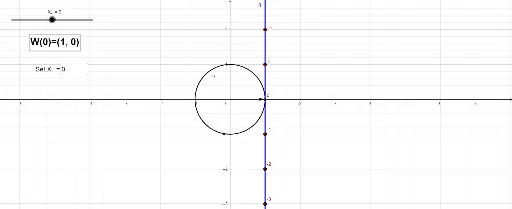
Loading the math board and drawing, please wait…
This example demonstrates how to wrap real numbers around the unit circle. Key mathematical concepts include real numbers, unit circle, and angles. Using GeoGebra commands such as If, Point, Textfield, and Angle, the construction shows the correspondence between real numbers and the unit circle. Suitable for high school mathematics education and learning.
GeoGebra Commands & Parameters
If(X_1 ≥ 0, Arc[c, (1, 0), (cos(X_1), sin(X_1))], Arc[c, (cos(X_1), sin(X_1)), (1, 0)]) → XIf(X_1 > 0, If[((-1)^(floor(X_1 / π)) * x) < ((-1)^(floor(X_1 / π)) * cos(X_1)), (((-cos(X_1))) / sin(X_1) * (x - cos(X_1))) + sin(X_1)]) → fIf(X_1 ≟ 0, x = 1) → gIf(X_1 > 0, Segment[(1, 0), (1, -10)], X_1 < 0, Segment[(1, 0), (1, 10)]) → hIf(X_1 < 0, If[((-1)^(floor(X_1 / π)) * x) > ((-1)^(floor(X_1 / π)) * cos(X_1)), (((-cos(X_1))) / sin(X_1) * (x - cos(X_1))) + sin(X_1)]) → pIf(0 < X_1 < 1, Point[{cos(X_1) - ((1 - X_1) * sin(X_1)), sin(X_1) + ((1 - X_1) * cos(X_1))}]) → BIf(X_1 ≥ 1, Point[{cos(1), sin(1)}]) → CIf(0 < X_1 < 2, Point[{cos(X_1) - ((2 - X_1) * sin(X_1)), sin(X_1) + ((2 - X_1) * cos(X_1))}]) → DIf(X_1 ≤ 0, Point[{1, 2}]) → EIf(X_1 ≤ 0, Point[{1, 1}]) → AIf(X_1 ≥ 2, Point[{cos(2), sin(2)}]) → FIf(X_1 ≤ 0, Point[{1, 3}]) → GIf(0 < X_1 < 3, Point[{cos(X_1) - ((3 - X_1) * sin(X_1)), sin(X_1) + ((3 - X_1) * cos(X_1))}]) → HIf(X_1 ≥ 3, Point[{cos(3), sin(3)}]) → IIf(X_1 ≥ 0, Point[{1, -1}]) → JIf(-1 < X_1 < 0, Point[{cos(X_1) - ((-1 - X_1) * sin(X_1)), sin(X_1) + ((-1 - X_1) * cos(X_1))}]) → KIf(X_1 ≤ -1, Point[{cos(-1), sin(-1)}]) → LIf(X_1 ≥ 0, Point[{1, -2}]) → MIf(-2 < X_1 < 0, Point[{cos(X_1) - ((-2 - X_1) * sin(X_1)), sin(X_1) + ((-2 - X_1) * cos(X_1))}]) → NIf(X_1 ≤ -2, Point[{cos(-2), sin(-2)}]) → OIf(X_1 ≥ 0, Point[{1, -3}]) → PIf(-3 < X_1 < 0, Point[{cos(X_1) - ((-3 - X_1) * sin(X_1)), sin(X_1) + ((-3 - X_1) * cos(X_1))}]) → QIf(X_1 ≤ -3, Point[{cos(-3), sin(-3)}]) → RIf(X_1 ≥ 0, Point[{1, -4}]) → SIf(-4 < X_1 < 0, Point[{cos(X_1) - ((-4 - X_1) * sin(X_1)), sin(X_1) + ((-4 - X_1) * cos(X_1))}]) → TIf(X_1 ≤ -4, Point[{cos(-4), sin(-4)}]) → UIf(0 < X_1 < 4, Point[{cos(X_1) - ((4 - X_1) * sin(X_1)), sin(X_1) + ((4 - X_1) * cos(X_1))}]) → WIf(X_1 ≥ 4, Point[{cos(4), sin(4)}]) → ZPoint({cos(X_1), sin(X_1)}) → A_1If(X_1 ≤ 0, Point[{1, 4}]) → VIf(X_1 ≤ 0, Point[{1, 5}]) → B_1If(0 < X_1 < 5, Point[{cos(X_1) - ((5 - X_1) * sin(X_1)), sin(X_1) + ((5 - X_1) * cos(X_1))}]) → C_1If(X_1 ≥ 5, Point[{cos(5), sin(5)}]) → D_1If(X_1 ≤ 0, Point[{1, 6}]) → E_1If(0 < X_1 < 6, Point[{cos(X_1) - ((6 - X_1) * sin(X_1)), sin(X_1) + ((6 - X_1) * cos(X_1))}]) → F_1If(X_1 ≥ 6, Point[{cos(6), sin(6)}]) → G_1Point({1, 0}) → H_1Textfield(X_1) → InputBox1Point({cos(X_1), sin(X_1)}) → myPointAngle(Vector[(1, 0)], victor) → θAngle(victor, Vector[(1, 0)]) → theta