
Volumes of Revolution - Disk and Washer Method
Loading the math board and drawing, please wait…
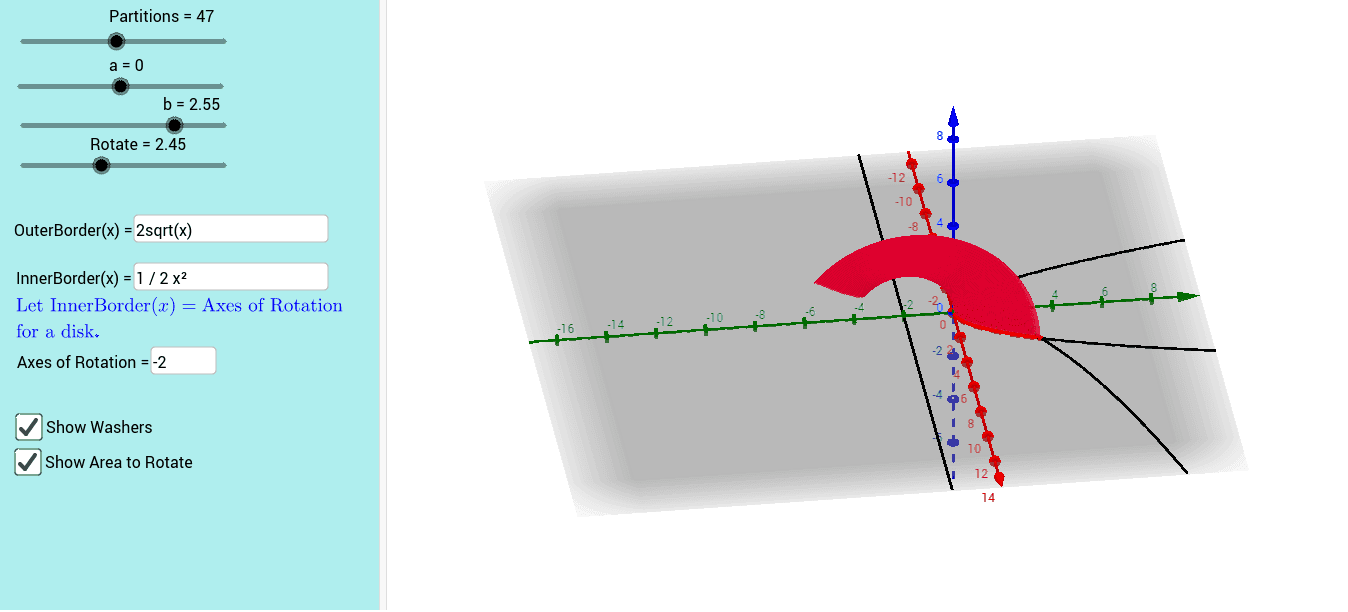
This example demonstrates the calculation of volumes of revolution by rotating 2D regions, visually illustrating the disk and washer methods. Key math concepts include integration, volume calculation, function graphing, and limit concepts. It is constructed using GeoGebra commands like Textfield, Segment, Sequence, and Surface, with objects such as Partitions, Sliders, and InputBoxes for dynamic visualization. Suitable for high school students and calculus beginners learning volume calculation methods, as well as teaching demonstrations.
GeoGebra Commands & Parameters
Textfield(f) → InputBox1Textfield(g) → InputBox2Textfield(h) → InputBox3Segment((a, f(a)), (a, h(a))) → intervalLSegment((b, f(b)), (b, h(b))) → intervalRSequence(Surface[t, g(t) + (v * cos(u)), (v * sin(u)), u, 0, Rotate, v, innerradius(t), outerradius(t)], t, a, b - deltax, deltax) → washersidesSurface(b, g(b) + (v * cos(u)), (v * sin(u)), u, 0, Rotate, v, innerradius(b - deltax), outerradius(b - deltax)) → endSequence(Surface[v, g(t) + (innerradius(t) * sin((-u) + π / 2)), (innerradius(t) * cos((-u) + π / 2)), u, 0, Rotate, v, t, t + deltax], t, a, b - deltax, deltax) → innersurfaceSequence(Surface[v, g(t) + (outerradius(t) * sin((-u) + π / 2)), (outerradius(t) * cos((-u) + π / 2)), u, 0, Rotate, v, t, t + deltax], t, a, b - deltax, deltax) → outersurface