
Volumes of Cubes and Prisms by LearnZillion
Loading the math board and drawing, please wait…
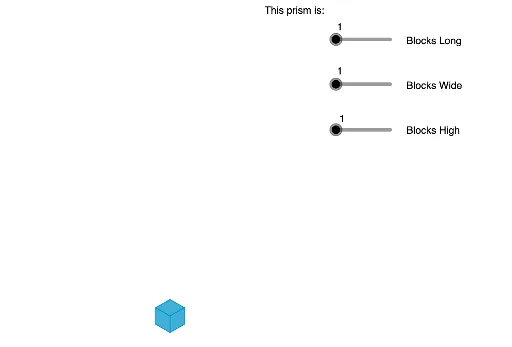
This example demonstrates the calculation of volumes of cubes and prisms. Key mathematical concepts include geometric transformations, reflection, cuboid, linear functions, and congruence. Using GeoGebra commands such as Dilate (scaling), Polygon (polygon), Vector (vector), Sequence (sequence), and Translate (translation), the construction of cubes and prisms is achieved, and their volumes are calculated through transformations and computations. Suitable for middle and high school students studying solid geometry and volume calculations.
GeoGebra Commands & Parameters
Dilate(E, a, A) → E'_1Dilate(F, a, D) → F'_1Dilate(G, a, C) → G'_1Dilate(A, b, D) → A'_1Dilate(E'_1, b, F'_1) → E''_1Dilate(B, b, C) → B'_1Dilate(F'_1, c, G'_1) → F''_1Dilate(D, a, B) → D'_1Dilate(E'_1, c, D'_1) → E''Dilate(E'', b, F''_1) → E'''Dilate(A'_1, c, B'_1) → A''_1Dilate(D, c, C) → D'_2Polygon(C, G'_1, F''_1, D'_2) → poly1, c_2, g', f'', d'Polygon(C, D'_2, A''_1, B'_1) → poly2, c_1, d'_1, a'', b'Polygon(A''_1, D'_2, F''_1, E''') → poly3, a''_1, d'_2, f''_1, e'''Polygon(B, A, D, C) → poly4, b_1, a_1, d_3, c_3Polygon(C, D, F, G) → poly5, c_4, d_1, f_2, g_1Polygon(D, F, E, A) → poly6, d_2, f_1, e_1, a_2Vector(C, D) → uSequence(Segment[Translate[C, Vector[(j * u)]], Translate[G'_1, Vector[(j * u)]]], j, 1, c - 1) → list1Sequence(Segment[Translate[B'_1, Vector[(j * u)]], Translate[C, Vector[(j * u)]]], j, 1, c - 1) → list2Vector(C, G) → vVector(C, B) → wSequence(Segment[Translate[C, Vector[(j * v)]], Translate[D'_2, Vector[(j * v)]]], j, 1, a - 1) → list3Sequence(Segment[Translate[C, Vector[(j * w)]], Translate[D'_2, Vector[(j * w)]]], j, 1, b - 1) → list4Sequence(Segment[Translate[F''_1, Vector[(j * w)]], Translate[D'_2, Vector[(j * w)]]], j, 1, b - 1) → list5Sequence(Segment[Translate[D'_2, Vector[(j * v)]], Translate[A''_1, Vector[(j * v)]]], j, 1, a - 1) → list6Dilate(G, (a * d), C) → G'Dilate(F, (a * d), D) → F'Dilate(F', (c * f), G') → F''Dilate(D, (c * f), C) → D'Dilate(B, (b * e), C) → B'Dilate(A, (b * e), D) → A'Dilate(A', (c * f), B') → A''Vector(D', F'') → zTranslate(A'', z) → A'''Polygon(D', C, G', F'') → poly7, d'_3, c_5, g'_1, f_4Polygon(D', C, B', A'') → poly8, d_6, c_6, b'_1, a_4Polygon(A'', D', F'', A''') → poly9, a''_3, d'_5, f''_3, a'''Sequence(Segment[Translate[C, Vector[((j * c) * u)]], Translate[G', Vector[((j * c) * u)]]], j, 1, f) → list7Sequence(Segment[Translate[C, Vector[((j * c) * u)]], Translate[B', Vector[((j * c) * u)]]], j, 1, f) → list8Sequence(Segment[Translate[D', Vector[((j * a) * v)]], Translate[C, Vector[((j * a) * v)]]], j, 1, d) → list9Sequence(Segment[Translate[D', Vector[((j * b) * w)]], Translate[C, Vector[((j * b) * w)]]], j, 1, e) → list10Sequence(Segment[Translate[A'', Vector[((j * a) * v)]], Translate[D', Vector[((j * a) * v)]]], j, 1, d) → list11Sequence(Segment[Translate[F'', Vector[((j * b) * w)]], Translate[D', Vector[((j * b) * w)]]], j, 1, e) → list12