
Volumes by Washers
Loading the math board and drawing, please wait…
In collections
AP Calculus volume problems
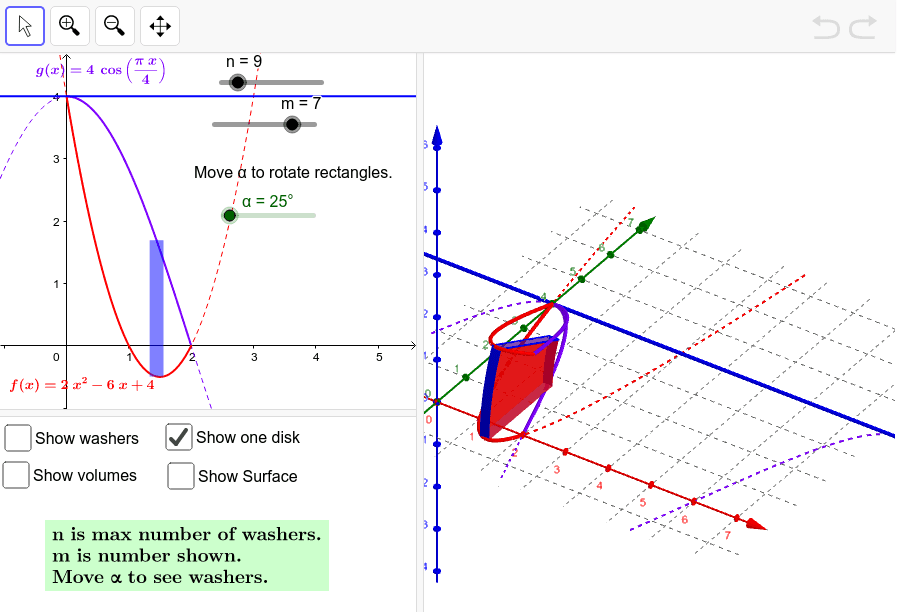
This example demonstrates the calculation of solid volumes using the washer method in calculus. It involves integral computation, area summation of washers, and utilizes GeoGebra commands like Sequence, Polygon, Rotate, Integral, Surface, and RectangleSum. Ideal for high school and above students learning about volume calculations of solids of revolution.
GeoGebra Commands & Parameters
Sequence(Polygon[((k * h), f(((k + p) * h))), (((k + 1) * h), f(((k + p) * h))), (((k + 1) * h), g(((k + p) * h))), ((k * h), g(((k + p) * h)))], k, 0, m - 1) → RectanglesPolygon(((DK * h), g(((DK + p) * h))), (((DK + 1) * h), g(((DK + p) * h))), (((DK + 1) * h), f(((DK + p) * h))), ((DK * h), f(((DK + p) * h)))) → Rectangle1, b, c, d, eRotate(Rectangle1, α, a) → Rectangle1'Integral((π * ((4 - f(x))^(2) - (4 - g(x))^(2))), 0, 2) → VolIntegRotate(f_1, α, a) → iRotate(g_1, α, a) → jSurface(((DK + 1) * h), 4 - ((4 - u) * cos(β)), ((4 - u) * sin(β)), u, f(((DK + p) * h)), g(((DK + p) * h)), β, 0, α) → SideRight1Surface((DK * h), 4 - ((4 - u) * cos(β)), ((4 - u) * sin(β)), u, f(((DK + p) * h)), g(((DK + p) * h)), β, 0, α) → SideLeft1Surface(u, 4 - ((4 - f(((DK + p) * h))) * cos(β)), ((4 - f(((DK + p) * h))) * sin(β)), u, (DK * h), ((DK + 1) * h), β, 0, α) → Outer1Surface(u, 4 - ((4 - g(((DK + p) * h))) * cos(β)), ((4 - g(((DK + p) * h))) * sin(β)), u, (DK * h), ((DK + 1) * h), β, 0, α) → Inner1Rotate(Rectangles, α, a) → Rectangles'Surface(u, 4 - ((4 - g(u)) * cos(β)), ((4 - g(u)) * sin(β)), u, 0, 2, β, 0, (2 * π)) → InnerSurface(u, 4 - ((4 - f(u)) * cos(β)), ((4 - f(u)) * sin(β)), u, 0, 2, β, 0, (2 * π)) → OuterSequence(Surface[u, 4 - ((4 - g(((k + p) * h))) * cos(β)), ((4 - g(((k + p) * h))) * sin(β)), u, (k * h), ((k + 1) * h), β, 0, α], k, 0, m - 1) → InnersSequence(Surface[u, 4 - ((4 - f(((k + p) * h))) * cos(β)), ((4 - f(((k + p) * h))) * sin(β)), u, (k * h), ((k + 1) * h), β, 0, α], k, 0, m - 1) → OutersSequence(Surface[(k * h), 4 - ((4 - u) * cos(β)), ((4 - u) * sin(β)), u, f(((k + p) * h)), g(((k + p) * h)), β, 0, α], k, 0, m - 1) → SidesLeftSequence(Surface[((k + 1) * h), 4 - ((4 - u) * cos(β)), ((4 - u) * sin(β)), u, f(((k + p) * h)), g(((k + p) * h)), β, 0, α], k, 0, m - 1) → SidesRightRectangleSum(A, 0, (m * h), m, p) → WS
AI Drawing Prompt Reference
Draw a solid of revolution formed by rotating two concentric annuli around the x-axis, where the outer radius is 4 and the inner radius varies with x. First, draw the two concentric annuli, then rotate them around the x-axis to form the solid. Next, calculate and display the volume of the solid. Finally, use the washer method to approximate the volume by drawing a sequence of rectangles and rotating them.
The prompt above was compiled from the original drawing commands and is for reference only.