
Volumes by Washer Example
Loading the math board and drawing, please wait…
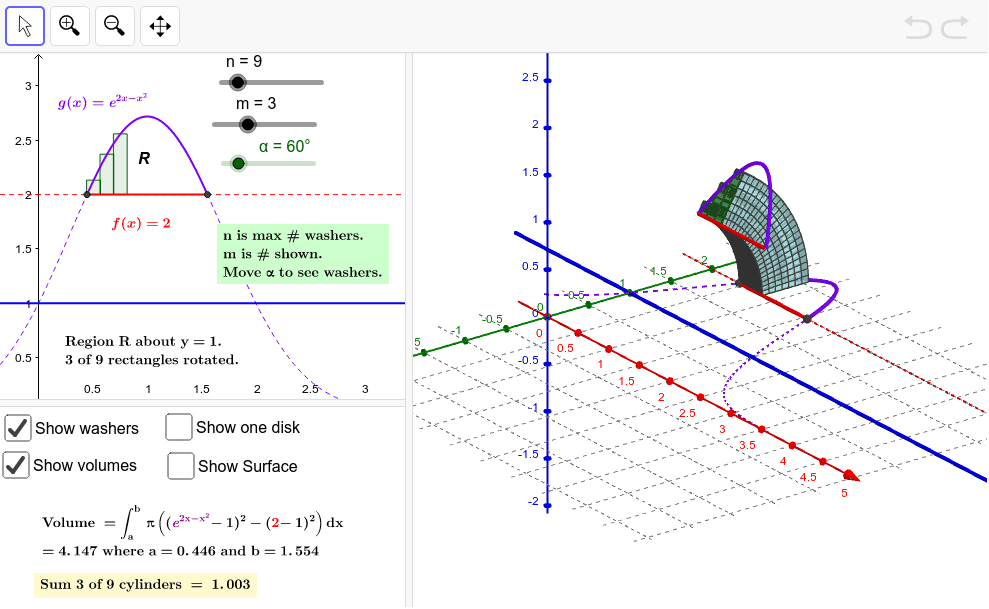
This example demonstrates the calculation of the volume of a solid of revolution using the washer method. It involves core mathematical concepts such as integration, function graphs, and volume calculation of rotated bodies. The construction utilizes GeoGebra commands like Intersect, Sequence, Sum, Polygon, Rotate, Integral, Surface, and RectangleSum. Suitable for high school and above mathematics education, illustrating the practical application of integration in volume calculations.
GeoGebra Commands & Parameters
Intersect(g, f, 0, 2) → A, BSequence(Cylinder[(a + (k * h), 1, 0), (a + ((k + 1) * h), 1, 0), 1 + f(a + ((k + p) * h))], k, 0, m - 1) → COSequence(Cylinder[(a + (k * h), 1, 0), (a + ((k + 1) * h), 1, 0), 1 + g(a + ((k + p) * h))], k, 0, m - 1) → CISequence(Polygon[(a + (k * h), f(a + ((k + p) * h))), (a + ((k + 1) * h), f(a + ((k + p) * h))), (a + ((k + 1) * h), g(a + ((k + p) * h))), (a + (k * h), g(a + ((k + p) * h)))], k, 0, m - 1) → RectanglesSequence(If[Defined[Volume[Element[CO, k]]], Volume[Element[CO, k]], 0], k, 1, m) → VCOSequence(If[Defined[Volume[Element[CI, k]]], Volume[Element[CI, k]], 0], k, 1, m) → VCISum(VCO - VCI) → VCPolygon((a + (DK * h), g(a + ((DK + p) * h))), (a + ((DK + 1) * h), g(a + ((DK + p) * h))), (a + ((DK + 1) * h), f(a + ((DK + p) * h))), (a + (DK * h), f(a + ((DK + p) * h)))) → Rectangle1, c, d, e, kRotate(Rectangle1, (-α), line) → Rectangle1'Integral((π * ((g(x) - 1)^(2) - (f(x) - 1)^(2))), a, b) → VolIntegRotate(f_1, (-α), line) → iRotate(g_1, (-α), line) → jRotate(Rectangles, (-α), line) → Rectangles'Surface(u, 1 + ((f(u) - 1) * cos(β)), ((f(u) - 1) * sin(β)), u, a, b, β, 0, (2 * π)) → InnerSurface(a + (DK * h), 1 + ((u - 1) * cos(β)), ((u - 1) * sin(β)), u, f(a + ((DK + p) * h)), g(a + ((DK + p) * h)), β, 0, α) → SideLeft1Surface(a + ((DK + 1) * h), 1 + ((u - 1) * cos(β)), ((u - 1) * sin(β)), u, f(a + ((DK + p) * h)), g(a + ((DK + p) * h)), β, 0, α) → SideRight1Surface(u, 1 + ((g(u) - 1) * cos(β)), ((g(u) - 1) * sin(β)), u, a, b, β, 0, (2 * π)) → OuterSurface(u, 1 + ((f(a + ((DK + p) * h)) - 1) * cos(β)), ((f(a + ((DK + p) * h)) - 1) * sin(β)), u, a + (DK * h), a + ((DK + 1) * h), β, 0, α) → Inner1Surface(u, 1 + ((g(a + ((DK + p) * h)) - 1) * cos(β)), ((g(a + ((DK + p) * h)) - 1) * sin(β)), u, a + (DK * h), a + ((DK + 1) * h), β, 0, α) → Outer1Sequence(Surface[u, 1 + ((g(a + ((k + p) * h)) - 1) * cos(β)), ((g(a + ((k + p) * h)) - 1) * sin(β)), u, a + (k * h), a + ((k + 1) * h), β, 0, α], k, 0, m - 1) → InnersSequence(Surface[u, 1 + ((f(a + ((k + p) * h)) - 1) * cos(β)), ((f(a + ((k + p) * h)) - 1) * sin(β)), u, a + (k * h), a + ((k + 1) * h), β, 0, α], k, 0, m - 1) → OutersSequence(Surface[a + (k * h), 1 + ((u - 1) * cos(β)), ((u - 1) * sin(β)), u, f(a + ((k + p) * h)), g(a + ((k + p) * h)), β, 0, α], k, 0, m - 1) → SidesLeftSequence(Surface[a + ((k + 1) * h), 1 + ((u - 1) * cos(β)), ((u - 1) * sin(β)), u, f(a + ((k + p) * h)), g(a + ((k + p) * h)), β, 0, α], k, 0, m - 1) → SidesRightRectangleSum((π * ((ℯ^((2 * x) - x^(2)) - 1)^(2) - 1)), a, a + (m * h), m, p) → VCyls
AI Drawing Prompt Reference
Create a 3D solid of revolution illustrating the washer method for volume calculation. Two function curves enclose a region that rotates around a horizontal axis, forming inner and outer surfaces with multiple thin cylindrical washers between them. The graphic includes: outer surface, inner surface, several semi-transparent washers, a highlighted rectangular cross-section and its rotated position, and an integral curve. Construction order: first draw the two function curves and mark their intersections, then generate a series of cylindrical washers, then show the rotated rectangle and surfaces, and finally display the volume integral formula. Use semi-transparency to reveal internal structure.
The prompt above was compiled from the original drawing commands and is for reference only.