
Volumes by Cross Sections
Loading the math board and drawing, please wait…
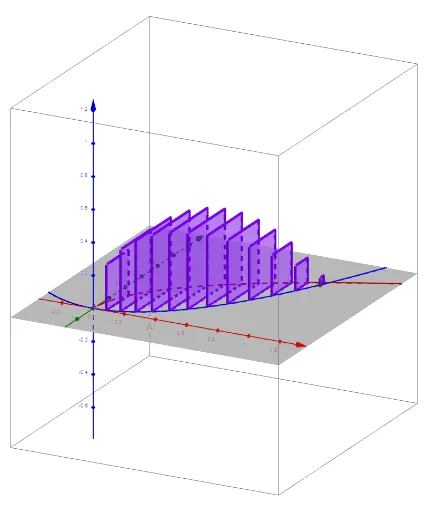
This example demonstrates the calculation of volume by stacking cross-sectional shapes. It involves core math concepts like volume computation, Pythagorean theorem, polygon properties, and relationships between functions and straight lines. Construction highlights include commands like Polygon and Sequence, with objects such as functions f, g, parameters X, n, points A, B, and lists list1, list3, list2. Suitable for high school mathematics, integrating integral concepts with solid geometry.
GeoGebra Commands & Parameters
Polygon((X, f(X), 0), (X, f(X), f(X) - g(X)), (X, g(X), f(X) - g(X)), (X, g(X), 0)) → poly1, a, b, c, dSequence(Polygon[(((k * X)) / n, f(((k * X)) / n), 0), (((k * X)) / n, f(((k * X)) / n), f(((k * X)) / n) - g(((k * X)) / n)), (((k * X)) / n, g(((k * X)) / n), f(((k * X)) / n) - g(((k * X)) / n)), (((k * X)) / n, g(((k * X)) / n), 0)], k, 1, n) → list1Sequence(CircumcircleArc[((k * X / n), f((k * X / n)), 0), ((k * X / n), (f((k * X / n)) + g((k * X / n))) / 2, (f((k * X / n)) - g((k * X / n))) / 2), ((k * X / n), g((k * X / n)), 0)], k, 1, n) → list3Sequence(Polygon[((k * X / n), f((k * X / n)), 0), ((k * X / n), (f((k * X / n)) + g(((k * X)) / n)) / 2, (sqrt(3) * (f((k * X / n)) - g((k * X / n))) / 2)), ((k * X / n), g((k * X / n)), 0)], k, 1, n) → list2
AI Drawing Prompt Reference
Draw a solid figure demonstrating volume calculation by stacking cross-sectional shapes. The figure includes two function curves and their intersection points, with rectangular and triangular cross-sections that change gradually from bottom to top, colored differently. Start by drawing the bottom rectangular cross-section, then use a sequence command to generate multiple cross-sections that gradually change from bottom to top, and finally fill the gaps with circular arcs and triangular cross-sections to show the accumulation of volume.
The prompt above was compiled from the original drawing commands and is for reference only.