
Volume Transformation Demo
Loading the math board and drawing, please wait…
In collections
Connolly Geometry Volume
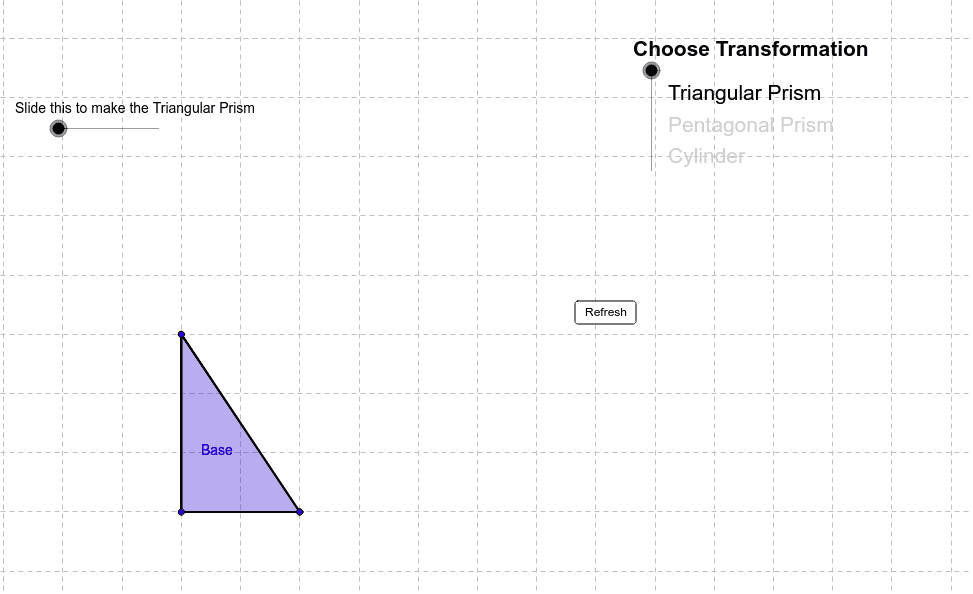
This example dynamically constructs geometric solids using sliders to visually demonstrate volume transformation. It involves core math concepts like volume, similarity transformation, arithmetic mean, definite integral, and Pythagorean theorem. Construction uses commands like Polygon, Dilate, Ray, Translate, Vector, Circle, Segment, Line, Intersect, OrthogonalLine, Semicircle, PointIn, and objects A, B, C, D, poly1, etc. Suitable for high school mathematics teaching to introduce volume and similarity transformation applications.
GeoGebra Commands & Parameters
Polygon(C, D, B) → poly1, b, c, dDilate(C, a, A) → C'_1Dilate(D, a, A) → D'_1Dilate(B, a, A) → B'_1Polygon(C'_1, D'_1, B'_1) → poly1'_1, b', c', d'Ray(A, C) → eRay(A, B) → fRay(A, D) → gTranslate(C, Vector[(horz, vert)]) → C'_2Translate(D, Vector[(horz, vert)]) → D'_2Translate(B, Vector[(horz, vert)]) → B'_2Polygon(C'_2, D'_2, B'_2) → poly1'_2, b'_1, c'_1, d'_1Vector(C, C'_2) → uVector(B, B'_2) → vVector(D, D'_2) → wPolygon(E, G, 5) → poly2, h, i, j, l, m, I, J, KCircle(L, M) → p_2Segment(N, O) → nVector(N, O) → zTranslate(p_2, z) → p'Line(M, L) → qIntersect(p_2, q, 2) → POrthogonalLine(P, q) → rOrthogonalLine(M, q) → sOrthogonalLine(L, q) → a_1Intersect(p', r, 1) → QIntersect(p', s, 1) → RLine(Q, R) → b_1Intersect(a_1, b_1) → SSegment(Q, P) → c_1Segment(R, M) → d_1Segment(Q, P) → e_1Segment(R, M) → f_1Polygon(Q, P, M, R) → poly3, q_1, p_1, m_1, r_1Semicircle(Q, R) → g_1Semicircle(M, P) → h_1Line(K, I) → pLine(G, E) → i_1Line(J, p) → j_1Vector(T, V) → u_1Translate(poly2, u_1) → poly2'PointIn(poly2') → UPointIn(poly2') → WPointIn(poly2') → ZPointIn(poly2') → A_1PointIn(poly2') → B_1Segment(B_1, K) → k_1Segment(U, E) → l_1Segment(W, G) → n_1Segment(Z, I) → s_1Segment(A_1, J) → t_1Segment(B_1, K) → a_2Segment(U, E) → b_2Segment(W, G) → c_2Segment(Z, I) → d_2Segment(U, W) → e_2Segment(W, Z) → f_2Segment(A_1, Z) → g_2Segment(A_1, B_1) → h_2Segment(B_1, U) → i_2Segment(K, J) → j_2Segment(J, I) → k_2Segment(I, G) → l_2Segment(E, G) → m_2Segment(K, E) → n_2Vector(C_1, D_1) → v_1Translate(C, v_1) → C'Translate(D, v_1) → D'Translate(B, v_1) → B'Polygon(C', D', B') → poly1', b'_2, c'_2, d'_2Segment(E_1, C') → q_2Segment(B', F_1) → r_2Segment(D', D) → s_2Segment(E_1, F_1) → a_3Segment(C', D') → c_3Segment(D', B') → d_3Segment(B', C') → e_3Segment(E_1, D) → t_2Segment(D, F_1) → b_3