
Volume of Spheres Copy (no proof window)
Loading the math board and drawing, please wait…
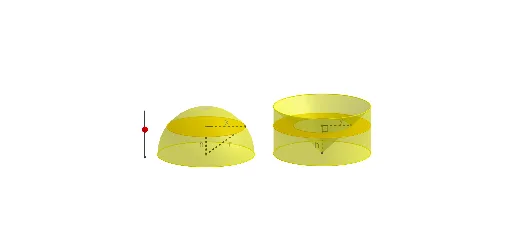
① This GeoGebra example demonstrates the volume of a sphere in relation to cylinders and cones through an interactive 3D visualization, allowing learners to intuitively grasp the derivation of the sphere volume formula. ② Core mathematical concepts include sphere volume, cylinder volume, cone volume, inscribed circles, polygonal approximation, solids of revolution, and volume optimization ideas from linear programming. ③ Construction highlights: using GeoGebra commands such as Circle, Point, Sphere, Cylinder, Cone, Segment, OrthogonalPlane, IntersectPath, Intersect, Rotate, Polygon, Sequence, Angle, and Surface, the model builds a sphere, cylinder, cone, and auxiliary cross-sections, with rotation and intersection paths to create multiple solids for dynamic exploration. ④ Suitable for upper secondary or early university students studying solid geometry and volume formulas, and useful for teachers as a classroom demonstration tool, especially for exploring the proportional relationships among sphere, cylinder, and cone volumes.
GeoGebra Commands & Parameters
Circle(A, 1) → cCircle(B, 1) → dPoint(c) → CSphere(A, C) → aCylinder(B, D, 1) → b, e, f, gCone(D, B, 1) → h, k, iSegment(E, E + (0, 0, 1)) → jPoint(j) → FOrthogonalPlane(F, j) → lIntersectPath(l, a) → pIntersectPath(l, h) → qIntersectPath(l, b) → rPoint(q) → HIntersect(Ray[G, H], r) → I,Rotate(H, α, G) → H'Rotate(I, α, G) → I'Polygon(H, H', I', I) → poly1, h_1, h', i', i_1Sequence(Rotate[poly1, (k * α), G], k, 0, n) → list1Intersect(Ray[J, J + (1, 0, 0)], p) → K,Segment(A, J) → sSegment(J, K) → tSegment(K, A) → a_1Intersect(Ray[G, G + (1, 0, 0)], q) → L, MSegment(B, G) → b_1Segment(G, L) → c_1Circle(s, C) → d_1Angle(A, J, K) → βAngle(B, G, L) → γCircle(B, 1, Segment[B, B + (0, 0, 1)]) → e_1Surface((sqrt(1 - h^(2)) * cos(θ)) + x(A), (sqrt(1 - h^(2)) * sin(θ)) + y(A), h, θ, 0, 6.28319, h, 0, 1) → o