
Volume of Solids of Revolution by Claudio
Loading the math board and drawing, please wait…
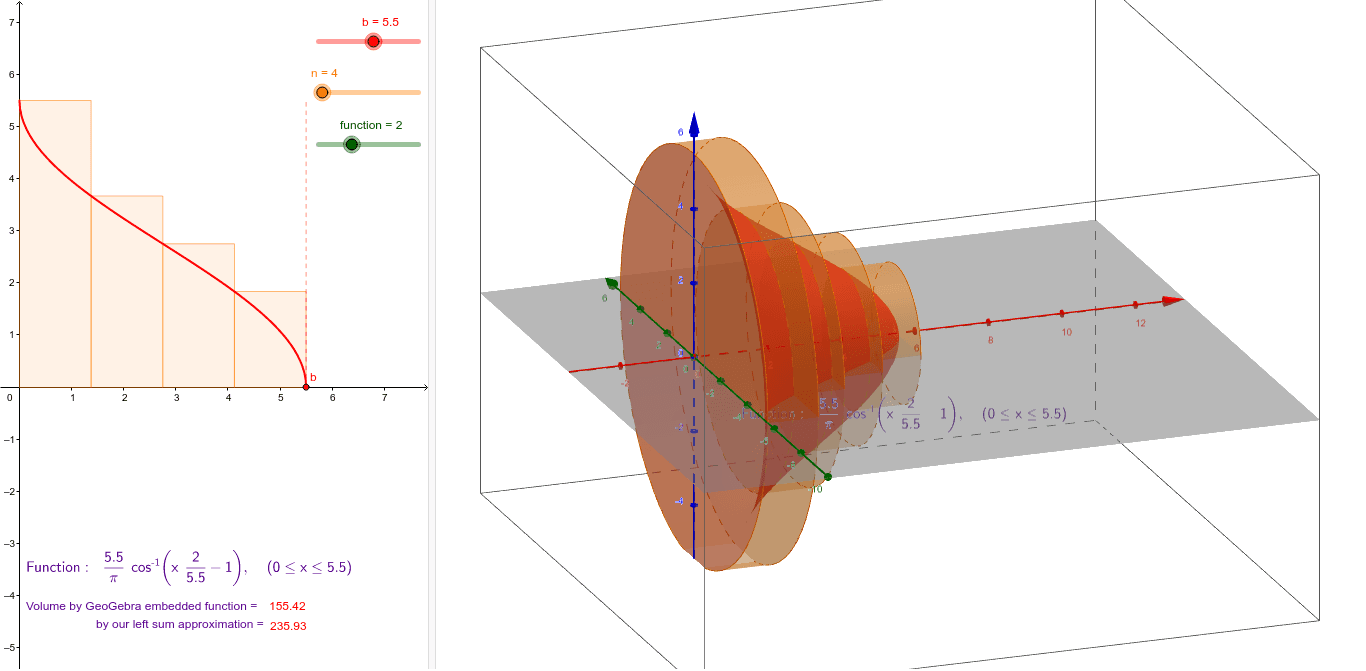
This example demonstrates the calculation of the volume of solids formed by revolving 2D shapes around an axis, utilizing integral calculus. It involves visualizing functions, generating sequences, and plotting surfaces. Key math concepts include rotation, integration, and geometric transformations. The construction uses GeoGebra commands like Element, Sequence, Surface, Integral, and LeftSum. Ideal for high school and college students learning calculus and geometry applications.
GeoGebra Commands & Parameters
Element(listaf, function) → fSequence((i / n * b), i, 0, n) → lista1Sequence(f(Element[lista1, i]), i, 1, n + 1) → lista2Sequence(Cylinder[(Element[lista1, i], 0, 0), (Element[lista1, i + 1], 0, 0), f(Element[lista1, i])], i, 1, n + 1) → lista3Surface(t, (f(t) * cos(r)), (f(t) * sin(r)), t, 0, b, r, 0, 6.283185307179586) → aSequence((Element[lista1, i], 0), i, 1, n + 1) → lista4Sequence((Element[lista1, i], Element[lista2, i]), i, 1, n) → lista5Sequence(Polygon[Element[lista4, i], Element[lista5, i], (Element[lista1, i + 1], Element[lista2, i]), Element[lista4, i + 1]], i, 1, n) → lista6Integral((π * f(x)^(2)), 0, b) → VolumeLeftSum((π * f(x)^(2)), 0, b, n) → LeftSumAppxSequence(((π * Element[lista2, i]^(2)) * b / n), i, 1, n) → lista7Sum(lista7) → gLine(A, B) → cSegment(A, B) → dIntersect(d, xAxis) → C