
Approximation of a solid of revolution by disks
Loading the math board and drawing, please wait…
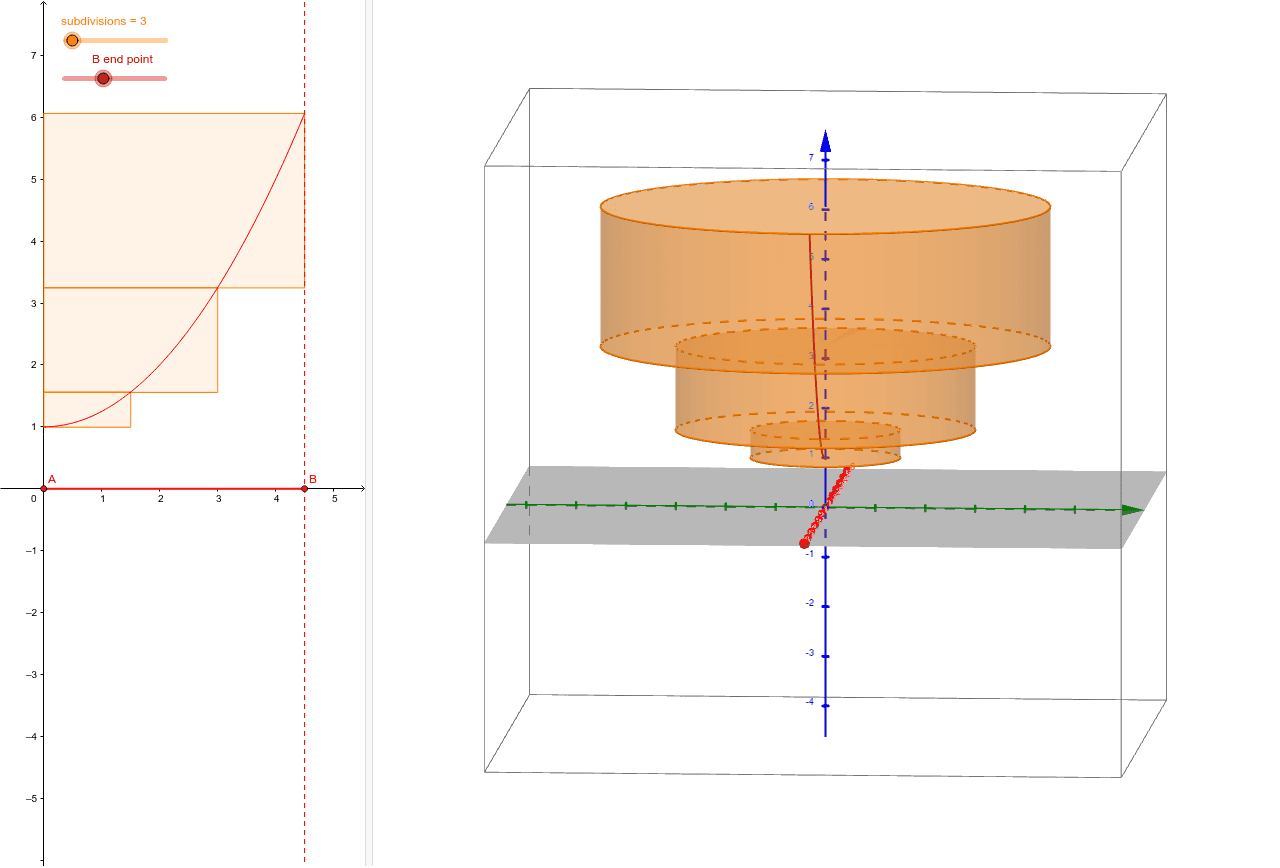
This example demonstrates how to approximate the volume of a solid of revolution using disks. The key mathematical concepts include integration, the disk formula, and volume calculation. Construction involves GeoGebra commands such as Sequence, CurveCartesian, Intersect, and Segment to create disks and the solid. Suitable for high school students or college freshmen learning calculus basics.
GeoGebra Commands & Parameters
Sequence((b_1 * i / subdivisions), i, 0, subdivisions) → lista1Sequence(f(Element[lista1, i]), i, 1, subdivisions + 1) → lista2CurveCartesian(t, 0, f(t), t, 0, b_1) → aSequence((0, Element[lista2, i]), i, 1, subdivisions + 1) → lista4Sequence(Cylinder[(0, 0, Element[lista2, i]), (0, 0, Element[lista2, i + 1]), Element[lista1, i + 1]], i, 1, subdivisions) → lista3Sequence(Polygon[Element[lista4, i], Element[lista4, i + 1], (Element[lista1, i + 1], Element[lista2, i + 1]), (Element[lista1, i + 1], Element[lista2, i])], i, 1, subdivisions + 1) → lista6Intersect(b, xAxis) → A_1Intersect(xAxis, yAxis) → ASegment(A, A_1) → c
AI Drawing Prompt Reference
Draw a diagram illustrating the approximation of a solid of revolution's volume using disks. Start by plotting a curve and the x-axis, then place evenly spaced points along the curve. Connect these points to the x-axis to form rectangles, rotate each rectangle to create a disk, and stack all disks to approximate the solid of revolution.
The prompt above was compiled from the original drawing commands and is for reference only.