
Volume of a Truncated Pyramid: Geometric Construction and Integral Demonstration
Loading the math board and drawing, please wait…
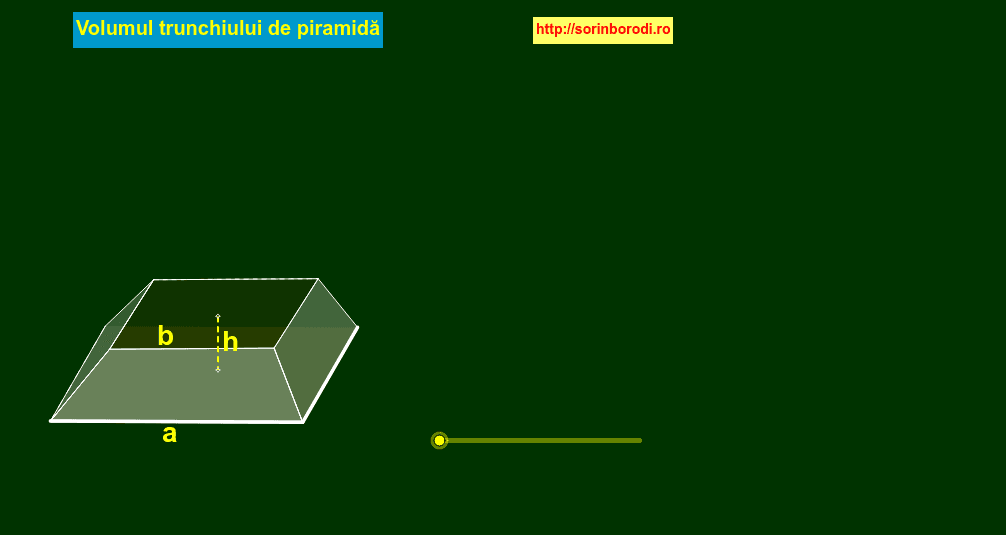
① This GeoGebra example demonstrates the construction of a truncated pyramid (frustum) and its volume, linking to the concept of definite integrals. ② Core mathematical concepts include the frustum volume formula, similar polygons, definite integral for volume, vectors, and 3D coordinates. ③ Construction highlights: using commands like Point, Segment, Line, Intersect, and Polygon to build the top and bottom base polygons and lateral edges; segments such as AA', BB' represent the height; faces poly1 to poly4 form the solid; possibly using integration or vector operations to compute volume. ④ Suitable for high school or early college students, this serves as a dynamic tool for teaching solid geometry, introductory calculus, and GeoGebra-based mathematical exploration, clarifying the relationship between frustum volume and integration.
GeoGebra Commands & Parameters
Point(Circle[A, AB]) → BSegment(A, B) → dPoint(Circle[A, BC]) → DSegment(A, D) → ePoint(Circle[A, AA']) → A'Segment(A, A') → fLine(B, e) → gLine(D, d) → h_3Intersect(g, h_3) → CLine(B, f) → iLine(A', i) → jLine(A', d) → kIntersect(i, k) → B'Line(B', g) → l_1Line(C, i) → mIntersect(l_1, m) → C'Line(A', l_1) → n_2Line(C', k) → pIntersect(n_2, p) → D'Polygon(A, B, C, D) → poly1, a_1, b_1, e_1, c_1Polygon(A', B', C', D') → poly2, d_1, f_1, g_1, h_1Polygon(B', B, C, C') → poly3, f_2, b_2, e_2, g_2Polygon(A', A, B, B') → poly4, d_2, a_2, b_3, f_3Polygon(D, C, C', D') → poly5, c_2, e_3, g_3, h_2Segment(B, D') → aSegment(D', B) → bPoint(Circle[A_1, AB_1]) → B_1Segment(A_1, B_1) → d_5Point(Circle[A_1, BC_1]) → D_1Segment(A_1, D_1) → e_7Point(Circle[A_1, AA'_1]) → A'_1Segment(A_1, A'_1) → f_7Line(B_1, e_7) → g_7Line(D_1, d_5) → h_6Intersect(g_7, h_6) → C_1Line(B_1, f_7) → i_1Line(A'_1, i_1) → j_1Line(A'_1, d_5) → k_1Intersect(i_1, k_1) → B'_1Line(B'_1, g_7) → l_2Line(C_1, i_1) → m_1Intersect(l_2, m_1) → C'_1Line(A'_1, l_2) → n_1Line(C'_1, k_1) → p_1Intersect(n_1, p_1) → D'_1Polygon(A_1, B_1, C_1, D_1) → poly1_1, a_3, b_4, e_6, c_3Polygon(A'_1, B'_1, C'_1, D'_1) → poly2_1, d_3, f_4, g_4, h_4Polygon(B'_1, B_1, C_1, C'_1) → poly3_1, f_5, b_5, e_4, g_5Polygon(A'_1, A_1, B_1, B'_1) → poly4_1, d_4, a_4, b_6, f_6Polygon(D_1, C_1, C'_1, D'_1) → poly5_1, c_4, e_5, g_6, h_5Segment(B_1, D'_1) → a_5Segment(D'_1, B_1) → b_7Polygon(A_1, A, B, B_1) → poly6, a_6, a_7, b_8, b_9Polygon(C_1, C, B, B_1) → poly7, c_5, c, b_{10}, b_{11}Polygon(A, A_1, D_1, D) → poly8, a_8, a_9, d_6, d_7Polygon(D_1, C_1, B_1, A_1) → poly9, d_8, c_6, b_{12}, a_{10}Polygon(A_1, D_1, D'_1, A'_1) → poly10, a_{11}, d_9, d'_1, a'_1Polygon(A'_1, A', A, A_1) → poly11, a'_2, a', a_{12}, a_{13}Polygon(A'_1, D'_1, D', A') → poly12, a'_3, d'_2, d', a'_4Polygon(B'_1, B', B, B_1) → poly13, b'_1, b', b_{13}, b_{14}Polygon(C'_1, C', B', B'_1) → poly14, c'_1, c', b'_2, b'_3Polygon(A', A'_1, B'_1, B') → poly15, a'_5, a'_6, b'_4, b'_5Polygon(D'_1, C'_1, C', D') → poly16, d'_3, c'_2, c'_3, d'_4Segment(E, F) → hSegment(G, H) → lSegment(G, E) → q
AI Drawing Prompt Reference
Draw a truncated pyramid (frustum) to illustrate its volume calculation and the concept of definite integrals. Start by constructing two parallel polygons as the top and bottom bases, then connect corresponding vertices to form the lateral faces. Label the height of the frustum and color-code the top base, bottom base, and four lateral faces. Next, draw an inscribed smaller frustum within the larger one, also labeling its height. The diagram should visually demonstrate the relationship between the volumes of the two frustums and hint at the role of definite integrals in volume calculation.
The prompt above was compiled from the original drawing commands and is for reference only.