
Volume of a Cuboid – GeoGebra Construction and Exploration
Loading the math board and drawing, please wait…
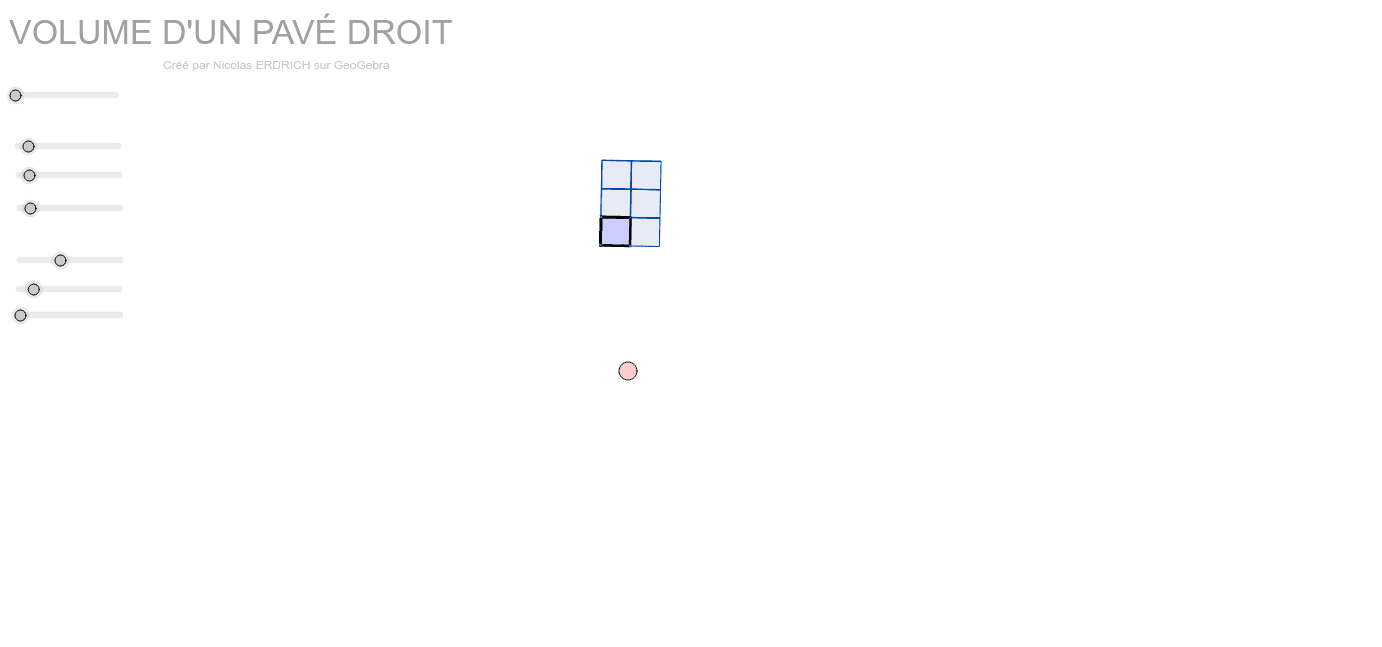
This example shows how to compute the volume of a cuboid using GeoGebra. By setting parameters for length, width, and height, and employing vector and matrix transformations, a three‑dimensional cube model is constructed step by step. The key mathematical ideas include the volume formula V = a·b·c, vector operations, matrix representation, and trigonometric parametrization. The construction uses GeoGebra commands such as Sequence, Element, Point, Polygon, and Segment, together with objects like rotation matrices R_x and R_y (α, β), enabling dynamic adjustment of edge lengths for interactive exploration. It is suitable for high‑school or first‑year university courses in geometry and linear algebra.
GeoGebra Commands & Parameters
Sequence((Mat * Element[cube, k]), k, 1, 8) → cube'Element(Element[AE, 3], 1) → droiteSequence((Element[cube', k, 1, 1], Element[cube', k, 2, 1]), k, 1, 8) → listepointsPoint(listepoints) → APoint(listepoints) → EPoint(listepoints) → C_1Point(listepoints) → DPolygon(A, E, C_1, D) → poly1, a_1, b, c_1, dPoint(listepoints) → BPoint(listepoints) → FPoint(listepoints) → GPoint(listepoints) → HPolygon(B, F, G, H) → poly2, e, f, g, hPoint(listepoints) → CPolygon(F, C, A, B) → poly3, f_1, i, a_2, b_1Element(AB, 3, 1) → avantPolygon(C_1, G, H, E) → poly4, c_2, g_1, h_1, e_1Element(AC, 3, 1) → dessusPolygon(F, C, C_1, G) → poly5, f_2, c_3, c_4, g_2Polygon(A, B, H, E) → poly6, a_3, b_2, h_2, e_2Segment(E, A) → cSegment(A, C) → jSegment(A, B) → kSegment(C, C_1) → lSegment(C_1, E) → mSegment(H, E) → nSegment(A, B) → pSegment(B, H) → qSegment(H, E) → rSegment(H, G) → sSegment(B, F) → tSegment(G, C_1) → d_1Segment(F, G) → i_1Segment(F, C) → j_1Sequence(Sequence[Sequence[Polygon[Translate[A, Vector[(k * Vector[A, E]) + (l * Vector[A, B]) + (i * Vector[A, D])]], Translate[E, Vector[(k * Vector[A, E]) + (l * Vector[A, B]) + (i * Vector[A, D])]], Translate[C_1, Vector[(k * Vector[A, E]) + (l * Vector[A, B]) + (i * Vector[A, D])]], Translate[D, Vector[(k * Vector[A, E]) + (l * Vector[A, B]) + (i * Vector[A, D])]]], k, 0, u], l, 0, k_1], i, 0, l_1) → liste1Sequence(Sequence[Sequence[Polygon[Translate[B, Vector[(k * Vector[A, E]) + (l * Vector[A, B]) + (i * Vector[A, D])]], Translate[F, Vector[(k * Vector[A, E]) + (l * Vector[A, B]) + (i * Vector[A, D])]], Translate[G, Vector[(k * Vector[A, E]) + (l * Vector[A, B]) + (i * Vector[A, D])]], Translate[H, Vector[(k * Vector[A, E]) + (l * Vector[A, B]) + (i * Vector[A, D])]]], k, 0, u], l, 0, k_1], i, 0, l_1) → liste2Sequence(Sequence[Sequence[Polygon[Translate[F, Vector[(k * Vector[A, E]) + (l * Vector[A, B]) + (i * Vector[A, D])]], Translate[C, Vector[(k * Vector[A, E]) + (l * Vector[A, B]) + (i * Vector[A, D])]], Translate[A, Vector[(k * Vector[A, E]) + (l * Vector[A, B]) + (i * Vector[A, D])]], Translate[B, Vector[(k * Vector[A, E]) + (l * Vector[A, B]) + (i * Vector[A, D])]]], k, 0, u], l, 0, k_1], i, 0, l_1) → liste3Sequence(Sequence[Sequence[Polygon[Translate[C_1, Vector[(k * Vector[A, E]) + (l * Vector[A, B]) + (i * Vector[A, D])]], Translate[G, Vector[(k * Vector[A, E]) + (l * Vector[A, B]) + (i * Vector[A, D])]], Translate[H, Vector[(k * Vector[A, E]) + (l * Vector[A, B]) + (i * Vector[A, D])]], Translate[E, Vector[(k * Vector[A, E]) + (l * Vector[A, B]) + (i * Vector[A, D])]]], k, 0, u], l, 0, k_1], i, 0, l_1) → liste4Sequence(Sequence[Sequence[Polygon[Translate[F, Vector[(k * Vector[A, E]) + (l * Vector[A, B]) + (i * Vector[A, D])]], Translate[C, Vector[(k * Vector[A, E]) + (l * Vector[A, B]) + (i * Vector[A, D])]], Translate[C_1, Vector[(k * Vector[A, E]) + (l * Vector[A, B]) + (i * Vector[A, D])]], Translate[G, Vector[(k * Vector[A, E]) + (l * Vector[A, B]) + (i * Vector[A, D])]]], k, 0, u], l, 0, k_1], i, 0, l_1) → liste5Sequence(Sequence[Sequence[Polygon[Translate[A, Vector[(k * Vector[A, E]) + (l * Vector[A, B]) + (i * Vector[A, D])]], Translate[B, Vector[(k * Vector[A, E]) + (l * Vector[A, B]) + (i * Vector[A, D])]], Translate[H, Vector[(k * Vector[A, E]) + (l * Vector[A, B]) + (i * Vector[A, D])]], Translate[E, Vector[(k * Vector[A, E]) + (l * Vector[A, B]) + (i * Vector[A, D])]]], k, 0, u], l, 0, k_1], i, 0, l_1) → liste6
AI Drawing Prompt Reference
Draw a cuboid with adjustable length, width, and height. First, define its eight vertices, with four forming the bottom face and four the top face, and connect corresponding vertices to create vertical edges. Use six quadrilateral faces to enclose the solid. Then, replicate these faces by translating them along the three edge directions in integer multiples, creating a grid-like stack of cuboids to illustrate volume subdivision. The whole figure should have a 3D perspective and be rotatable for viewing.
The prompt above was compiled from the original drawing commands and is for reference only.