
Volume Experiment: Prism Translation and Rotation
Loading the math board and drawing, please wait…
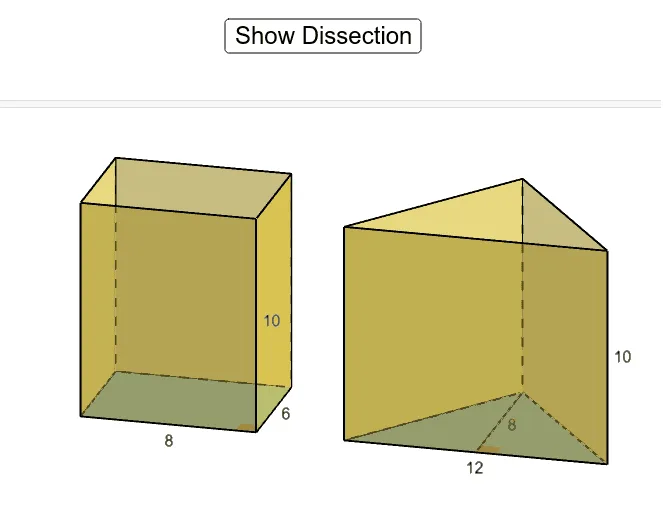
This GeoGebra example demonstrates a volume experiment on a prism under translation and rotation transformations. It visualizes how the volume of a 3D prism remains invariant when the base polygon is translated or rotated in space. Core mathematical concepts include solid geometry (prism volume), rigid transformations (translation and rotation), trigonometric functions for rotation angles, and reflections/tangent lines as auxiliary geometric relations. Construction details: the base polygon is created with the Polygon command, vertices are translated using Translate, the prism is generated with Prism, and edges/angles are marked with Segment and Angle commands. Key objects include faces (faceABB'H, faceACIH, faceCDJI, faceBB'JD, faceB'HIJ) and edges (edgeBB', edgeAH, edgeCI, edgeDJ, edgeB'H, edgeHI), along with auxiliary points A' through G' to support dynamic manipulation. Suitable for high school or early college students to explore volume invariance under transformations, and for teachers as an interactive demonstration tool in geometry classes.
GeoGebra Commands & Parameters
Polygon(E, M, G) → poly2, f, g, kPolygon(B, A, C, D) → poly1, b, a, c, dTranslate(A, v) → A'Translate(B, v) → B'Translate(C, v) → C'Translate(D, v) → D'Translate(E, v) → E'Translate(F, v) → F'Translate(G, v) → G'Prism(poly1, B') → h_1, H, edgeAH, edgeCI, edgeDJ, edgeB'H, edgeHI, edgeIJ, edgeB'J, I, J, faceABB'H, faceACIH, faceCDJI, faceBB'JD, faceB'HIJ, edgeBB'Prism(poly2, E') → i, K, edgeE'K, edgeKL, edgeE'L, L, faceEE'KF, faceFGLK, faceEE'LG, faceE'KL, edgeEE', edgeFK, edgeGL_1Segment(M, G) → jAngle(F, M, G) → αPolygon(G, M, F) → poly3, f_1, g_1, mPrism(poly3, L) → e, N, edgeLN, edgeNO, edgeLO, O, faceGLNM, faceFMNO, faceFGLO, faceLNO, edgeGL, edgeMN, edgeFOSegment(D, A) → lSegment(J, H) → nAngle(A, B, D) → βAngle(E, M, G) → γAngle(D, C, A) → δSegment(E, F) → p