
Volume and Polyhedron Construction in GeoGebra: Vectors, Polygons, and Sequences
Loading the math board and drawing, please wait…
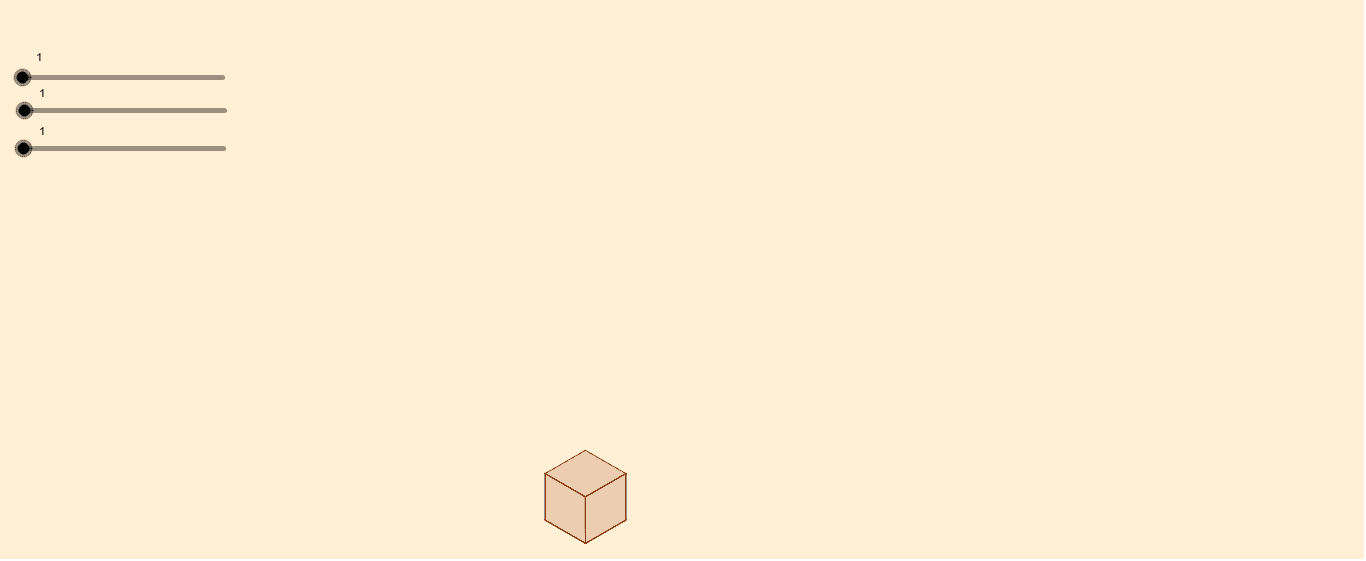
This GeoGebra example demonstrates a volume- and surface-related geometric construction, using points, segments, lines, polygons, vectors, and translations to build an interactive spatial figure, with sequences generating repeated objects. Core concepts include solid geometry, vectors, polygons, coordinate geometry, and geometric transformations. Construction highlights: Intersect finds intersection points; Vector, Segment, Line, and Point create basic elements; Polygon generates objects such as çokgen1, çokgen2, and çokgen3; Translate applies translations; Sequence organizes repeated structures. It is suitable for high-school or university lessons on volume, surface, vectors, and polyhedra, and as a GeoGebra geometric construction and dynamic modeling example.
GeoGebra Commands & Parameters
Intersect(xAxis, yAxis) → HVector(H, I) → uSegment(D, C) → bSegment(C, F) → fSegment(D, G) → gSegment(G, F) → hSegment(F, E) → iLine(E, F) → jLine(H, j) → k_1Segment(E, B) → aSegment(B, C) → cPoint(yAxis) → AVector(H, A) → vVector(H, J) → wPolygon(B, C, F, E) → çokgen1, b_1, c_1, f_1, e_1Polygon(C, D, G, F) → çokgen2, c_2, d_1, g_1, f_2Polygon(B, K, D, C) → çokgen3, b_2, k_2, d, c_3Translate(B, u) → B'Translate(K, u) → K'Translate(D, u) → D'Translate(C, u) → C'Intersect(j, f) → LIntersect(g, h) → MLine(L, M) → qTranslate(B, w) → B'_1Translate(K, w) → K'_1Translate(D, w) → D'_1Translate(C, w) → C'_1Translate(B', w) → B''Translate(K', w) → K''Translate(D', w) → D''Translate(C', w) → C''Translate(B'', w) → B'''Translate(K'', w) → K'''Translate(D'', w) → D'''Translate(C'', w) → C'''Translate(B''', w) → NTranslate(K''', w) → OTranslate(D''', w) → PTranslate(C''', w) → QTranslate(N, w) → N'Translate(O, w) → O'Translate(P, w) → P'Translate(Q, w) → Q'Translate(B'', w) → B'''_1Translate(K'', w) → K'''_1Translate(D'', w) → D'''_1Translate(C'', w) → C'''_1Translate(B'''_1, w) → RTranslate(K'''_1, w) → STranslate(D'''_1, w) → TTranslate(C'''_1, w) → UTranslate(R, w) → R'Translate(S, w) → S'Translate(T, w) → T'Translate(U, w) → U'Intersect(j, q) → VIntersect(b, f) → WIntersect(b_2, k_2) → Z_1Intersect(b_2, k_2) → K_1Translate(C, w) → C'_2Translate(D, w) → D'_2Translate(G, w) → G'Translate(F, w) → F'Sequence(Polygon[Translate[B, Vector[i * u]], Translate[K, Vector[i * u]], Translate[D, Vector[i * u]], Translate[C, Vector[i * u]]], i, 1, k - 1) → liste3Sequence(Translate[Element[liste1, 1], Vector[i * u]], i, 1, k - 1) → liste4Sequence(Polygon[Translate[B, Vector[i * u]], Translate[C, Vector[i * u]], Translate[F, Vector[i * u]], Translate[E, Vector[i * u]]], i, 1, k - 1) → liste5Sequence(Segment[Translate[F, Vector[u * i]], Translate[E, Vector[u * i]]], i, 0, k - 1) → liste10Sequence(Translate[liste10, Vector[v * i]], i, 1, o - 1) → liste11Sequence(Segment[Translate[G, Vector[w * i]], Translate[F, Vector[w * i]]], i, 0, m - 1) → liste12Sequence(Translate[liste12, Vector[v * i]], i, 1, o - 1) → liste13