
Viviani's Theorem
Loading the math board and drawing, please wait…
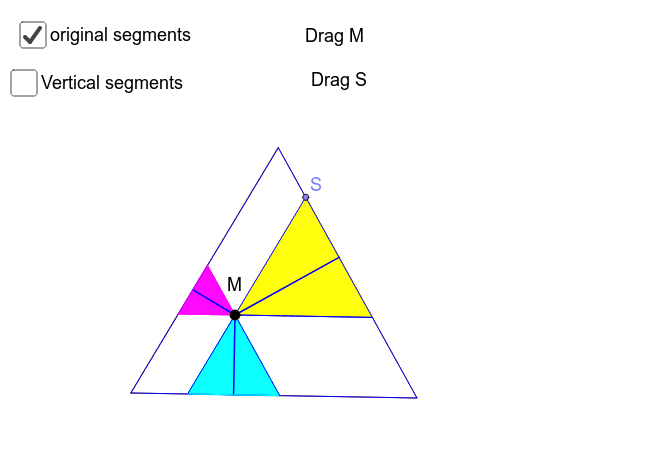
This example visually demonstrates Viviani's theorem: the sum of the distances from any point inside an equilateral triangle to its sides is equal to the triangle's height. Key mathematical concepts include the properties of an equilateral triangle and distance. GeoGebra commands used include Polygon, PointIn, OrthogonalLine, Intersect, Segment, Angle, Rotate, Ray, Line, Point, Vector, Translate. Suitable for middle school and above students for geometric construction and theorem proof.
GeoGebra Commands & Parameters
Polygon(B, C, 3) → poly1, a, b, c, APointIn(poly1) → MOrthogonalLine(M, b) → dOrthogonalLine(M, a) → eOrthogonalLine(M, c) → fIntersect(d, b) → PIntersect(e, a) → NIntersect(f, c) → QSegment(M, P) → gSegment(M, Q) → hSegment(M, N) → iSegment(A, Q) → jSegment(B, N) → kSegment(C, P) → lAngle(M, Q, A) → αAngle(M, P, C) → βAngle(M, N, B) → γSegment(A, M) → pSegment(B, M) → qSegment(M, C) → rRotate(P, 30*°, M) → P'Angle(P, M, P') → δRay(M, P') → sIntersect(b, s) → DIntersect(i, poly1) → EPolygon(D, M, 3) → poly2, t, a_1, b_1, FSegment(M, F) → c_1Segment(M, D) → d_1OrthogonalLine(D, a_1) → e_1Intersect(a_1, c_1) → GIntersect(a_1, c_1) → HIntersect(e_1, a_1) → ISegment(D, I) → f_1Rotate(N, 30*°, M) → N'Angle(N, M, N') → εRay(M, N') → g_1Intersect(a, g_1) → JPolygon(J, M, 3) → poly3, h_1, i_1, j_1, KLine(M, a) → k_1Intersect(c, k_1) → LPolygon(L, M, 3) → poly4, l_1, m_1, n_1, OOrthogonalLine(O, k_1) → p_1Intersect(k_1, p_1) → RSegment(O, R) → q_1Segment(M, K) → r_1Segment(M, J) → s_1Segment(D, A) → t_1Point(t_1) → SVector(D, S) → uTranslate(poly2, u) → poly2'Translate(D, u) → D'Translate(I, u) → I'Segment(D', I') → a_2Translate(M, u) → M'Translate(F, u) → F'Segment(M', F') → b_2
AI Drawing Prompt Reference
Draw an equilateral triangle ABC, then select an arbitrary point M inside the triangle. Drop perpendiculars from M to each side, marking the feet of the perpendiculars as P, N, and Q. Rotate P around M by 30 degrees to get P', and extend MP' to intersect BC at D, forming an equilateral triangle MDP'. Similarly, rotate N around M by 30 degrees to get N', and extend MN' to intersect AC at J, forming an equilateral triangle MJN'. Finally, rotate D around A by 30 degrees to get A', and extend MA' to intersect BC at L, forming an equilateral triangle MAL.
The prompt above was compiled from the original drawing commands and is for reference only.