
Visualizing Multiplication of Improper Fraction by Whole Number
Loading the math board and drawing, please wait…
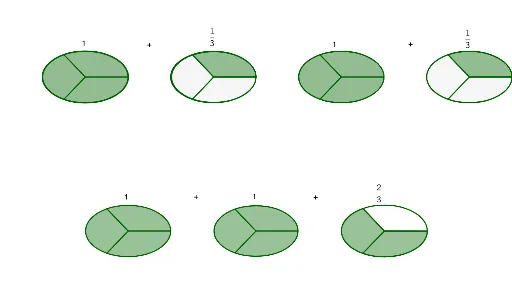
① This example dynamically demonstrates the multiplication of an improper fraction (greater than 1) by a whole number, using grouped sectors and circles to represent the product. ② The core mathematical concept is fraction multiplication, specifically improper fraction times whole number, involving the meaning of fractions, equal grouping, and representation of results. ③ Construction highlights: uses GeoGebra commands such as Sequence, Sort, First, Flatten to generate sequences and groups; Circle, Sector, Segment to draw circular sectors; Textfield, Text, InputBox, and button for interactive input; sliders to control step and opacity for dynamic visualization. ④ Suitable for upper elementary to middle school students to understand fraction multiplication, and for teachers to demonstrate in class or for students to explore independently.
GeoGebra Commands & Parameters
Sequence(Point[{(-1.5 * (dividend - 1)) + (3 * Mod[i, dWidth]), -3 - (3 * Div[i, dWidth])}], i, 0, (den * dividend) - 1) → destinationCentersSort(Sequence[(x(Element[Reverse[destinationCenters], i]), i), i, 1, Length[destinationCenters]]) → dc_hSequence(Element[Reverse[destinationCenters], y(Element[dc_h, i])], i, 1, Length[destinationCenters]) → dc_sFirst(destinationCenters, numberFinalGroups) → fgc2Flatten(Sequence[Sequence[Element[fgc2, i], j, 1, num], i, 1, Length[fgc2]]) → realFGCTextfield(dividendText) → InputBox1Textfield(numText) → InputBox2Textfield(denText) → InputBox3Sequence(Circle[Element[circleCenters, i], 0.5], i, 1, 4) → circlesSequence((Element[repeatedCenters, i] * (1 - wedgeMover)) + (Element[dc_s, i] * wedgeMover), i, 1, (den * dividend)) → movingCentersSequence(Sequence[Sector[Element[circles, i], (((2 * π)) / den * j), (((2 * π)) / den * (j + 1))], j, 1, den], i, 1, 4) → wedgesSequence(Circle[Element[movingCenters, i], 0.5], i, 1, 2) → movingCirclesSequence((Element[dc_s, i] * (1 - wedgemover2)) + (Element[realFGC, i] * wedgemover2), i, 1, (den * 2)) → secondMovingCentersSequence(Sector[Element[movingCircles, i], ((i * 2) * π / den), (((i + 1) * 2) * π / den)], i, 1, (den * dividend)) → movingWedgesSequence(Take[destinationCenters, i, i + num - 1], i, 1, (den * dividend), num) → finalGroupedCentersSequence(Circle[Element[secondMovingCenters, i], 0.5], i, 1, 2) → secondMovingCirclesText(floor((den * dividend / num))) → wholeNumberIf(floor((den * dividend / num)) ≟ (den * dividend / num), "", FractionText[(den * dividend / num) - floor((den * dividend / num))]) → fractionPoint({0, (top + bottom) / 2}) → centerSequence(Sector[Element[secondMovingCircles, i], (i * ((2 * π)) / den), ((i + 1) * ((2 * π)) / den)], i, 1, (den * dividend)) → movingWedges2Point(xAxis) → CPoint(xAxis) → DCircle(C, D) → dPoint(xAxis) → EPoint(xAxis) → GPoint(xAxis) → HCircle(G, H) → gPoint(xAxis) → IPoint(circles) → JCircle(I, J) → hSequence(Rotate[D, (360° * i / den), C], i, 1, den) → l1Sequence(Segment[C, Element[l1, i]], i, 1, den) → l2Sequence(Rotate[F, (360° * i / den), E], i, 1, den) → l3Sequence(Segment[E, Element[l3, i]], i, 1, den) → l4Circle(E, F) → eSector(e, F, Element[l3, 1]) → kSequence(Rotate[H, (360° * i / den), G], i, 1, den) → l5Sequence(Segment[G, Element[l5, i]], i, 1, den) → l6Sequence(Rotate[J, (360° * i / den), I], i, 1, den) → l7Sequence(Segment[I, Element[l7, i]], i, 1, den) → l8Sector(h, J, Element[l7, 1]) → pPoint(movingWedges2) → KCircle(L, M) → qSequence(Rotate[M, (360° * i / den), L], i, 1, den) → l9Sequence(Segment[L, Element[l9, i]], i, 1, den) → l10Sector(q, M, Element[l9, 2]) → rPoint(movingWedges2) → OPoint(yAxis) → PCircle(P, Q) → tSequence(Rotate[Q, (360° * i / den), P], i, 1, den) → l13Sequence(Segment[P, Element[l13, i]], i, 1, den) → l14Circle(N, R) → sSequence(Rotate[R, (360° * i / den), N], i, 1, den) → l11Sequence(Segment[N, Element[l11, i]], i, 1, den) → l12If(bruno > 0, 1, 0) → lalSegment(A, S) → f
AI Drawing Prompt Reference
Create a dynamic visualization showing the multiplication of an improper fraction (greater than 1) by a whole number using grouped sectors and circles to represent the product. Include sliders to control steps and opacity for dynamic effects. Begin by drawing multiple circles and sectors, then group the sectors based on the input improper fraction and whole number to illustrate the multiplication, and finally use moving circles and sectors to dynamically demonstrate the result.
The prompt above was compiled from the original drawing commands and is for reference only.