
Visualizing Integer Addition Commutativity - CUEBA0024
Loading the math board and drawing, please wait…
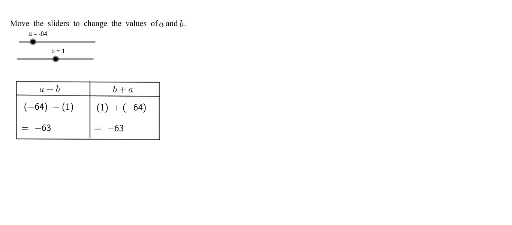
① This GeoGebra example dynamically demonstrates the commutative property of integer addition (a+b=b+a) by using segments and points on a number line to show that swapping the order of two integers does not change their sum. ② The core mathematical concept is integer addition and its commutativity, rooted in arithmetic and algebra, with connections to number line representation, segment lengths, and coordinate correspondence. ③ Construction highlights: based on the summary, the commands Segment and Point are used, creating points A through L and objects f, g, h, i, m, along with text objects text1 to text10 for labeling values and results; points M and N likely assist in positioning the addends, making the abstract operation visually concrete. ④ Suitable for upper elementary to early middle school students, this example helps learners grasp the intuitive meaning of the commutative law, and serves as a classroom demonstration or self-exploration tool to build number sense and foundational algebraic thinking.
GeoGebra Commands & Parameters
Segment(C, G) → fSegment(C, A) → gSegment(A, I) → hSegment(I, G) → iSegment(F, J) → mPoint(g) → MPoint(i) → NSegment(M, N) → j
AI Drawing Prompt Reference
Visualize the commutative property of integer addition on a number line using segments and points. Draw two segments representing the addends, find their sum, and mark key positions with points. Connect these points with segments to create a visual model, labeling values and results with text to demonstrate that swapping the order of the integers does not change the sum.
The prompt above was compiled from the original drawing commands and is for reference only.