
Visualizing Complex Roots of Quadratic Functions
Loading the math board and drawing, please wait…
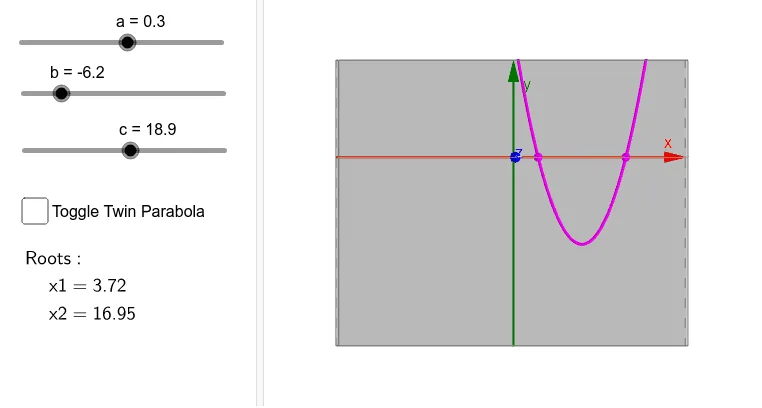
This example demonstrates how to find roots of quadratic equations in the complex number domain and visualize their distribution on the complex plane. Key mathematical concepts include the quadratic formula, geometric representation of complex numbers, and the relationship between roots and coefficients. Construction: Use the Root command to solve for complex roots, CurveCartesian to plot points on the complex plane, Solutions to obtain all equation solutions, and rp/ip to extract real and imaginary parts. Roots are color-coded to distinguish real roots from conjugate pairs. Suitable for high school advanced mathematics or pre-university students learning complex numbers and their geometric properties, particularly for understanding conjugate symmetry when discriminant Δ<0.
GeoGebra Commands & Parameters
Root(f) → A, BCurveCartesian(((-b)) / ((2 * a)), ((-a) * (t + b / ((2 * a)))^(2)) + f(((-b)) / ((2 * a))), t + b / ((2 * a)), t, -200, 200) → eSolutions(p = 0) → L_1
AI Drawing Prompt Reference
Draw a quadratic function and visualize its roots in the complex plane. First, plot the function's curve and mark any real roots. Then, represent all complex roots as points on the complex plane, using distinct colors for real roots versus conjugate pairs. Also, draw the parabola with its vertex, and show the symmetry of roots when the discriminant is negative. Finally, indicate all solutions of the equation on the complex plane with labeled axes.
The prompt above was compiled from the original drawing commands and is for reference only.