
Visualizing Commutativity of Vector Addition
Loading the math board and drawing, please wait…
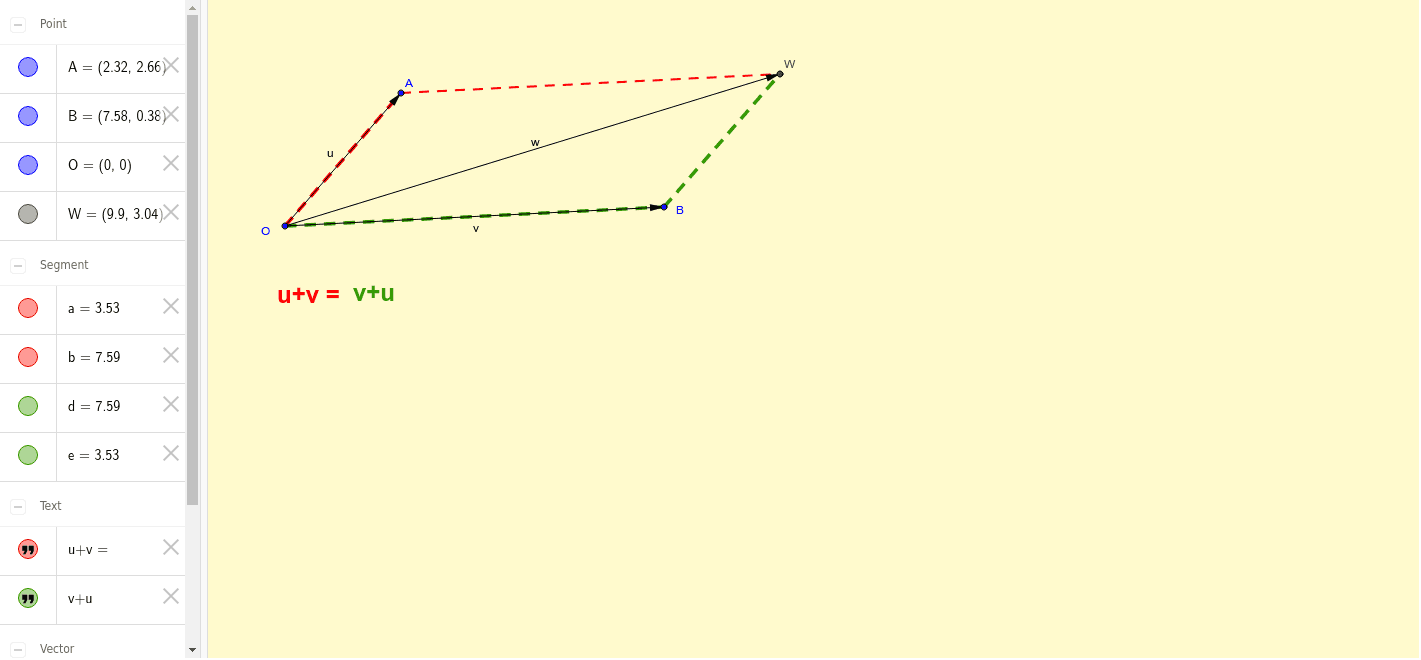
① This GeoGebra example dynamically demonstrates the commutative property of vector addition, showing that the resultant vector is identical regardless of the order in which two vectors are added. ② The core mathematical concept is vector addition and its commutativity, involving vector translation, the parallelogram or triangle rule, and the visual verification of vector equality. ③ Construction details: Based on the summary, the Vector command is used to create vectors u, v, w, and W, while the Segment command draws segments to form head-to-tail connections. Objects O, A, B serve as origins and endpoints, with auxiliary objects a, b, d, e and text labels text1, text2 used to annotate vectors and explanatory notes, clearly illustrating that u+v equals v+w (or similar combinations). ④ This resource is suitable for high school or early college students learning vector algebra, and serves as an interactive teaching tool for instructors or a self-exploration aid for students to grasp the link between algebraic properties and geometric intuition.
GeoGebra Commands & Parameters
Vector(O, A) → uVector(O, B) → vSegment(O, A) → aSegment(A, W) → bSegment(O, B) → dSegment(B, W) → e