
Visual Proof of the Sum of a Geometric Series
Loading the math board and drawing, please wait…
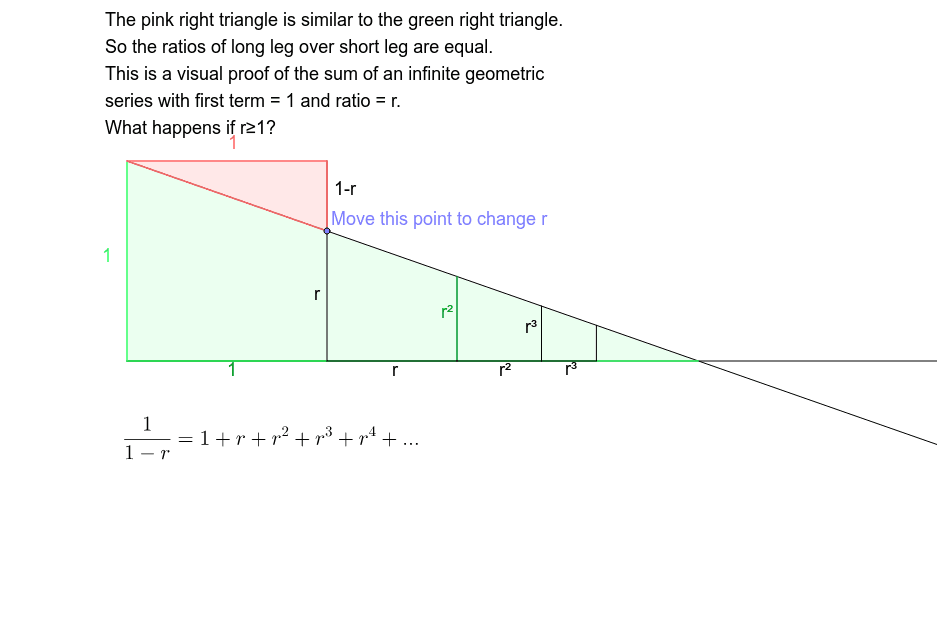
This GeoGebra example demonstrates the sum of an infinite geometric series through a visual proof using two similar right triangles. The core mathematical concepts involve similar triangles, proportions, and infinite series convergence. The construction uses commands such as Point, OrthogonalLine, Intersect, Circle, Ray, Polygon, Segment, Rotate, and Line to create a sequence of similar triangles. By translating and rotating these triangles, the example reveals that the total length or area corresponds to the series sum, providing an intuitive geometric interpretation of the algebraic formula. This resource is suitable for high school students learning about geometric series, as well as for college-level courses in calculus or geometry, offering a clear visual bridge between abstract series and concrete geometric relationships.
GeoGebra Commands & Parameters
Point(b) → AOrthogonalLine(A, b) → cIntersect(a, c) → BCircle(A, B) → dIntersect(d, b, 2) → COrthogonalLine(C, b) → eIntersect(a, e) → DPoint(e) → ERay(A, E) → fIntersect(a, f) → FPolygon(A, B, D, C) → poly1, a_1, b_1, d_1, c_1Ray(B, D) → gPolygon(A, F, B) → poly2, b_2, a_2, f_1Segment(D, E) → rRotate(E, 270*°, D) → E'OrthogonalLine(E', a_2) → hIntersect(h, f) → GSegment(G, E') → iSegment(D, E') → jRotate(G, 270*°, E') → G'Segment(E', G') → kOrthogonalLine(G', a_2) → lIntersect(l, f) → HSegment(H, G') → mRotate(l, 270*°, G') → l'Rotate(H, 270*°, G') → H'Rotate(G', 270*°, G') → G''Segment(H', G'') → m'Line(H', d_1) → nIntersect(n, f) → ISegment(I, H') → pSegment(C, E) → qPolygon(A, C, E) → poly3, e_1, a_3, c_2