
Visual Proof of Pythagorean Theorem
Loading the math board and drawing, please wait…
In collections
Geo&Alg:Area Volume Pythagorean Th.
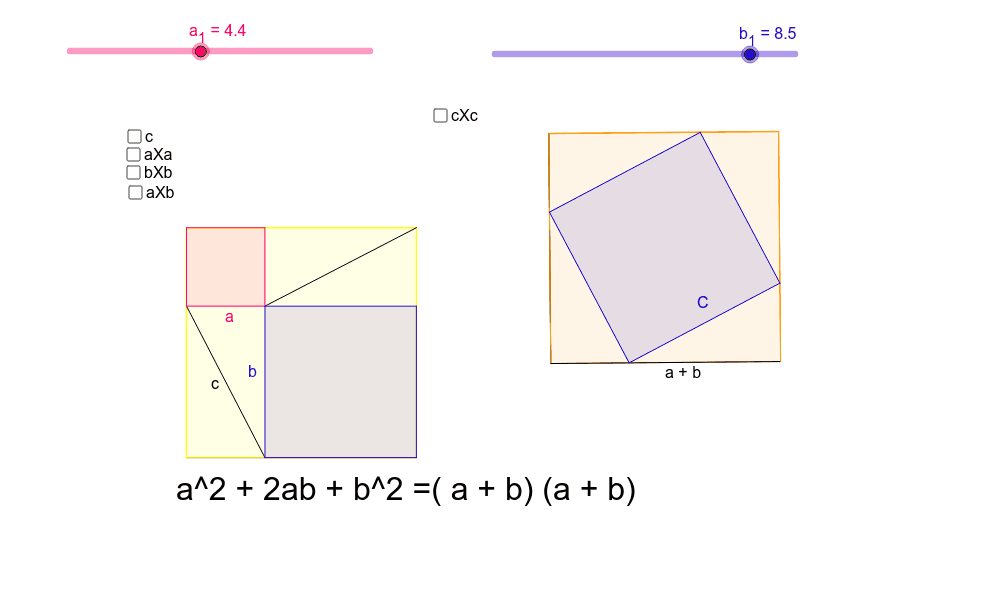
This example demonstrates the Pythagorean theorem through geometric figures, showing that the sum of the squares of the two legs of a right triangle equals the square of the hypotenuse. Key mathematical concepts include triangles, area, Pythagorean theorem, and geometric construction. The construction uses GeoGebra commands such as Point, Segment, Polygon, Circle, and Intersect to create the right triangle and verify the theorem. Suitable for middle or high school mathematics education to understand the geometric significance and practical application of the theorem.
GeoGebra Commands & Parameters
Point(Circle[A, a_1 + b_1]) → BSegment(A, B) → c_1Polygon(A, B, 4) → poly1, a_4, b_4, d, e, C_1, DCircle(D, a_1) → fCircle(B, b_1) → gIntersect(f, d) → E,Intersect(f, e) → F,Intersect(g, b_4) → G,Intersect(g, c_1) → H,OrthogonalLine(E, d) → hOrthogonalLine(F, e) → iIntersect(i, h) → ISegment(F, H) → cSegment(I, C_1) → kPolygon(D, F, I, E) → poly2, a_3, a, i_1, e_1Polygon(I, H, B, G) → poly3, b, h_1, b_2, g_1Point(Circle[J, a_1 + b_1]) → KSegment(J, K) → jPolygon(J, K, 4) → poly4, j_1, k_1, l, m, L, MCircle(J, a_1) → pCircle(L, a_1) → qCircle(J, b_1) → rCircle(L, b_1) → sIntersect(p, j) → N,Intersect(r, m) → O,Intersect(s, k_1) → P,Intersect(q, l) → Q,Polygon(N, O, Q, P) → poly5, n, o, C, p_1Text(aXa) → text1Text(bXb) → text2Text(aXb) → text3Text(cXc) → text4Text(c) → text5
AI Drawing Prompt Reference
Draw a right triangle and construct circles with diameters equal to the two legs, intersecting on the hypotenuse. Create squares on both the legs and the hypotenuse, showing that the sum of the areas of the two smaller squares equals the area of the larger square, proving the Pythagorean theorem. Label the areas of the squares for clarity.
The prompt above was compiled from the original drawing commands and is for reference only.