
Verify the Result: Check the Solution of a Linear Equation
Loading the math board and drawing, please wait…
In collections
Wiederholung: Variablen, Terme und Gleichungen
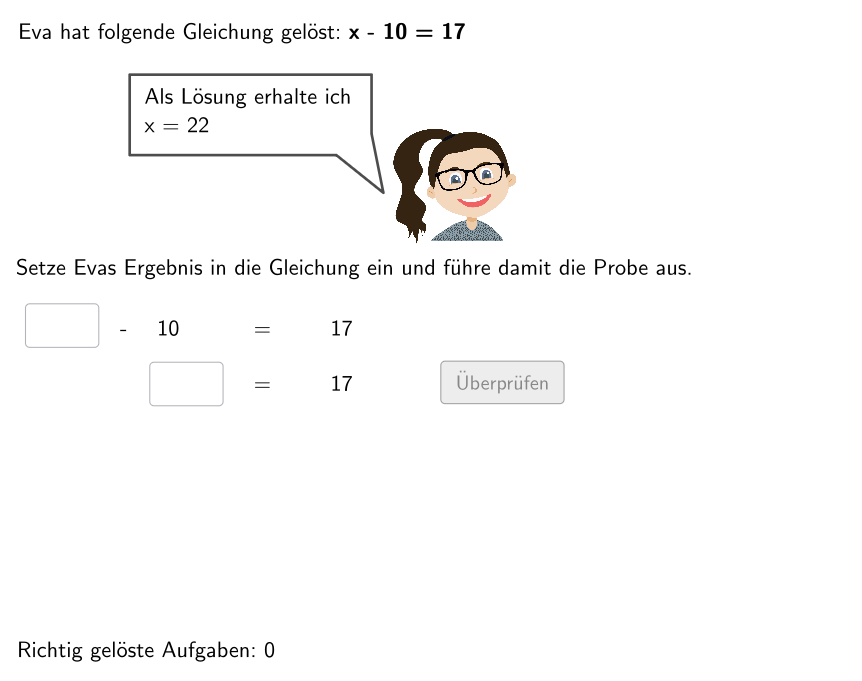
This example demonstrates how to verify the solution of a linear equation through trial. The core mathematical concept involved is solving linear equations. GeoGebra commands such as Textfield, Shuffle, Append, etc., are used to construct the equation. Suitable for 5-6 grade students for practice.
GeoGebra Commands & Parameters
Textfield(bInput) → InputBox2Shuffle(Sequence[Random[21, 40], i, 1, 100]) → randomNosFora, {34, 38, 24, 22, 32, 22, 26, 36, 26, 31, 24, 37, 29, 26, 31, 40, 37, 26, 34, 31, 21, 37, 37, 35, 40, 26, 26, 30, 34, 29, 40, 32, 22, 34, 26, 36, 28, 24, 38, 31, 33, 39, 31, 26, 33, 32, 22, 40, 33, 23, 26, 28, 24, 26, 39, 24, 22, 35, 30, 23, 27, 34, 22, 36, 37, 32, 34, 33, 40, 33, 38, 40, 31, 22, 25, 35, 26, 37, 28, 34, 26, 27, 28, 37, 22, 37, 32, 35, 40, 37, 30, 28, 33, 35, 23, 38, 27, 37, 39, 33}Append(true, Sequence[If[randomNosFora(i) ≟ randomNosFora(i - 1), false, true], i, 2, 100]) → stayaRemove(Sequence[If[staya(i), randomNosFora(i), 0], i, 1, 100], Sequence[0, i, 1, 100]) → randomNosForawithoutRepeatElement(randomNosForawithoutRepeat, Mod[questionCount, Length[randomNosForawithoutRepeat]] + 1) → numawithoutRepeatDivisorsList(numawithoutRepeat) → TeilerlistenumawithoutRepeatFactors(numawithoutRepeat) →RandomElement(TeilerlistenumawithoutRepeat) → randomTeilerShuffle(Sequence[RandomElement[{numawithoutRepeat, numawithoutRepeat + 1, numawithoutRepeat - 5, numawithoutRepeat / randomTeiler, numawithoutRepeat + 12, (numawithoutRepeat * 4)}], i, 1, 100]) → RandomSolution, {28, 28, 22, 39, 3, 108, 22, 108, 3, 28, 39, 39, 22, 27, 3, 28, 22, 22, 28, 39, 3, 108, 108, 22, 28, 39, 39, 22, 39, 3, 39, 108, 108, 27, 108, 108, 28, 108, 108, 27, 22, 27, 28, 39, 108, 27, 28, 108, 3, 39, 108, 27, 28, 3, 3, 22, 3, 22, 28, 27, 3, 39, 28, 22, 108, 27, 108, 27, 108, 22, 3, 108, 22, 108, 108, 39, 3, 39, 28, 28, 39, 3, 28, 3, 27, 27, 22, 108, 22, 108, 108, 108, 39, 27, 22, 3, 108, 22, 39, 108}Element(RandomSolution, Mod[questionCount, 100] + 1) → numSolShuffle(Sequence[Min[Random[1, 10], numSol], i, 1, 100]) → RandomNosFory, {1, 7, 7, 1, 6, 10, 1, 2, 7, 5, 2, 2, 2, 9, 3, 5, 1, 1, 3, 2, 9, 1, 7, 4, 5, 3, 5, 5, 7, 2, 10, 2, 9, 7, 7, 8, 4, 3, 10, 5, 10, 9, 2, 8, 2, 7, 9, 4, 2, 7, 6, 5, 1, 8, 10, 9, 5, 2, 6, 8, 2, 10, 1, 10, 9, 7, 5, 5, 3, 1, 9, 5, 5, 9, 6, 7, 9, 8, 1, 2, 1, 7, 6, 1, 1, 4, 9, 10, 10, 8, 8, 7, 9, 10, 6, 10, 10, 8, 5, 3}Append(true, Sequence[If[randomNosFora(i) ≟ randomNosFora(i - 1), false, true], i, 2, 100]) → stayyRemove(Sequence[If[stayy(i), RandomNosFory(i), 0], i, 1, 100], Sequence[0, i, 1, 100]) → RandomNosForywithoutRepeatShuffle(Join[{Sequence[i, i, 3, 10], Sequence[(10 * i), i, 1, 9]}]) → Faktor2List, {9, 3, 30, 4, 60, 8, 50, 90, 5, 40, 80, 10, 20, 6, 10, 70, 7}Element(RandomNosForywithoutRepeat, Mod[questionCount, Length[RandomNosForywithoutRepeat]] + 1) → numywithoutRepeatShuffle(Sequence[RandomElement[l1], i, 1, 100]) → l1zufi, {"a + 10", "a - 10", "a - 10", "a + 10", "a - 10", "10 \cdot a", "10 + a", "10 + a", "a \cdot 10", "a + 10", "10 \cdot a", "a - 10", "a + 10", "10 + a", "10 \cdot a", "10 + a", "10 \cdot a", "a \cdot 10", "10 + a", "10 + a", "a - 10", "10 + a", "10 + a", "10 + a", "a \cdot 10", "a - 10", "a - 10", "a - 10", "a - 10", "a + 10", "a \cdot 10", "a + 10", "a \cdot 10", "a \cdot 10", "10 \cdot a", "10 + a", "a + 10", "a + 10", "a + 10", "10 \cdot a", "a \cdot 10", "a - 10", "a + 10", "a \cdot 10", "a + 10", "10 + a", "a + 10", "a + 10", "10 \cdot a", "a + 10", "a \cdot 10", "10 \cdot a", "a + 10", "a - 10", "a + 10", "a - 10", "a - 10", "a - 10", "10 \cdot a", "10 + a", "a - 10", "10 \cdot a", "a \cdot 10", "a - 10", "10 \cdot a", "10 \cdot a", "a - 10", "10 + a", "a + 10", "10 + a", "a + 10", "10 \cdot a", "10 \cdot a", "10 \cdot a", "10 \cdot a", "10 \cdot a", "10 \cdot a", "a + 10", "a + 10", "a + 10", "a \cdot 10", "a - 10", "a \cdot 10", "a \cdot 10", "a \cdot 10", "a + 10", "a - 10", "a - 10", "a - 10", "a - 10", "10 \cdot a", "a \cdot 10", "a + 10", "10 + a", "a + 10", "a - 10", "10 + a", "a + 10", "a - 10", "a + 10"}Append(true, Sequence[If[l1zufi(i) ≟ l1zufi(i - 1), false, true], i, 2, 100]) → stayzufiRemove(Sequence[If[stayzufi(i), l1zufi(i), 0], i, 1, 100], Sequence[0, i, 1, 100]) → l1zufiwithoutRepeatSplit(Text2, {""}) → l2Shuffle(Sequence[i, i, 10, 50]) → Faktor1List, {44, 22, 17, 30, 19, 26, 48, 47, 35, 34, 42, 27, 29, 32, 43, 10, 40, 45, 50, 14, 12, 37, 49, 33, 21, 15, 18, 39, 46, 13, 11, 23, 36, 28, 20, 31, 38, 25, 41, 24, 16}Textfield(aInput) → InputBox1Element(randomNosFora, Mod[questionCount, 100] + 1) → numaElement(RandomNosFory, Mod[questionCount, 100] + 1) → numyElement(l1zufiwithoutRepeat, Mod[questionCount, 100] + 1) → numzufiPolygon(PtopLeftCornerFeedback, PtopRightCornerFeedback, PbottomRightCornerFeedback, PbottomLeftCornerFeedback) → rectangleCorrect, ptopleftcornerfeedback, ptoprightcornerfeedback, pbottomrightcornerfeedback, pbottomleftcornerfeedbackIf(numzufi ≟ F9, NumberSeparationComma[floor((E9 * 100)) / 100], numzufi ≟ F4, NumberSeparationComma[E4], numzufi ≟ F3, NumberSeparationComma[E3], numzufi ≟ F2, NumberSeparationComma[E2], numzufi ≟ F8, NumberSeparationComma[E8], numzufi ≟ F7, NumberSeparationComma[E7], numzufi ≟ F6, NumberSeparationComma[E6], numzufi ≟ F5, NumberSeparationComma[E5]) → Text12Shuffle(Sequence[RandomElement[{6, 12, 18, 24, 30, 36, 42, 48, 54, 60, 66}], i, 1, 100]) → randomNosForaDivision, {12, 42, 42, 36, 54, 30, 42, 30, 6, 42, 36, 42, 66, 48, 18, 12, 60, 48, 60, 36, 48, 66, 30, 18, 42, 42, 24, 66, 24, 6, 6, 66, 18, 60, 18, 66, 30, 42, 18, 42, 24, 36, 6, 18, 54, 6, 24, 36, 54, 24, 24, 18, 48, 42, 60, 60, 54, 42, 66, 48, 48, 12, 18, 12, 18, 60, 18, 18, 48, 24, 12, 18, 60, 42, 66, 36, 42, 66, 30, 24, 6, 66, 54, 66, 18, 66, 42, 36, 54, 48, 42, 48, 48, 60, 42, 6, 42, 12, 18, 42}SpeechBubbleRight((1, 6), 3.5, 1) → Vieleck1Polygon(PtopLeftCornerFeedback_{1}, PtopRightCornerFeedback_{1}, PbottomRightCornerFeedback_{1}, PbottomLeftCornerFeedback_{1}) → rectangleCorrect_{1}, ptopleftcornerfeedback_{1}, ptoprightcornerfeedback_{1}, pbottomrightcornerfeedback_{1}, pbottomleftcornerfeedback_{1}Polygon(PtopLeftCornerFeedback_{2}, PtopRightCornerFeedback_{2}, PbottomRightCornerFeedback_{2}, PbottomLeftCornerFeedback_{2}) → rectangleCorrect_{2}, ptopleftcornerfeedback_{2}, ptoprightcornerfeedback_{2}, pbottomrightcornerfeedback_{2}, pbottomleftcornerfeedback_{2}If(l2(1) ≟ "a", G, H) → PosPolygon(I, J, K, Left) → q1, i, j, k, mPolygon(DownL, DownR, UpR, UpL) → q2, n, p, q, rPolygon(L, M, N, Right) → q3, f, g, h, lIf(numzufi ≟ F9, E9, If[numzufi ≟ F8, E8, If[numzufi ≟ F7, E7, If[numzufi ≟ F6, E6, If[numzufi ≟ F5, E5, If[numzufi ≟ F4, E4, If[numzufi ≟ F3, E3, If[numzufi ≟ F2, E2]]]]]]]) → zahlIf(numzufi ≟ F9, 4, If[numzufi ≟ F8, 4, If[numzufi ≟ F7, 3, If[numzufi ≟ F6, 3, If[numzufi ≟ F5, 2, If[numzufi ≟ F4, 2, If[numzufi ≟ F3, 1, If[numzufi ≟ F2, 1]]]]]]]) → modus
AI Drawing Prompt Reference
Create a diagram to visually verify the solution of a linear equation in one variable. Draw a coordinate-plane style layout with a text input box for entering the variable a. Add a main quadrilateral rectangle defined by four corner points (top-left, top-right, bottom-right, bottom-left), and also place a second identical rectangle for another part of the verification. Fill the relevant areas with text labels and small callout bubbles showing the chosen coefficient numbers (selected from the provided set) and the idea of checking the equation by substitution. Indicate the two-part structure using the two rectangles and their corresponding labels.
The prompt above was compiled from the original drawing commands and is for reference only.