
Vedic Multiplication Trick Visualized with Geometry
Loading the math board and drawing, please wait…
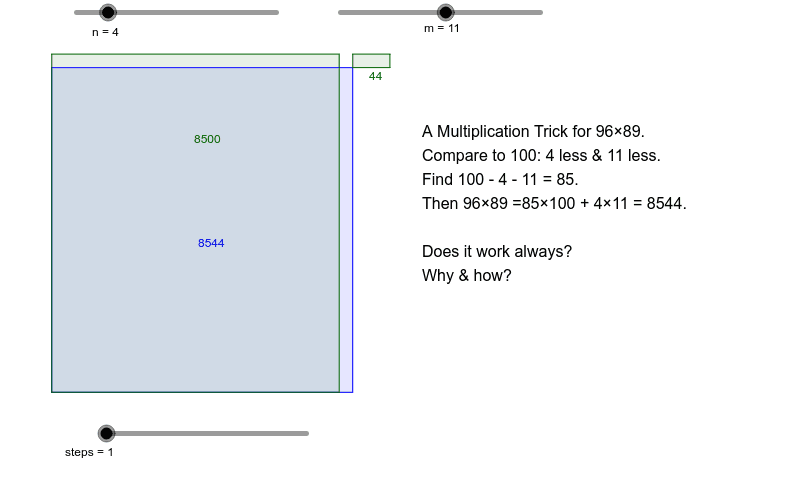
① This GeoGebra example visualizes an ancient Vedic multiplication trick, turning the vertical decomposition of two-digit multiplication into an intuitive geometric construction, revealing the elegant link between arithmetic operations and geometric shapes. ② Core mathematical concepts include the distributive property of multiplication, place-value decomposition, polygon areas and segment ratios, and the geometric representation of partial products. ③ Construction highlights: from the summary, numerous Polygon commands create multiple polygons (poly1 to poly8), with variables m, n and points a-l, p-t defined; polygon areas or side lengths correspond to partial products, while text objects (text1) and step objects (steps) guide the user through the calculation process, possibly with sliders for dynamic adjustment. ④ Suitable for upper elementary to middle school students, this example helps learners grasp multiplication principles and the idea of number-shape integration, and serves as a captivating classroom demonstration of Vedic math speed-calculation techniques, blending history, fun, and visual learning.
GeoGebra Commands & Parameters
Polygon((0, 0), (100 - m, 0), (100 - m, 100 - n), (0, 100 - n)) → poly2, a, b, c, dPolygon((0, 0), (100, 0), 4) → poly1Polygon((100, 100), (100 - m, 100), (100 - m, 100 - n), (100, 100 - n)) → poly3, e, f, g, hPolygon((0, 0), (100 - n - m, 0), (100 - n - m, 100), (0, 100)) → poly4, i, j, k, lPolygon((0, 0), (100, 0), (100, 100 - n - m), (0, 100 - n - m)) → poly5, p, q, r, sPolygon((100, 100), (100 - m, 100), (100 - m, 100 - n), (100, 100 - n)) → poly6, t, a_1, b_1, c_1Polygon((0, 0), (100 - m - n, 0), (100 - m - n, 100 - n), (0, 100 - n)) → poly7, d_1, e_1, f_1, g_1Polygon((100 - m, 0), (100 - m - n, 0), (100 - m - n, 100 - n), (100 - m, 100 - n)) → poly8, h_1, i_1, j_1, k_1Polygon((100 - m, 0), (100 - m - n, 0), (100 - m - n, 100 - m - n), (100 - m, 100 - m - n)) → poly9, l_1, m_1, n_1, p_1Polygon((100 - m, 100 - n), (100 - m - n, 100 - n), (100 - m - n, 100 - m - n), (100 - m, 100 - m - n)) → poly10, q_1, r_1, s_1, t_1Polygon((0, 100 - n), (100 - m - n, 100 - n), (100 - m - n, 100), (0, 100)) → poly11, a_2, b_2, c_2, d_2