
Vectors and curve derivatives: tangent and higher-order change from a Cartesian
Loading the math board and drawing, please wait…
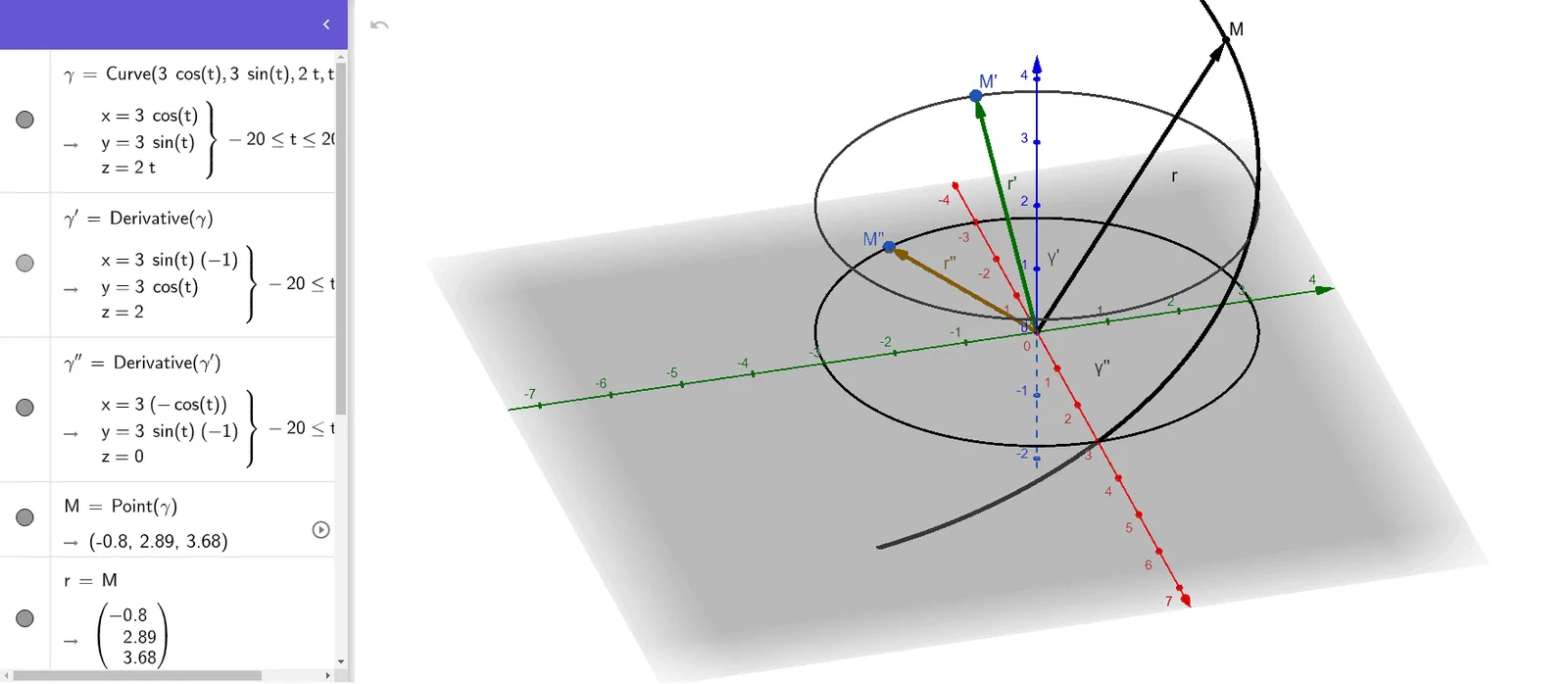
This example visualizes how vectors arise naturally from a Cartesian curve and its derivatives: by plotting the curve along with its first and second derivative objects, learners can see the geometric meaning of tangent direction and higher-order behavior. The key ideas are vector interpretation in geometry, the derivative as a directional/tangent quantity, and second derivatives as a measure linked to how the curve bends. Construction follows the GeoGebra command flow: CurveCartesian is used to define the curve γ, Derivative computes γ′ and γ″, and Point creates corresponding points such as M, M′, and M″. Vector-like objects (r, r′, r″) are then tied to these curve/derivative elements to emphasize how direction and variation evolve along the curve. Suitable for secondary advanced coursework and early university calculus/analytic geometry, especially when teaching the geometric meaning of derivatives.
GeoGebra Commands & Parameters
CurveCartesian((3 * cos(t)), (3 * sin(t)), (2 * t), t, -20, 20) → γDerivative(γ) → γ'Derivative(γ') → γ''Point(γ) → MPoint(γ') → M'Point(γ'') → M''
AI Drawing Prompt Reference
Draw a 3D spiral curve defined by parametric equations with parameter ranging from -20 to 20. Place a moving point on the curve. At this point, draw the tangent vector representing the first derivative, showing the direction of the curve. From the tip of this tangent vector, draw another vector for the second derivative, indicating how the curve bends. Use distinct colors or line styles for the curve, first derivative vector, and second derivative vector. As the point moves along the curve, these vectors update accordingly, illustrating the geometric meaning of derivatives.
The prompt above was compiled from the original drawing commands and is for reference only.