
Vector Subtraction Exploration
Loading the math board and drawing, please wait…
In collections
Complex Numbers as Vectors
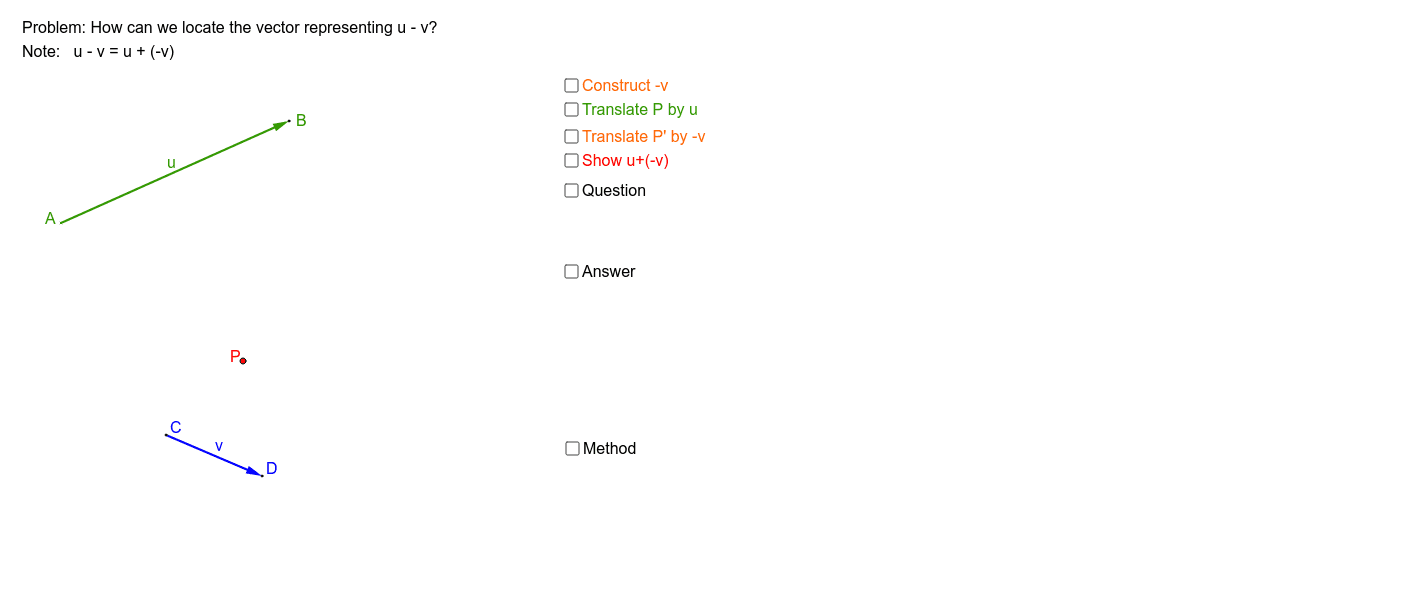
This example demonstrates geometric methods for vector subtraction by dragging vectors u and v to observe the changes in their difference vector. Key math concepts include vector subtraction, geometric representation, vector magnitude and direction. GeoGebra commands and objects used in construction are Vector, Translate, Rotate, Midpoint, and Polygon. Suitable for high school students learning vectors and spatial geometry, as well as university-level foundational mathematics instruction.
GeoGebra Commands & Parameters
Vector(A, B) → uVector(C, D) → vTranslate(P, u) → P'Vector(P, P') → w_1Rotate(D, 180*°, C) → D'Vector(C, D') → jMidpoint(C, D') → GTranslate(P', j) → P''Vector(P', P'') → wVector(P, P'') → zMidpoint(P, P'') → ETranslate(A, v) → A'Vector(A, A') → gVector(A', B) → hMidpoint(A, A') → FMidpoint(A', B) → HTranslate(B, g) → B'Vector(B, B') → kPolygon(A, B, B', A') → poly1, a_1, b_1, b', a'Vector(A', B) → p
AI Drawing Prompt Reference
Draw two draggable vectors, u and v, to show their difference vector. First, draw vectors u and v. Then find the starting point P of vector u, translate P along u to get P', and connect P and P' to get vector w1. Next, rotate vector v by 180 degrees to get vector j, find the midpoint G of C and D', translate P' along j to get P'', connect P' and P'' to get vector w, and connect P and P'' to get vector z. Then draw the starting point A of vector v, translate A along v to get A', connect A and A' to get vector g, and connect A' and B to get vector h. Find the midpoints F and H of A and A', and A' and B, translate B along g to get B', connect B and B' to get vector k. Finally, draw a polygon with vertices A, B, B', and A', and connect A' and B.
The prompt above was compiled from the original drawing commands and is for reference only.