
Vector Space Basis Transformation Demo
Loading the math board and drawing, please wait…
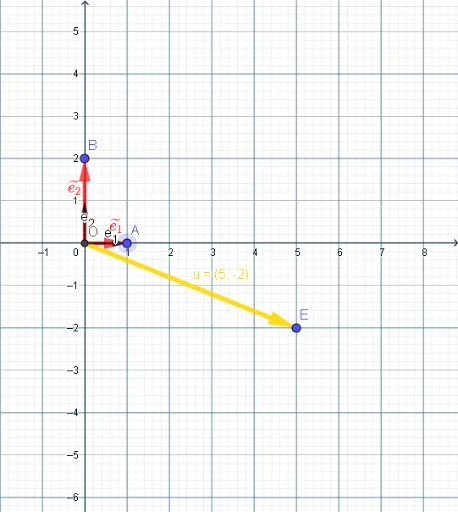
This example demonstrates the geometric meaning of basis transformation in vector spaces, visually showing the effect of coordinate changes under different bases through the representation of 2D vectors; Core math concepts include vectors, coordinate transformation, linear combinations, and basis vectors; Construction highlights utilize GeoGebra commands/objects like Intersect, Vector, Sequence, Point, Line to build basis vectors, transformed coordinate points, and vector graphics; Suitable for high school and above learners to understand abstract linear algebra concepts.
GeoGebra Commands & Parameters
Intersect(xAxis, yAxis) → OVector(O, A) → b_1Vector(O, B) → b_2Sequence(Line[Point[B, Vector[(b_2 * i)]], b_1], i, -13, 21) → SXSequence(Line[Point[A, Vector[(b_1 * i)]], b_2], i, -9, 11) → SYPoint(SX) → CLine(C, A) → fPoint(SY) → DLine(B, D) → gVector(O, E) → uVector((0, 0), (1, 0)) → e_1Vector((0, 0), (0, 1)) → e_2
AI Drawing Prompt Reference
Draw two basis vectors in a 2D coordinate system and show how they generate points on the axes through linear combinations. Then, draw two sets of parallel lines using these basis vectors to form a grid. Find the intersection points of these lines and connect them to the origin to draw transformed coordinate axes. Finally, draw a vector and show its representation in both the original and new coordinate systems to visualize the effect of basis transformation.
The prompt above was compiled from the original drawing commands and is for reference only.