
Vector Algebra: Intersections of Line and Circle
Loading the math board and drawing, please wait…
In collections
Light
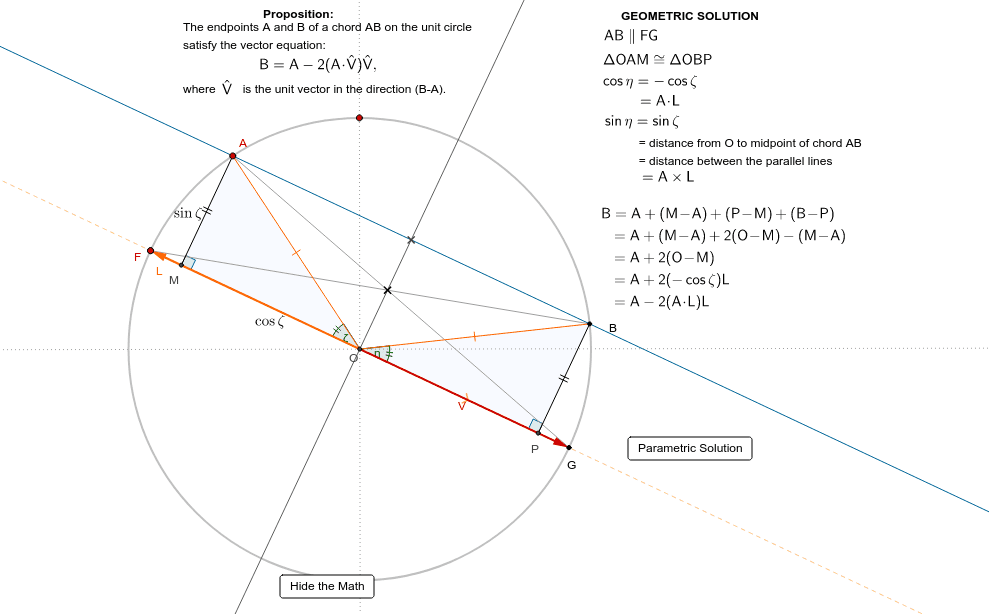
This example demonstrates the intersections of a line with a circle at different positions (between two points on the circle, from a point on the diameter to a point on the semicircle). Key math concepts include vector, line, circle, intersection, angle, ray, segment, and orthogonal line. It is constructed using GeoGebra commands like Circle, Point, Vector, Line, Intersect, Angle, Ray, Segment, and OrthogonalLine. Suitable for high school mathematics teaching, illustrating the combination of vector algebra and analytical geometry.
GeoGebra Commands & Parameters
Circle(O, 1) → cPoint(c) → lVector(O, l) → LPoint(c) → aLine(a, Vector[-L]) → fIntersect(c, f, 2) → bPoint(c) → nLine(O, n) → northVector(O, n) → NVector(O, e) → ELine(O, e) → eastVector(O, a) → AVector(a, b) → CAngle(E, A) → αVector(O, b) → BAngle(E, L) → θRay(S, O) → pIntersect(c, p) → I, JSegment(O, J) → l2Vector(O, J) → VSegment(l, b) → hSegment(J, a) → jSegment(O, a) → mIntersect(h, j) → DOrthogonalLine(O, p) → kIntersect(f, k) → KSegment(O, b) → qAngle(a, O, If[A * L > 0, l, J]) → ζAngle(If[A * L > 0, J, l], O, b) → ηOrthogonalLine(b, f) → rOrthogonalLine(a, f) → tIntersect(p, t) → MIntersect(r, p) → PSegment(a, M) → AMSegment(b, P) → a_1Angle(O, M, a) → ιAngle(b, P, O) → κSegment(O, M) → OM
AI Drawing Prompt Reference
Draw a circle and a line intersecting it at two points. From a point on the diameter to a point on the circle, show intersections at different positions. Use vectors to represent directions from the center to points, and draw a line opposite to the vector. Draw lines from the center to points on the circle and label angles. Then, draw a ray intersecting the circle at two points, connect the center to these points. Finally, draw a line perpendicular to the ray and find its intersection with the original line.
The prompt above was compiled from the original drawing commands and is for reference only.