
Using Cylinders to Show Volume of Revolution by Ms. Orr
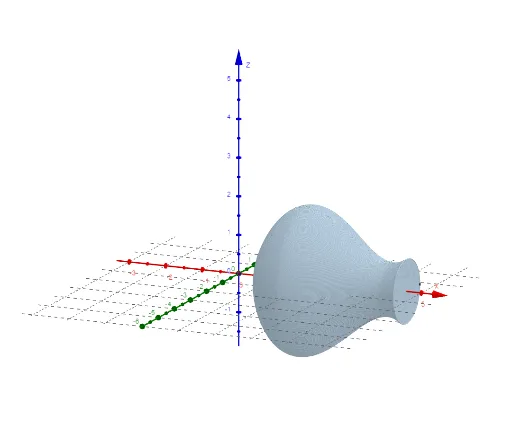
Loading the math board and drawing, please wait…
This example demonstrates how the volume of revolution is formed using cylinders. Key mathematical concepts include the calculation of the volume of revolution. GeoGebra commands such as Function, Div, and Sequence are used to dynamically show the formation of the volume. Suitable for high school mathematics education and learning.
GeoGebra Commands & Parameters
Function((((1 / 5 * (x - 1)) * (x - 3)) * (x - 5)) + 1.3, a, b) → fDiv(b - a, dx) → nstepsSequence({QuadricSide[Cylinder[(a + (dx * k), 0), (a + (dx * (k + 1)), 0), f(a + (dx * k))]], Top[Cylinder[(a + (dx * k), 0), (a + (dx * (k + 1)), 0), f(a + (dx * k))]], Bottom[Cylinder[(a + (dx * k), 0), (a + (dx * (k + 1)), 0), f(a + (dx * k))]]}, k, a, (b - a) / dx - 1) → cylinders
AI Drawing Prompt Reference
Draw a function graph and dynamically show the volume of revolution using multiple cylinders stacking from the function's bottom to top, illustrating the concept of volume calculation, suitable for high school mathematics education.
The prompt above was compiled from the original drawing commands and is for reference only.