
Upward and Downward Parabola
Loading the math board and drawing, please wait…
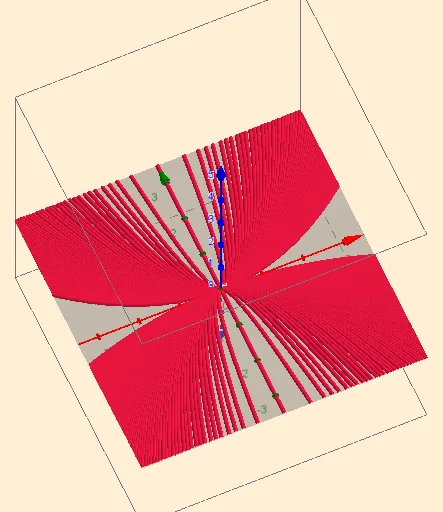
① This example visually demonstrates how the opening direction of a parabola (upward or downward) changes with parameter variation, comparing the graphical features of both orientations. ② The core mathematical concept is the role of the coefficient a in the standard quadratic function y = a(x - h)² + k, where the sign of a determines whether the parabola opens upward (a>0) or downward (a<0), along with properties such as vertex and axis of symmetry. ③ Construction highlights: from the summary, objects a and c are defined; a acts as the quadratic coefficient controlling the opening direction, while c may represent a constant term or the y-coordinate of the vertex; adjusting the sign of a toggles between upward and downward parabolas, and the intersections with axes can be observed. ④ Suitable for middle school advanced or high school introductory levels when learning quadratic function graphs, and useful for classroom demonstrations to build intuitive understanding of the relationship between coefficient sign and parabola orientation.
GeoGebra Commands & Parameters
Numeric a(2.17)x^(2) = (4 * (a * y))
AI Drawing Prompt Reference
Draw a Cartesian coordinate plane with a parabola whose vertex is at the origin and whose axis of symmetry is the y-axis. Use a slider-controlled parameter to change the opening direction: when the parameter is positive, the parabola opens upward; when negative, it opens downward. Show both parabolas simultaneously, one opening up and one opening down, to compare their shapes. Include visible axes and grid lines to highlight intersections with the axes.
The prompt above was compiled from the original drawing commands and is for reference only.