
Unmessupable Rhombus: Dynamic Geometry Construction
Loading the math board and drawing, please wait…
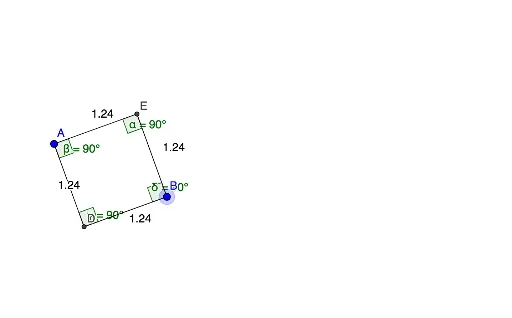
① This example demonstrates a rhombus with remarkable stability: no matter how you drag its vertices or sides, the shape remains a rhombus, hence the name 'unmessupable'. ② Core mathematical concepts include the definition of a rhombus (all sides equal), perpendicular bisecting diagonals, symmetry, and the idea of geometric invariance under dynamic constraints. ③ Construction highlights: from the summary, GeoGebra commands such as LineBisector, Segment, Intersect, Circle, and Angle are used, creating objects A, B, g, i, f, h, C, c, D, E, j, k, l, m and angles α, β, γ, δ. The rhombus vertices are constructed via intersections of perpendicular bisectors and circles, with angle measurements verifying properties. ④ Suitable for middle school geometry classes or dynamic geometry exploration, helping students understand rhombus criteria and properties, as well as the stability of geometric constraints in a dynamic environment.
GeoGebra Commands & Parameters
LineBisector(A, B) → gLineBisector(A, B) → iSegment(A, B) → fLineBisector(A, B) → hIntersect(h, f) → CCircle(C, B) → cIntersect(c, h, 1) → DIntersect(c, h, 2) → ESegment(A, D) → jSegment(D, B) → kSegment(B, E) → lSegment(E, A) → mAngle(A, E, B) → αAngle(D, A, E) → βAngle(B, D, A) → γAngle(E, B, D) → δ
AI Drawing Prompt Reference
Draw a rhombus formed by the intersection of two perpendicular lines. The four vertices are determined by these intersections. The diagonals of the rhombus are perpendicular bisectors and have equal lengths. Ensure the rhombus maintains its shape under dynamic adjustments to demonstrate geometric stability.
The prompt above was compiled from the original drawing commands and is for reference only.