
Unitary Fractions: The Circle Model
Loading the math board and drawing, please wait…
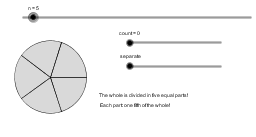
This example illustrates the concept of unit fractions using a circle model, demonstrating the geometric meaning of fractions. Key mathematical concepts include fractions and circle geometry. It uses GeoGebra commands such as Sequence and Circle for construction. Suitable for high-grade elementary to junior high school students learning fractions and geometry.
GeoGebra Commands & Parameters
Sequence(Vector[O, Rotate[A, ang / 2 + (ang * i), O]], i, 0, n) → SVSequence(Translate[Rotate[A, (ang * i), O], Vector[(separate * Element[SV, Mod[i, n] + 1])]], i, 0, n) → SPCircle(O, A) → cSequence(Translate[Rotate[(0, 0), ang / 2 + (ang * i), (0, 0)], Vector[(separate * Element[SV, Mod[i, n] + 1])]], i, 0, n) → SOSequence(Rotate[Element[SP, i], ang, Element[SO, i]], i, 1, Length[SV]) → SQSequence(CircleSector[Element[SO, i], Element[SP, i], Element[SQ, i]], i, 1, n) → SSSequence(Rotate[CircleSector[Element[SO, 1], Element[SP, 1], Element[SQ, 1]], ((i * 2) * π / n), O], i, 0, count - 1) → dSequence(Rotate[CircleSector[Element[SO, 1], Element[SP, 1], Element[SQ, 1]], ((i * 2) * π / n), O], i, 0, count - 1) → eSequence(Translate[Rotate[A, (ang * (i - 1)) + ang / 2, O], Vector[(separate * Element[SV, Mod[i, n] + 1])]], i, 1, count) → SNCircle(O, A) → fCircle(O, A) → g